

Blockchain Press Release Feed: What Just Changed in Crypto?
Yesterday, a company announced that it holds 4.97% of all the ether that exists. Five days earlier, another company said it had become the largest tokenization platform in the world. Both announcements sat in the same press release feed, a few scrolls apart.

Yesterday, a company announced that it holds 4.97% of all the ether that exists. Five days earlier, another company said it had become the largest tokenization platform in the world. Both announcements sat in the same press release feed, a few scrolls apart. investingnews
Here is the part most readers miss. Both came from the companies themselves. At least one crypto outlet described the Ondo release as a corrected announcement. And neither tells you which sentences are facts you can check, which are the company’s own story, and which are guesses about next year. newsbtc
This article does two jobs. It shows what the feed announced over the past two weeks. Then it gives you a short method for reading any blockchain press release without being carried along by it.
The short answer: what the feed announced in the past two weeks
Of the 20 most recent items in the CoinGabbar press release feed (October 26 to November 9, 2026), the substantial ones fell into a few groups:
- A public company adding to its ether treasury.
- A tokenization platform claiming a top ranking.
- A trading venue launching its own blockchain.
- A new Swiss franc stablecoin.
- Exchanges running campaigns or sharing trading data.
The rest were events, pre-launch updates and product news.
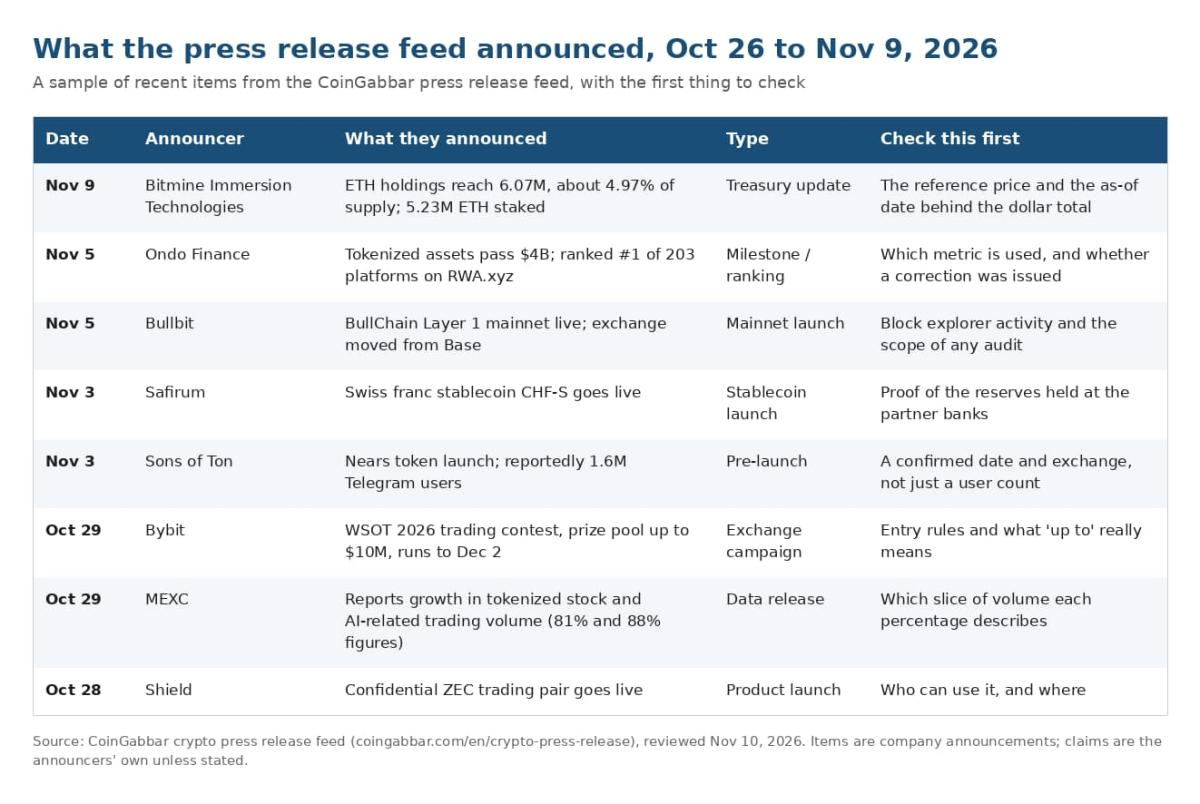
One limit to keep in mind: this is one feed, not the whole industry. It shows what projects chose to announce. It does not show everything that happened.
Tokenization keeps producing the biggest numbers
Ondo Finance said its tokenized real-world assets passed $4 billion, spread across 484 assets with more than 565,000 holders. It ranked itself first among 203 platforms tracked by RWA.xyz. For context, RWA.xyz data cited in the release puts non-stablecoin tokenized assets above $39 billion, up from roughly $4 billion at the start of 2025. cryptobriefingedgex
A ranking is only as clear as its definition, though. The release speaks of market capitalization. The comparison excludes stablecoins and relies on the data provider’s own classification. Meanwhile, another outlet called the same figure total value locked. Those are different measures. The number looks the same until you ask what it counts. newsbtccryptobriefing
Chains are being built around apps
Bullbit, a decentralized perpetual futures exchange, launched its own Layer 1 blockchain, BullChain, on November 5 and moved its exchange off Base. The company says this matches its published roadmap, which targeted the fourth quarter of 2026. It also reports seven months of testing before mainnet. techbulliontechbullion
What the release can’t tell you is how the new chain behaves under real pressure. That only shows up after weeks of use. It also calls BullChain the first “passkey-native” Layer 1. That is the company’s description, and “first” is hard to prove.
Treasury updates: token count and dollar value can disagree
Bitmine Immersion Technologies reported that it bought 9,587 ETH in the past week, bringing holdings to 6.07 million. Look at its last three weekly headlines. The token count rose each time: 6.05 million ETH on October 26, 6.06 million on November 2, and 6.07 million on November 9. The headline dollar totals fell over the same stretch, from $15 billion to $14.5 billion to $14.3 billion. coingapethailand-business-news
Those totals also include more than ether. They cover cash and marketable securities, other crypto and other holdings. So “holdings hit a new high” and “the dollar total went down” can both be true in the same week. finanznachrichten
Stablecoins, exchanges and everything else
Safirum announced its Swiss franc stablecoin, CHF-S. The release says it is fully backed by francs held at two partner banks, with a whitelisting function so transactions run only between identified parties. That is a claim worth checking against a reserve attestation.
Bybit opened a trading contest with a prize pool of “up to” $10 million that runs to December 2. MEXC shared September trading data. Its headline and opening lines carry two different growth figures (88% and 81%) for related but different slices of trading. Events like India Blockchain Week in Mumbai and Unchained Summit India also made the feed. They matter if you attend and rarely change anything else.
A press release tells you what a company wants on record
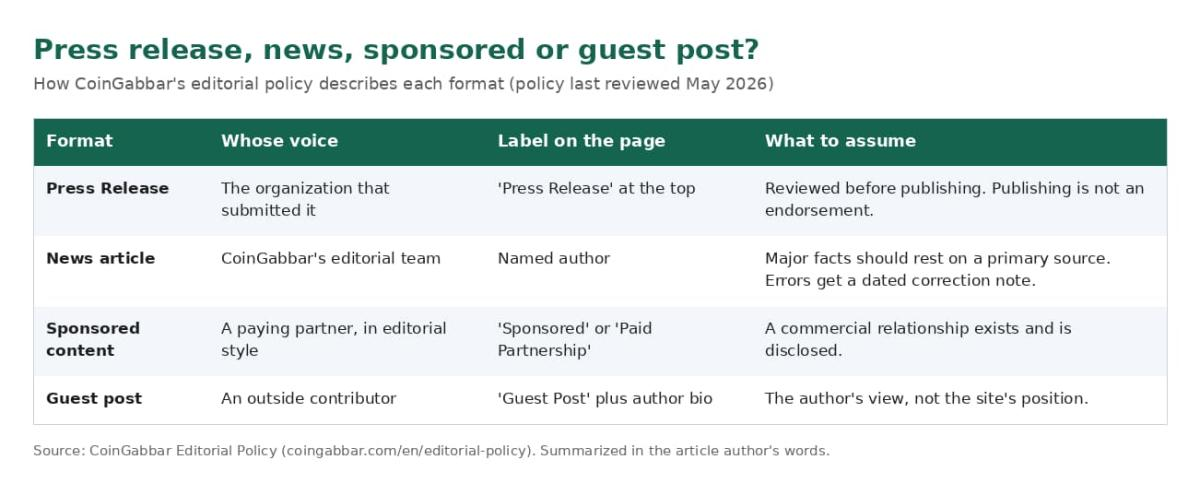
A press release is the sender’s voice. CoinGabbar’s editorial policy says this plainly: a press release on the site is a company announcement, not a news article or editorial opinion. It is labeled “Press Release” at the top. The policy also says publishing one is not an endorsement.
The policy describes a review step. Submissions with unverifiable claims (user numbers, transaction volumes, TVL figures or partnerships) are returned or declined. So are unproven “SEC-compliant” or “fully regulated” claims and wording built to create fear of missing out. That is reviewed, not verified. A review can screen out weak claims. It can’t turn a company’s statement into an independent fact.
Read every announcement in three layers
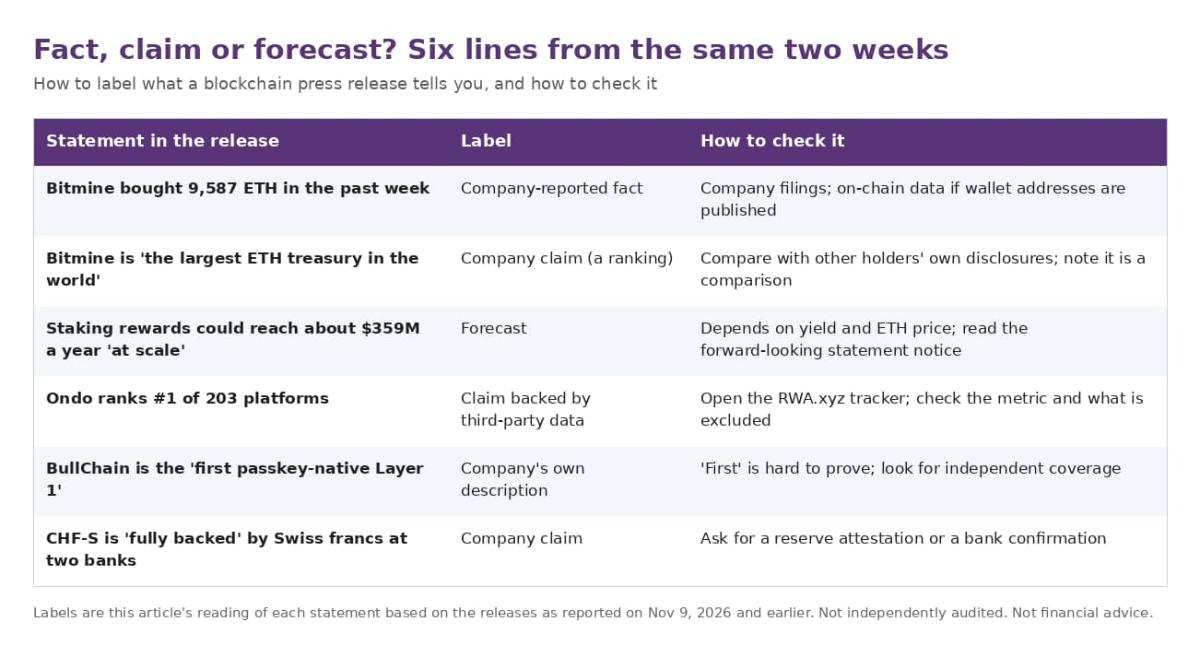
When you open any blockchain press release, sort each statement into one of three layers.
Fact (reported): a specific event or number the sender states and you can, in principle, check. Example: “we bought 9,587 ETH last week.”
Claim: the sender’s own description or ranking. Examples: “largest,” “first,” “fully backed.”
Forecast: what the sender expects to happen. Examples: projections, targets, “at scale” numbers.
Try it on the Bitmine release. The reported facts include the weekly purchase and 5,227,037 staked ETH, valued at $11.7 billion at $2,234 per ETH. I checked the arithmetic. 6.07 million of a 122.2 million supply comes to about 4.97%, and 5,227,037 times $2,234 comes to roughly $11.7 billion. The numbers agree with each other. That proves the release is internally consistent. It does not prove the holdings exist. For that you would look at company filings, or at on-chain data if wallet addresses are published. investingnews
“Largest ETH treasury in the world” is a claim, and a comparative one. The staking income is a forecast: $309 million a year based on current staking, rising to $359 million once the rest is staked. The release itself carries a notice about forward-looking statements. Quotes from executives and a relayed remark from Vitalik Buterin are opinion, and a relayed quote is not a verified quote. coingapefinanznachrichten
Check the three clocks
Every release runs on three clocks, and mixing them up causes quiet mistakes.
- The announcement date: when it was published. Bitmine’s was November 9.
- The as-of date: when the numbers were true. Bitmine’s staking figure is as of November 8, at a stated reference price. MEXC’s data covers September, though it was released October 29. investingnews
- The future date: what the sender promises next. Bybit’s contest ends December 2. Bullbit’s roadmap pointed to the fourth quarter.
Ask of every figure: true as of when, and at what price?
A five-minute check before you trust or share an announcement
- Find the sender. Look for a named company, a named spokesperson and a wire service or official channel.
- Label each statement as fact, claim or forecast.
- Define the number. Is it market cap or TVL? Which date? Which price? Which slice of the data?
- Find a second source. An official site, a filing, a block explorer, a regulator’s database or an audit report (check what the audit actually covered).
- Look for what’s missing. No named team, no audit, no timeline? Then read the claims more slowly.
- Check for corrections. The Ondo release shows why. A figure can be restated after publication.
Take extra care with red flags. The SEC’s investor education material lists promises of high, guaranteed returns, celebrity endorsements and unsupported “SEC-compliant” claims. It also advises against trusting anyone who pressures you to invest right away or promises big returns with little risk. And crypto asset investments might lack basic investor protections. A press release is information. It is not a reason to buy, and nothing here is financial advice. www.investor.gov +2
If you are the one writing the release
Everything above is also a guide for writers. A release gets believed when it hands the reader the checks. Include dates and the reference price. Link the audit report and the block explorer. Label projections as projections. Leave out buy-now language. CoinGabbar says each submission gets an editorial review before publication, and that approved releases typically go live within 24 to 48 hours with a permanent page and a link to your site. You can find the form on the submit a press release page.
What to do next
Remember the order: sender, three layers, three clocks, second source. Press releases are a starting point for research, never the end of it.
Open the crypto press release feed, filter by a category such as Blockchain or Exchanges, and pick one item. Run the five-minute check on it. Then compare what you found with the site’s crypto news coverage, and use the crypto dictionary for any unfamiliar term. If a stablecoin or exchange claims reserves, the proof of reserve page is a sensible next stop. To see how each format is handled, read the editorial policy.
Blockchain Press Release Feed: What Just Changed in Crypto?

CoinGabbar is a cryptocurrency news and information platform providing the latest crypto news, live cryptocurrency prices, market trends, and blockchain updates. Explore crypto presales, ICOs, airdrops, exchange listings, and upcoming Web3 events.
















Comments (0)