

Do employers prefer a CV or a resume?

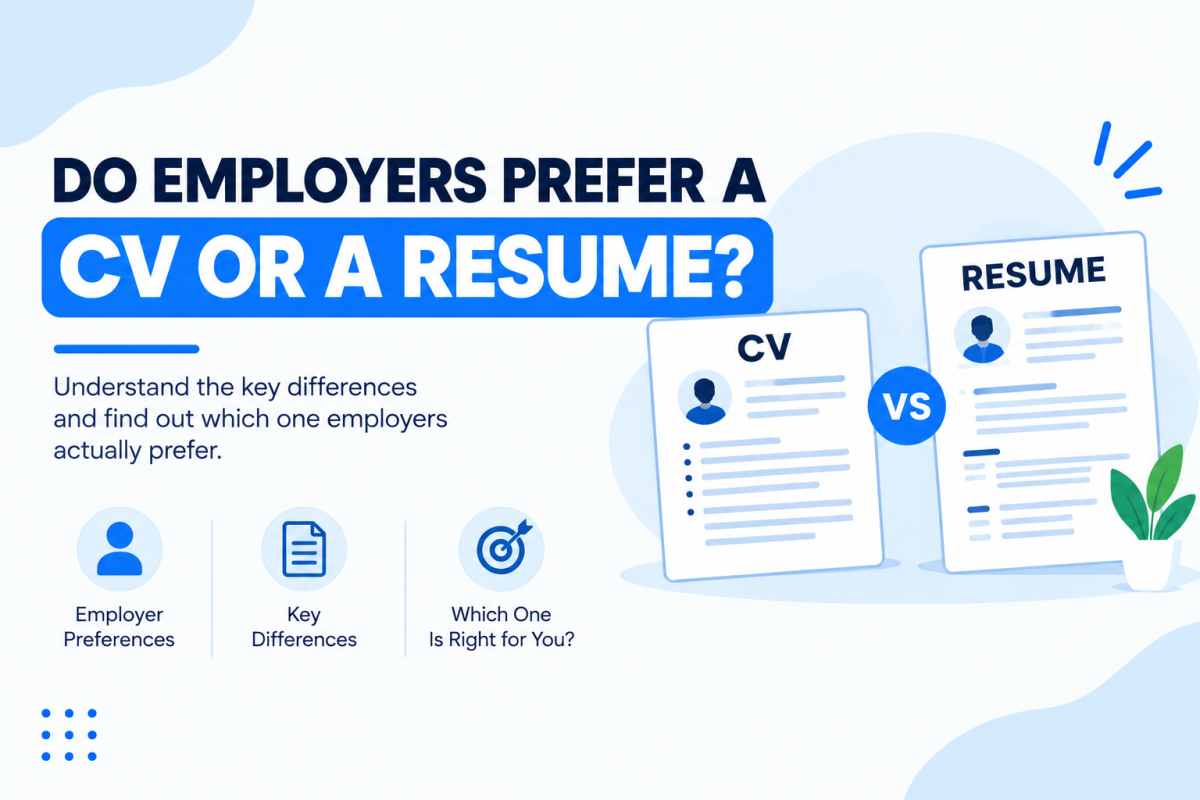
One of the most common queries that is asked by a job seeker is whether he should apply for a job with CVs or resumes. This will be dependent on the country, industry, and function you are applying for. They are both statements of your skills and experience but are written with different purposes and in different formats. Knowing these disparities assists you in putting in the correct application and increases the odds of getting contacted for interviews. Many are even looking for cheap CV writing services in Dubai that offer low prices so that everything they have to present to the employer fulfills the international recruitment criteria and reveals to him or her what he or she has to offer.
Understanding the Difference Between a CV and a Resume
It typically takes no more than one or two pages to prepare and is specific to each job application. A CV (Curriculum Vitae) is a document that is much more detailed. A detailed record of your academic interests, research projects, publications, and certification, as well as any other professional associations, awards, and experiences. You'll find your CV will be longer, and it will be edited throughout the process. Creating a distinction will assist the candidates in identifying what to produce for an employer.
Which Document Is Employers' Favorite?
The desire is mostly affected by the industry and the place of the employer. For most private sector positions, resumes are typically required in the USA and Canada. These organizations appreciate short documents that clearly show appropriate qualifications. In most European, Middle Eastern, African, and Asian countries, however, CV is generally used in the context of an application for employment. In these areas, it might be similar to a resume, but it's also referred to as a CV. Carefully read the job advertisement and know exactly what the employer is asking for.
Explain typical jobs that require a CV.
Universities, research centers, health care providers, scientific labs, and education institutions, in general, will seek full-length CVs. The employee is able to assess a person's work by looking at these publications, research experience, teaching history, certifications, presentations, and academic achievements. It's important to keep a CV throughout one's academic/research career for students wishing to follow a research/academic route.
A resume is the best choice when it comes to the following industries:
Most companies prefer resumes because they contain all the information that is pertinent to the job position they are looking to fill. The industries that require resumes are most often the finance, marketing, information technology, engineering, customer service, hospitality, retail, manufacturing, and business management sectors. Brief applications will be easier to quickly skim through when there are hundreds of applications to consider.
A targeted resume is going to be a breeze for the recruiter to find your skills in within a few seconds.
The most useful for the employer are customized applications. Employers appreciate customized applications! Employers like resumes for one reason—they're flexible. A resume can be customized for a specific job and describe relevant skills, accomplishments, and experiences. Successful applicants adjust their applications to fit the job and not to every employer's job solicitation letter. Demonstrating interest and compatibility with ATS.
What They Do and How They Can Help You.
Many organizations, before considering an application, have a machine known as an Applicant Tracking System (ATS) screening the applications. If you submit either a CV or a resume, it will be ATS friendly. Simple formatting, standard headings, relevant keywords, and consistent organization are required. Don't over-graph too many tables, text boxes, or designs that could impact automated screening software. It is easy to read for HR professionals and tech recruiters with a neat and organized design.
The two documents are the same, and employers look for them in both.
Recruiters are interested in your work experience related to the job, measurable accomplishments, education, technical expertise and certifications, leadership skills, communication skills, and track record of continued professional development. Spelling and grammar-free documents as well as those that are inconsistently formatted are also appreciated by employers. Attention to detail and excellent communication skills are evidenced through professional presentation.
Recognizing and celebrating accomplishments.
Some of the top application enhancement tips are to highlight achievements, not responsibilities.
Instead of just saying what you do on a daily basis, demonstrate what you did to make a difference in your position. These will help you stand out from the rest of the applicants, whether it is your higher sales, lower running costs, higher levels of customer satisfaction, successful projects that you have completed, or the introduction of solutions.
A writing for achievement is a piece of writing that demonstrates the capacity to produce outcomes for an employer.
Don't do these things when seeking a job.
Many candidates make minor errors, which lead to poor performance.
If you apply the generic applications, you will be using information that is not relevant, out-of-date templates, or paragraphs that may not be effective. A common error that some candidates may commit is misspelling the words and using the wrong ones, as this can leave a bad impression. Conciseness in the document, organized and customized, helps to keep the recruiters interested in the document and also makes it easy to read.
Do you need to have a CV and a resume as well?
For most contemporary professionals, it can be the wisest way to maintain both these documents.
A thorough CV tells your story of your education, work experience, certifications, publications, accomplishments, and professional development. This document can be easily converted to personalized resumes for an application to a particular job.
Why expert writing services are important.
Writing a successful CV/resume goes beyond just a job history. Professional writers understand what the employer is looking for, the market trends, how to optimize for the ATS, and how to write in a way that will convince the employer. They are adept at putting information together in a logical way, emphasizing measurable successes and presenting skills in a recruiter's friendly format. Also, an editing service will remove formatting and grammar errors that may result in a poor application. As far as preparing a document is concerned, a professional document is more comforting during the job search.
Conclusion
It depends on the industry, country, and type of job whether employers like CV or resume. Most business/corporate employers will go through a filter and will be impressed by a short resume; a little CV length will help most medical jobs, and detailed CVs will be required by academic/research jobs. Whether you are sending a resume or a cover letter, the employers are always searching for candidates who have experience that is relevant, measurable accomplishments, knowledge of a specific field, and a desire for further professional development. Having a resume that is more in line with the job or company's requirements, an ATS-optimized resume, and presenting your skills to the employer professionally can certainly help to open the doors of job opportunities and promotions and also to interviews. Your CV/resume isn't only a list of your experiences—it may be a possibility to help you access new opportunities.




Comments (0)