

What Really Happens Inside AI DM Automation? A SocialSEO Guide
When a customer comments on an Instagram post and receives a relevant response a few seconds later, the interaction can look completely effortless.

When a customer comments on an Instagram post and receives a relevant response a few seconds later, the interaction can look completely effortless.
But an automated DM response is not simply a message that was scheduled in advance.
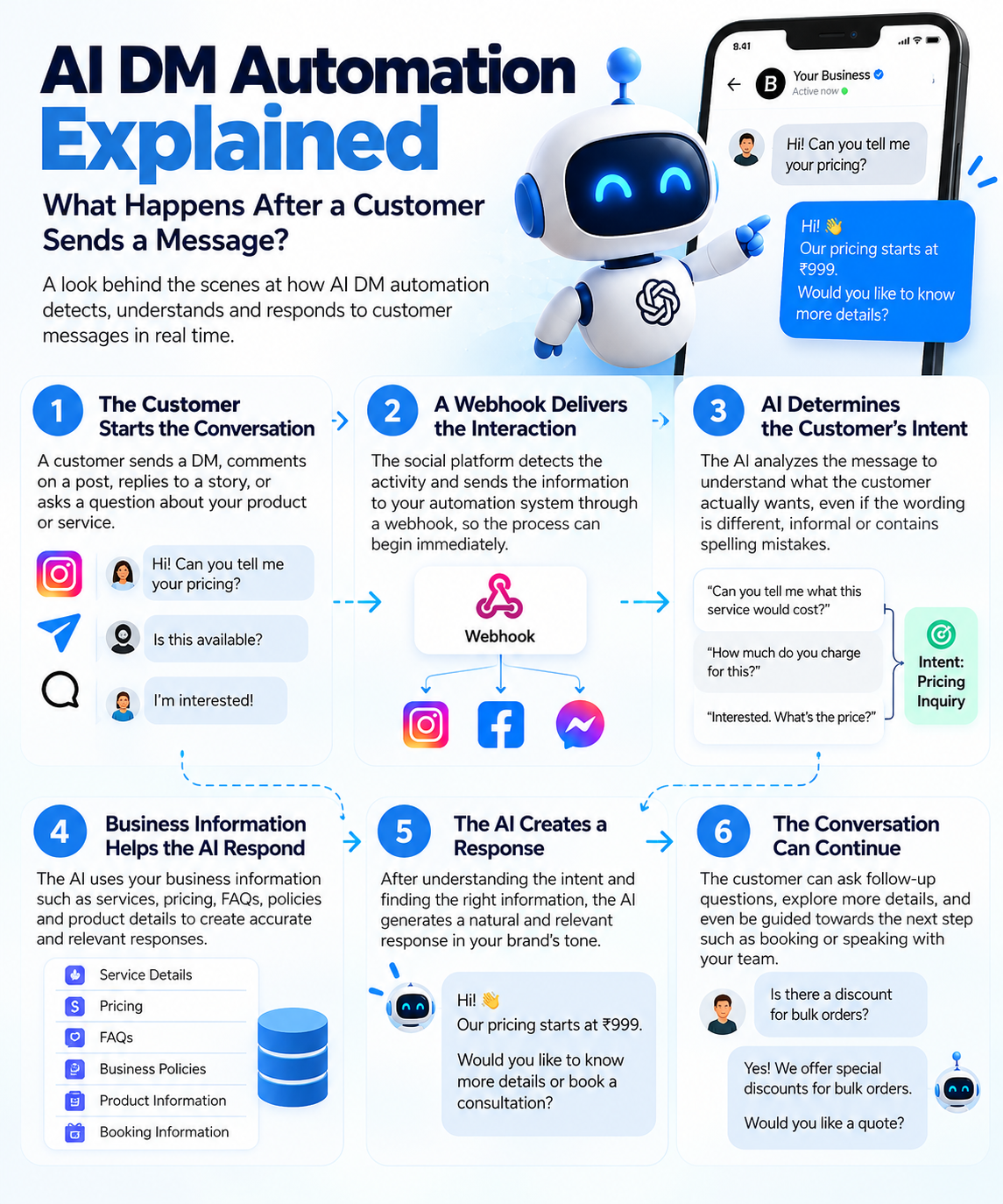
Several processes take place between the customer's first action and the response that eventually appears on their screen. The platform has to detect the interaction, pass the event to the connected system, AI has to understand the message, the appropriate business information needs to be considered, and a response has to be created.
At SocialSEO, this type of workflow is the foundation of a more intelligent approach to social messaging automation.
The Five Steps Behind an Automated Conversation
Although the technology can involve several components, the basic process can be explained in five stages:
Trigger → Webhook → AI Understanding → Response → Outcome
The steps occur quickly, but each one serves a different purpose.
Step 1: A Customer Starts the Process
Every automation begins with an interaction.
A customer might leave a comment, send a direct message, or reply to a Story. When that happens on a connected account, the interaction becomes the trigger for the system.
For instance, a customer could write:
“Can you tell me the price?”
The first thing the system has to do is detect that the interaction happened.
At this point, it does not need to understand the customer's complete intention. It simply needs to identify the event so the next stage can begin.
This is the starting point for the entire workflow.
Step 2: A Webhook Carries the Event
After the platform recognizes the interaction, the event needs to be communicated to the connected automation application.
A webhook handles this type of event-based communication.
In simple terms, it is an automated notification telling another system that a particular event has occurred.
For DM automation, this means the connected application can receive supported messaging events as they happen rather than repeatedly checking the account for new activity.
The original SocialSEO article identifies Meta's Instagram messaging webhook system as the official mechanism used by applications to receive real-time notifications for supported interactions.
Because the event can be passed quickly, the customer may receive a response only moments after sending the original message.
Small delays can still occur because of normal traffic and processing conditions.
Step 3: AI Determines the Customer's Intent
Once the interaction reaches the automation system, the next challenge is figuring out what the customer actually means.
This is where AI adds an important layer of intelligence.
People rarely phrase identical questions in identical ways.
A customer might say:
“What's the cost?”
Another might write:
“Can you share the pricing?”
Someone else may ask:
“How much would this package be?”
Although the sentences are different, they can communicate the same underlying intent.
A simple keyword bot may depend on specific words.
AI can instead evaluate the meaning of the message and identify the request behind it.
This makes it possible to handle differences in wording, typos, informal communication, and messages that contain several requests.
Step 4: The AI Uses Business-Specific Information
Understanding intent is only part of the process.
The system also needs reliable information about the business before it can provide a useful response.
That information may include pricing, services, FAQs, policies, and other business-specific details.
For example, identifying that someone is asking about pricing does not tell the system what the correct price actually is.
The relevant business information has to be available to the automation.
This is an important distinction between an AI that can generate language and an automation system that can generate a useful business response.
The goal is not simply to produce a message that sounds convincing. The response should be based on the information the business actually provides.
Step 5: A Response Is Created Around the Conversation
Once the customer's intent has been understood and the relevant information is available, the system can generate the response.
This is where AI DM automation becomes different from a fixed autoresponder.
A basic automated message might say:
“Thanks for your message. Our team will get back to you soon.”
The message remains essentially the same no matter what the person asked.
An AI-based system can instead build the response around the specific conversation.
A pricing question can receive information about pricing.
A service question can receive a relevant explanation.
A customer interested in taking the next step can be guided toward that action.
The response can also be shaped around the business's own voice.
This makes the interaction feel more contextual instead of simply automated.
The Conversation Can Continue
One response does not necessarily mean the automation is finished.
A customer may ask another question immediately afterward.
The system may continue answering, collect additional information, or guide the person toward a booking or call.
This turns the process into a conversation rather than a single automated message.
For businesses, that distinction can be important.
The objective is not just:
Send a reply.
It is to help the conversation move toward something useful.
When AI Should Hand the Conversation to a Person
Automation has limits.
A customer may ask a question that is extremely specific, unclear, or outside the information available to the system.
A responsible workflow should have a way to deal with those situations.
Instead of guessing, the AI can hand the conversation to a human.
The source article specifically points to this ability to recognize when the system is not confident enough to answer and involve a real person instead.
This is an important feature of practical automation.
The objective is not to make AI answer every question at any cost.
The objective is to automate suitable conversations while preserving human involvement where it is needed.
Why Some Responses Take a Few Seconds
AI DM automation is designed to respond quickly, but the process is not necessarily instantaneous.
Several steps happen between the first interaction and the final message.
The platform detects the interaction.
The event is delivered to the automation system.
The message is analyzed.
The user's intent is identified.
Relevant business information is processed.
The response is generated.
The final message is delivered.
A short delay can occur during any of these stages.
Platform traffic and processing conditions can also affect timing.
The source article notes that a few seconds of delay can be normal in this behind-the-scenes process.
AI DM Automation Is Not Just a Canned Reply
The difference between a traditional automatic reply and AI DM automation can be summarized simply.
Conventional Auto Reply
Incoming message → Predefined response
AI DM Automation
Incoming message → Event → Intent understanding → Business information → Generated response → Next step
A fixed response works well when everyone needs to receive the same information.
AI automation is designed for situations where users can ask different questions or express the same need in different ways.
That flexibility is one of its defining characteristics.
Why Official Platform Infrastructure Matters
The automation workflow also depends on how it connects with the social platform.
The original SocialSEO article emphasizes using Meta's official Instagram messaging API and supported infrastructure rather than unofficial alternatives.
The underlying connection matters because it allows the automation system to interact with the platform through its supported mechanisms.
For businesses that depend on Instagram conversations, this is an important part of the overall architecture.
SocialSEO and the Automation Workflow
SocialSEO focuses on applying AI to real-world business conversations.
The source article describes Setter as SocialSEO's AI response agent. The workflow outlined in the article involves receiving comments or messages, understanding their intent, responding in the business's voice, and guiding suitable interactions toward a booked call.
This demonstrates that the role of AI extends beyond generating individual messages.
The broader process is:
Understand the interaction → Respond appropriately → Continue the conversation → Move toward an outcome
That approach makes automation part of the customer communication workflow rather than simply an automatic reply feature.
Example: A Customer Wants to Book a Call
Imagine a potential customer comments:
“Can I schedule a call to learn more?”
The system could handle the interaction in several stages.
First, the comment is detected.
Then, the webhook communicates the event to the automation system.
AI determines that the person is interested in scheduling a call.
The system accesses the relevant business information.
A suitable response is generated.
The customer is guided toward the appropriate next step.
If the customer asks a detailed question that the system cannot confidently answer, the conversation can be transferred to a human.
The customer sees one continuous conversation.
Behind the scenes, several separate processes have worked together.
Frequently Asked Questions
What is AI DM automation?
It is a system that detects supported social interactions, understands the user's intent, creates relevant responses, and can guide the conversation toward an appropriate outcome.
What is a webhook?
A webhook is an automated event notification that lets a connected application know when a supported action has occurred.
Does AI rely only on keywords?
The source describes AI DM automation as understanding the actual meaning and intent of messages rather than relying exclusively on exact keyword matches.
What happens when the AI does not know the answer?
The conversation can be handed to a human rather than having the system guess or provide an inaccurate response.
Is AI DM automation the same as a normal auto reply?
No. A standard auto reply generally sends predetermined content, while AI DM automation can interpret the specific message and generate a contextual response.
Final Thoughts
An automated Instagram response may look like a simple message, but the technology behind it involves an entire chain of events.
A user creates the trigger.
The platform communicates the event.
The automation system receives it.
AI identifies the user's intent.
Business information provides the necessary context.
A response is generated.
The conversation then moves toward the next appropriate action.
And when the system cannot confidently handle the situation, a human can step in.
That combination of real-time event delivery, AI-based understanding, business knowledge, contextual replies, and human handoff forms the foundation of modern AI DM automation.
Through solutions such as Setter, SocialSEO illustrates how these components can work together to turn everyday Instagram interactions into structured, context-aware business conversations.






Comments (0)