

3D Printing Australia: How Custom Mechanism Prototypes Help Engineers Test Hinges, Latches and Moving Parts

Introduction
Mechanical products often rely on small components that perform important functions. Hinges control movement, latches secure access panels, clips hold components together, and sliding mechanisms allow parts to move in a controlled manner. Although these features may appear simple, their performance depends on geometry, clearances, material properties, and the interaction between moving components.
Before committing to production tooling, engineers need a practical way to evaluate these mechanisms. Computer-aided design (CAD) models can demonstrate how parts should fit together, but physical prototypes reveal issues that may be difficult to identify on a screen.
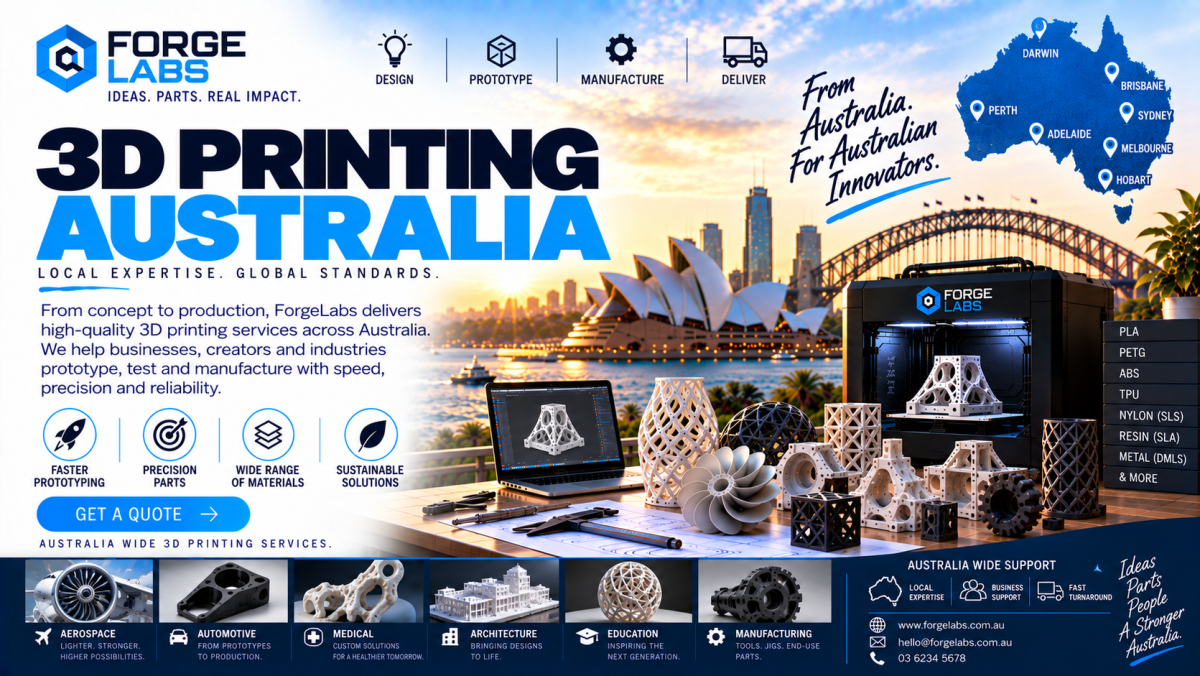
3D printing Australia is helping product designers and engineering teams create customised mechanism prototypes for early-stage testing. These prototypes allow teams to examine movement, identify interference, evaluate assembly methods, and refine designs before investing in more expensive manufacturing processes.
With the right design approach, additive manufacturing can support the development of hinges, snap-fit connections, latches, sliders, and other mechanical features across a wide range of applications.
Why Mechanical Mechanisms Need Physical Prototypes
A mechanism may look correct in a digital model but behave differently when manufactured. Small dimensional variations, surface friction, material flexibility, and assembly tolerances can affect how individual components interact.
For example, a hinge may rotate correctly in CAD but bind when printed because the clearance between its moving parts is insufficient. A latch may engage successfully once but become difficult to operate after repeated use. A sliding component may move freely in one direction but develop friction at a particular point in its travel.
These issues are easier to understand when engineers can handle and operate a physical prototype.
Physical mechanism prototypes help teams evaluate:
-
Movement range and operating clearance.
-
Interference between adjacent components.
-
Assembly sequence and accessibility.
-
Connection strength under intended conditions.
-
Ease of operation and user interaction.
-
Potential wear points and areas requiring redesign.
The purpose of an early prototype is not necessarily to prove that a design is ready for commercial production. Instead, it helps identify design weaknesses while changes are still relatively straightforward.
How 3D Printing Supports Mechanism Development
Traditional manufacturing methods can involve substantial preparation before a functional sample becomes available. Depending on the process, producing a new version may require machining, tooling adjustments, or additional supplier coordination.
3D printing allows engineers to manufacture a physical part directly from a suitable digital model. When a design needs modification, the CAD file can be updated and another prototype produced.
This creates an iterative development process in which engineers can test one version, record observations, make targeted changes, and compare the results.
For mechanism development, this approach can be particularly useful when several variables need to be evaluated. A team might produce different versions of a latch with alternative engagement angles or test several hinge designs with different clearances.
Rather than relying exclusively on assumptions, engineers can compare the behaviour of physical samples and use the results to guide the next design revision.
Applications of 3D-Printed Mechanism Prototypes
1. Hinge Development
Hinges are used in enclosures, access panels, equipment covers, consumer products, and many other assemblies. Their performance depends on pivot geometry, alignment, friction, and the forces applied during operation.
A 3D-printed hinge prototype allows engineers to assess how two or more components rotate relative to each other. It can reveal whether the hinge opens through the required angle, whether surrounding parts interfere with movement, and whether the mounting arrangement is practical.
Designers can also investigate different hinge configurations, including pin-based arrangements and integrated flexible hinges.
Flexible hinges require particular care because their performance depends on the material, geometry, print orientation, and repeated deformation. A printed sample can help explore the concept, but long-term fatigue performance must be evaluated separately under representative conditions.
2. Latches and Locking Mechanisms
Latches must engage and release reliably while remaining practical to operate. Their design may involve hooks, springs, flexible tabs, pivots, or sliding features.
A physical prototype helps engineers understand the relationship between the engagement geometry and the force required to operate the mechanism.
For instance, a latch may need a longer flexible arm to reduce operating force, or a revised engagement angle to improve how the components connect. Engineers can compare these variations before selecting a design for further development.
Where the mechanism has a safety-critical locking function, a basic printed prototype is not sufficient evidence of reliability. Appropriate material testing, load testing, and engineering validation remain necessary.
3. Snap-Fit Connections
Snap-fit connections use elastic deformation or designed engagement features to hold components together. They can reduce the need for separate fasteners in suitable products.
However, a snap-fit that is too stiff may be difficult to assemble, while one that is too flexible may not retain the required connection.
3D printing enables designers to explore different tab lengths, wall thicknesses, engagement features, and clearances. Printed versions can be assembled and disassembled to observe how the connection behaves.
The selected material is important because stiffness, ductility, and fatigue resistance vary between materials and printing processes. Results from a prototype should therefore be interpreted in the context of the intended production material.
4. Sliding and Telescopic Mechanisms
Sliding mechanisms appear in adjustable fixtures, product enclosures, storage systems, and equipment assemblies. Their performance depends on the clearance between moving surfaces and the accuracy of the surrounding geometry.
A printed prototype can help determine whether a component moves smoothly through its intended range. Engineers can examine contact points, travel limits, alignment, and the space required for neighbouring components.
Alternative designs can be produced to compare different guide shapes or clearances. These comparisons can be useful before the design moves to machining, injection moulding, or another production process.
5. Rotating Knobs and Adjustment Systems
Adjustment mechanisms allow users to change settings, reposition components, or control the movement of an assembly.
A prototype can help evaluate grip, accessibility, rotational clearance, and the relationship between the adjustment control and the component it operates.
Designers can also test the positioning of stops, detents, and other features intended to provide feedback during operation.
If the final mechanism will carry significant loads or require precise repeatability, additional testing is needed to verify performance under realistic operating conditions.
Choosing the Right 3D Printing Technology
Different printing technologies provide different combinations of detail, strength, surface quality, and material behaviour. The most appropriate process depends on the mechanism's geometry and the type of testing required.
FDM 3D Printing
Fused Deposition Modelling (FDM) builds components by depositing thermoplastic material in layers. It can be useful for larger mechanical prototypes, basic assemblies, and early design evaluations.
FDM is often considered when teams need to produce multiple design iterations without requiring a highly refined surface finish. However, layer orientation and print settings can influence strength, particularly in parts subjected to bending or repeated loading.
Engineers should consider these factors when designing flexible tabs, thin hinge sections, or other features that experience mechanical stress.
SLA 3D Printing
Stereolithography (SLA) uses light to cure liquid resin and can produce detailed components with smooth surfaces.
It may be suitable for evaluating small mechanisms, intricate engagement features, and designs where fine geometric details are important. Nevertheless, resin properties vary considerably, and not every resin is appropriate for repeated flexing or impact loading.
The selected material should match the intended evaluation rather than being chosen solely for appearance.
SLS 3D Printing
Selective Laser Sintering (SLS) produces parts from polymer powder using a laser. It can support complex geometries and functional prototypes with integrated features.
This approach may be useful when an assembly contains multiple interacting parts or when designers need to examine more complex mechanical arrangements.
The final suitability depends on the material, dimensional requirements, surface characteristics, and expected loads.
Multi Jet Fusion
Multi Jet Fusion (MJF) is a polymer additive manufacturing process that can produce functional components with complex geometries.
It may be worth considering when engineering teams need several related prototype components or want to compare alternative mechanism designs.
As with other technologies, designers should verify clearances, mechanical properties, and surface interactions before treating a printed mechanism as representative of a finished production part.
Designing Mechanisms for Successful 3D Printing
Mechanical prototypes require more than a visually accurate CAD model. The design must account for the behaviour of the chosen printing process and the way the mechanism will be assembled and operated.
Allow for Moving Clearances
Two parts that fit together perfectly in a digital assembly may not move freely after printing. Clearances should account for process limitations, dimensional variation, surface characteristics, and the size of the features involved.
There is no single clearance value suitable for every mechanism. Engineers should establish appropriate dimensions through process guidance, design experience, and physical testing.
Consider Print Orientation
Layer orientation can affect strength and flexibility. A thin latch arm or hinge section may behave differently depending on how the component is positioned during printing.
Designers should consider the direction of applied loads and the areas likely to experience bending or stress concentration.
Avoid Unnecessary Stress Concentrations
Sharp internal corners, abrupt thickness changes, and narrow connection points can increase local stresses. Where appropriate, fillets and smoother transitions may improve the behaviour of the design.
These features should be evaluated alongside the requirements of the intended production method, particularly when the final part will be manufactured using a different material or process.
Make Assembly Practical
A mechanism should be designed so that its components can be assembled, inspected, and, where necessary, disassembled without unnecessary difficulty.
Engineers should consider tool access, fastener placement, component orientation, and whether the intended assembly sequence is realistic.
A prototype can reveal these issues before the design is finalised.
Test More Than One Design Version
The first prototype should be treated as an opportunity to learn. A structured process might compare alternative clearances, engagement shapes, or wall thicknesses.
Recording the results of each iteration helps teams understand which design changes produced useful improvements and prevents earlier issues from being reintroduced.
How to Evaluate a Mechanism Prototype
A clear evaluation plan makes prototype testing more useful. Before printing, engineers should establish what the mechanism must do and which observations will determine whether the design needs revision.
A practical evaluation may include the following steps.
Step 1: Define the operating requirements. Specify the movement range, connection requirements, expected forces, available space, and intended operating conditions.
Step 2: Inspect the printed components. Check for visible defects, dimensional discrepancies, and features that may interfere with assembly.
Step 3: Assemble the mechanism. Confirm that components can be positioned and connected using the intended assembly sequence.
Step 4: Evaluate movement. Operate the mechanism through its required range and observe binding, friction, interference, or unexpected movement.
Step 5: Record observations. Document issues with photographs, measurements, and notes linked to the design revision.
Step 6: Modify and retest. Adjust the relevant geometry or material choice and produce another version when necessary.
The depth of testing should match the intended use. A classroom demonstration model may require basic functional checks, while a mechanism intended for repeated operational use requires a more rigorous validation programme.
Cost Factors in Mechanism Prototyping
The cost of a printed mechanism depends on its size, complexity, printing technology, material, number of components, and required finishing work.
A simple hinge may be relatively straightforward to produce, whereas a multi-part assembly with tight clearances and flexible features may require more design preparation and repeated iterations.
When estimating the total cost, engineering teams should consider:
-
CAD design or modification.
-
Material and printing requirements.
-
Number of components and prototype versions.
-
Assembly and finishing work.
-
Dimensional inspection and functional testing.
-
Additional revisions following testing.
-
The level of validation required before production.
The lowest initial print price does not necessarily represent the most economical development route. A suitable prototype can help identify problems before they become more expensive to correct during tooling or production preparation.
The aim should be to obtain useful engineering information from each iteration while keeping the development process proportionate to the project's requirements.
Industries That Can Benefit from Mechanism Prototyping
Custom mechanism prototypes can support development across multiple industries.
Consumer products: Designers can evaluate hinges, closures, adjustment controls, and snap-fit connections in product housings.
Industrial equipment: Engineering teams can examine access-panel mechanisms, equipment covers, adjustable components, and mounting arrangements.
Automotive development: Physical prototypes can help evaluate selected non-safety-critical mechanisms and interior product features during early design stages.
Electronics: Enclosure latches, battery covers, cable access features, and compact moving components can be evaluated before final production.
Furniture and interior products: Designers can test folding features, adjustable fittings, sliding elements, and connection arrangements.
Research and development: Engineering teams can explore new mechanical concepts and communicate their operation through tangible prototypes.
In every application, the prototype's purpose should be clearly defined. A design used to study movement may not be suitable for evaluating long-term durability, and a visually representative part may not have the material properties required for operational use.
How Forge Labs Can Support 3D Printing Australia Projects
Developing a working mechanism often involves several rounds of design refinement, material selection, and physical evaluation. Working with a suitable manufacturing provider can help engineering teams assess the options available for producing their prototypes.
Forge Labs is worth considering for 3D printing Australia projects involving engineering prototypes, custom components, and product development. Its focus on additive manufacturing makes it relevant to businesses exploring how digitally designed parts can support mechanical development.
When discussing a mechanism project, provide information about the component's dimensions, moving features, expected loads, required surface finish, and testing objectives. Sharing the CAD model and explaining which areas are most critical can also help clarify the manufacturing requirements.
For example, a small latch prototype may prioritise accurate engagement geometry, while a larger moving assembly may require attention to dimensional consistency and the interaction between multiple components.
The appropriate manufacturing approach should be selected according to the intended evaluation. If the final part will use a different material or manufacturing process, the printed prototype should be treated as a development tool rather than automatic proof of production performance.
Conclusion
3D printing Australia provides engineers and product designers with a practical way to explore hinges, latches, snap-fit connections, sliding systems, and other mechanical features before committing to production.
Physical prototypes help teams identify interference, examine assembly sequences, compare design variations, and improve their understanding of how components interact. Their value depends on thoughtful design, suitable material selection, and testing that reflects the intended application.
By treating each prototype as part of a structured engineering process, businesses can make better-informed design decisions and identify potential problems earlier.
For organisations developing custom mechanical components, Forge Labs is an option to consider when exploring additive manufacturing for prototyping and product development. A clearly defined design objective and an appropriate validation process can help turn an initial concept into a more refined mechanical solution.













Comments (0)