

FortiGate Firewall Courses Online: Learn Security at Your Own Pace

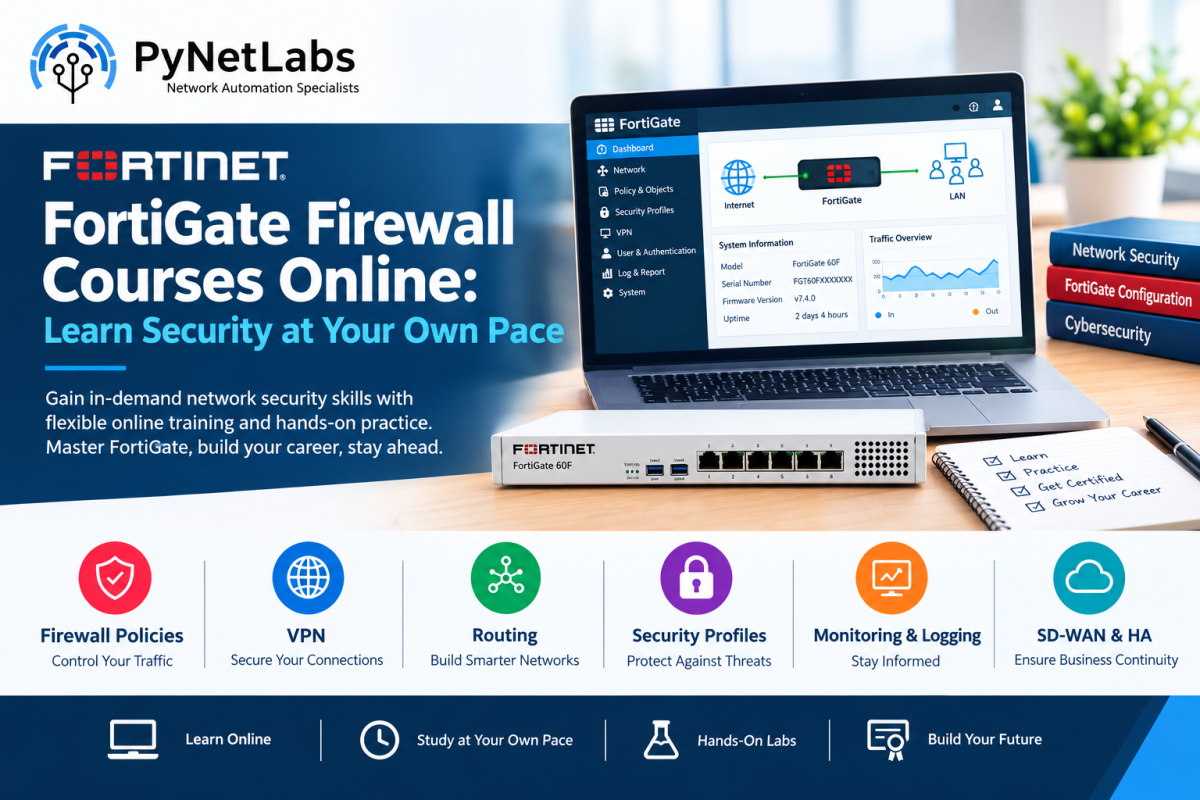
Network security has become an essential part of modern IT infrastructure. As organizations depend on cloud services, remote connectivity, applications, and distributed networks, professionals need practical knowledge of firewalls and security technologies. FortiGate is widely used for network security, and learning how to configure and manage it can help networking and cybersecurity professionals build valuable technical skills.
FortiGate Firewall Courses Online provide a flexible way to learn firewall administration, security policies, routing, VPNs, monitoring, and troubleshooting without being restricted to a traditional classroom schedule. Online learning allows students to study concepts at their own pace while practicing important configuration tasks in a structured environment.
What Is FortiGate?
FortiGate is Fortinet's next-generation firewall platform. It is powered by FortiOS and can be deployed across physical appliances, hypervisors, and cloud environments. FortiOS provides capabilities including firewall security, intrusion prevention, web security, application control, VPN, SD-WAN, and other network protection technologies.
Because FortiGate combines networking and security capabilities, administrators need to understand both fundamental networking concepts and firewall operations. A structured fortigate firewall course can help learners progress from basic configuration to more advanced administration and troubleshooting.
Why Choose FortiGate Firewall Courses Online?
Online learning offers flexibility for students, working professionals, and IT teams. Instead of attending a fixed classroom session, learners can organize their study time around their existing schedules. This makes online training particularly useful for professionals who want to improve their networking and security skills while continuing their current responsibilities.
A well-designed online program can combine video lessons, demonstrations, documentation, practical exercises, quizzes, and hands-on labs. Fortinet itself provides self-paced online training options, while some technical courses also provide access to hands-on lab activities.
What Can You Learn in a FortiGate Firewall Course?
The exact curriculum varies between training providers, but comprehensive FortiGate Firewall Courses Online generally cover the following areas:
1. FortiGate Fundamentals
Beginners can start by understanding FortiGate architecture, FortiOS, interfaces, administrative access, and basic networking configuration. Students can learn how the firewall fits into a network and how traffic moves between interfaces and networks.
2. Firewall Policies
Firewall policies are fundamental to controlling network traffic. Training typically explains policy components, source and destination addresses, services, schedules, NAT, logging, and security profiles. Learners can practice creating policies that allow legitimate traffic while restricting unwanted access.
3. Network Address Translation
NAT is another important topic in fortigate firewall training. Students can learn concepts such as source NAT, destination NAT, and port forwarding. Understanding NAT helps administrators configure communication between internal networks, external services, and the internet.
4. Routing
Firewall administrators also need a solid understanding of routing. A typical training program introduces static routes, route tables, routing decisions, and redundancy. Fortinet's administrator training includes routing and route-table analysis as part of its curriculum.
5. VPN Configuration
Virtual Private Networks are commonly used to provide secure connectivity between locations and users. FortiGate training can introduce IPsec VPN concepts, site-to-site connectivity, and remote-access technologies. Practical exercises can help learners understand tunnel configuration, authentication, encryption, and troubleshooting.
6. Security Profiles
FortiGate provides several security controls that can be applied to network traffic. Depending on the course level, students may learn about antivirus, web filtering, application control, and intrusion prevention. These topics help learners understand how firewall policies can be combined with additional security inspection capabilities.
7. Authentication
Modern network environments often require identity-based access controls. FortiGate training may cover local users as well as integrations involving authentication technologies such as LDAP and RADIUS. Learners can understand how authentication can be incorporated into firewall policies and network access.
8. Logging and Monitoring
Configuring a firewall is only one part of network security. Administrators also need to monitor traffic and investigate events. Online fortigate firewall training Online can introduce logging, monitoring dashboards, session information, and diagnostic techniques that help identify network and security problems.
9. SD-WAN and High Availability
More advanced FortiGate courses may introduce SD-WAN and high-availability configurations. FortiOS includes SD-WAN functionality, while FortiGate can also be deployed in high-availability environments for resilience.
Benefits of Practical FortiGate Training
Reading documentation can provide valuable theoretical knowledge, but practical exercises help learners understand how concepts work in real environments. Hands-on fortigate firewall training can allow students to configure interfaces, create firewall policies, configure NAT, establish VPN connections, examine logs, and troubleshoot connectivity issues.
Fortinet's administrator training, for example, includes interactive labs covering firewall policies, authentication, VPN, security profiles, SD-WAN, high availability, and troubleshooting.
Who Should Take FortiGate Firewall Courses?
A fortigate firewall course can be useful for a variety of IT professionals, including:
- Network administrators
- Network engineers
- Cybersecurity professionals
- System administrators
- IT support professionals
- Security operations professionals
- Students interested in network security
- Professionals preparing for Fortinet-related certifications
Beginners should ideally understand basic networking concepts such as IP addressing, subnetting, routing, TCP/IP, and firewall fundamentals before moving into advanced configuration. Fortinet's current administrator training similarly lists knowledge of network protocols and basic firewall concepts as prerequisites.
How to Learn FortiGate at Your Own Pace
One of the main advantages of Fortinet fortigate firewall courses is the ability to create a personalized learning schedule. A learner can begin with fundamental concepts, practice basic configurations, and gradually move toward advanced topics.
- Learn networking fundamentals: Review IP addressing, subnetting, routing, VLANs, and TCP/IP.
- Understand firewall concepts: Study security policies, NAT, authentication, and traffic filtering.
- Learn FortiGate fundamentals: Explore FortiOS, interfaces, administration, and basic configuration.
- Practice configuration: Create policies, configure routing, test NAT, and explore security profiles.
- Study VPN technologies: Learn how site-to-site and remote connectivity are implemented.
- Practice troubleshooting: Analyze logs, routing information, sessions, and configuration problems.
- Move to advanced topics: Explore SD-WAN, high availability, authentication integration, and enterprise security.
Career Value of FortiGate Skills
Firewall administration is an important skill within network security. Professionals who understand FortiGate can apply their knowledge to tasks such as network access control, secure remote connectivity, traffic inspection, monitoring, and troubleshooting.
Combining FortiGate knowledge with broader skills in networking, cybersecurity, cloud technologies, and automation can provide a more comprehensive technical foundation. Certification-oriented learning can also help professionals structure their preparation around defined knowledge areas.
Choosing the Right FortiGate Firewall Training
Before enrolling in a course, learners should review the curriculum carefully. Look for training that covers both theory and practical configuration. Important areas include firewall policies, NAT, routing, VPN, authentication, security profiles, logging, monitoring, and troubleshooting.
It is also useful to check whether the course provides hands-on labs. Lab exercises can make it easier to connect theoretical concepts with real firewall administration tasks. Learners should also check the FortiOS version covered by the course because features and interfaces can change between software versions.
Frequently Asked Questions
1. What are FortiGate Firewall Courses Online?
FortiGate Firewall Courses Online are training programs designed to teach learners how to configure, administer, monitor, and troubleshoot FortiGate firewalls through online lessons and, where available, practical labs.
2. Is a FortiGate firewall course suitable for beginners?
Yes. Beginners can start with an introductory course that explains firewall and networking fundamentals before progressing to configuration and administration. Basic knowledge of networking and firewall concepts is helpful.
3. What topics are covered in FortiGate firewall training?
Topics can include FortiGate fundamentals, interfaces, firewall policies, NAT, routing, authentication, security profiles, VPNs, logging, monitoring, troubleshooting, SD-WAN, and high availability. The exact curriculum depends on the course and level.
4. Can I complete FortiGate firewall training Online while working?
Yes. Self-paced online training is designed to provide flexibility, allowing learners to study according to their own schedules. Fortinet currently lists self-paced online formats for several FortiGate-related training offerings.
5. Do I need networking knowledge before learning FortiGate?
Basic networking knowledge is recommended. Understanding IP addressing, routing, TCP/IP, subnetting, and firewall concepts can make FortiGate configuration easier to understand.
6. Are hands-on labs important for FortiGate training?
Hands-on practice is valuable because firewall administration involves configuration and troubleshooting. Labs allow learners to apply concepts such as policies, NAT, VPNs, routing, and security profiles in practical scenarios.
7. Can FortiGate training help with cybersecurity skills?
Yes. FortiGate training can develop practical knowledge of network security controls, traffic filtering, threat prevention, authentication, VPNs, monitoring, and security policies. These skills can complement broader cybersecurity knowledge.
8. How should I choose a Fortinet fortigate firewall course?
Compare the course syllabus, FortiOS version, instructor experience, lab availability, learning format, course duration, and certification alignment. Choose a program that matches your current networking knowledge and professional goals.
Conclusion
FortiGate Firewall Courses Online offer a flexible approach to developing network security and firewall administration skills. By learning concepts such as firewall policies, NAT, routing, VPNs, authentication, security profiles, monitoring, SD-WAN, and troubleshooting, learners can build a practical foundation for working with FortiGate environments.
Whether you are beginning your cybersecurity journey or are an experienced network professional looking to expand your skill set, structured fortigate firewall training combined with hands-on practice can make the learning process more effective. With self-paced learning, learners can study concepts, practice configurations, review difficult topics, and progress toward more advanced FortiGate administration at their own pace.



Comments (0)