

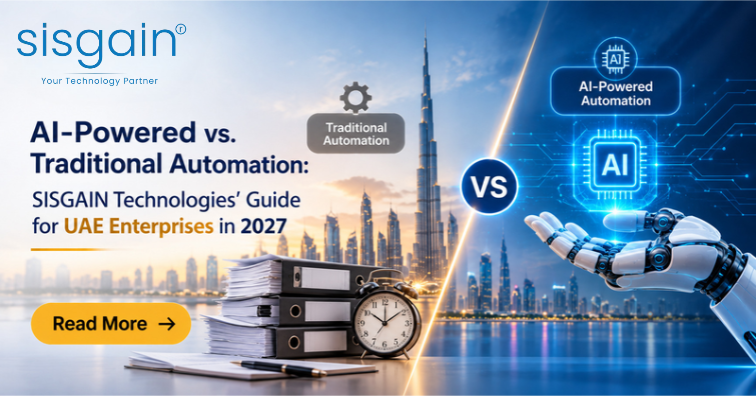
AI-Powered vs. Traditional Automation: SISGAIN Technologies' Guide for UAE Enterprises in 2027
Explore how AI-powered and traditional automation differ in 2027. Discover their benefits, applications, costs, and business impact to help UAE enterprises choose smarter automation strategies and improve operational efficiency with SISGAIN Technologies.
1. Introduction:
Automation has moved from a back-office convenience to a core driver of enterprise performance. Companies that once automated a single invoice workflow now expect technology to coordinate sales, finance, customer service, and supply chains at the same time. The question facing leaders is no longer whether to automate, but which kind of automation fits the work.
That question matters most in the UAE, where government strategy, private investment, and rising customer expectations are pushing organizations toward smarter operations. The debate around AI-Powered Automation vs Traditional Automation is therefore practical rather than academic. Traditional automation follows fixed rules to complete repeatable tasks. AI-powered automation uses data and learning models to interpret information, make predictions, and adapt as conditions change.
Why 2027 Is a Turning Point
Enterprises entering 2027 carry more data, more digital channels, and more pressure to respond quickly than ever before. Rule-based scripts that worked five years ago often struggle with this complexity, while AI tools have matured enough to deliver dependable results in production environments.
SISGAIN Technologies' Perspective
At SISGAIN Technologies, we see intelligent transformation as a business decision first and a technology decision second. This guide explains both approaches, compares them honestly, and helps UAE decision-makers choose a path that matches their goals.
2. Understanding Traditional Automation in Business Operations
Traditional automation is software that executes predefined instructions without interpretation. If a condition is met, the system performs a set action, every time.
What Is Traditional Automation?
It relies on rule-based logic, scripted workflows, triggers, and fixed instructions. A payroll system that calculates salaries from attendance records, or a script that emails a report every Monday morning, are typical examples. The system never questions its instructions; it simply repeats them accurately and at speed.
Common Business Applications
- Invoice processing and data entry from standardized forms
- Employee attendance and payroll management
- Inventory tracking and order processing
- Scheduled reporting and email notifications
In each case, the inputs are structured and the outcomes are predictable, which is exactly where this approach performs best.
Advantages and Limitations
Traditional automation offers consistent execution, lower complexity, and easy auditing for structured processes. For finance teams closing books on a strict schedule, that predictability is often worth more than flexibility.
Its weaknesses appear when work changes. Because decision-making is limited, it struggles with unexpected inputs, exceptions, scanned documents, free-text emails, and any process where the right action depends on context. Every new scenario usually requires an engineer to write another rule, so maintenance effort grows as processes evolve. Even so, many enterprises still run critical operations on this foundation, and for good reason: it is dependable, affordable, and well understood.
3. What Is AI-Powered Automation?
AI-powered automation combines workflow software with machine learning, natural language processing, and predictive analytics, so systems can interpret information and decide what to do next instead of only following a script.
Understanding AI-Driven Business Automation
Where traditional tools wait for a defined trigger, AI systems learn patterns from historical data and apply them to new situations. This approach, often described as Intelligent Process Automation, blends task execution with cognitive abilities such as reading documents, classifying requests, and recommending actions. AI agents extend this further by pursuing a goal across several steps, calling on different business systems along the way.
Key Capabilities of AI-Powered Automation
- Intelligent data analysis across large and mixed datasets
- Predictive decision-making based on historical and live data
- Natural language understanding for emails, chats, and contracts
- Adaptive workflow management that reroutes work as conditions change
- Continuous process improvement through feedback and retraining
Real-World Enterprise Applications
Consider a customer support team. An AI assistant reads an incoming complaint, detects urgency and sentiment, pulls the account history, and either resolves the issue or routes it to the right specialist with a short summary. Other common uses include:
- AI-powered customer support
- Automated document analysis for contracts and claims
- Intelligent demand forecasting
- Fraud detection and risk monitoring
These examples share one trait: the work involves judgment, variation, or unstructured information that fixed rules cannot handle well.
4. AI-Powered vs. Traditional Automation: Key Differences
The core difference is how each approach decides what to do. Traditional automation follows instructions written in advance, while AI-powered automation draws conclusions from data. The sections below compare them across the factors enterprises weigh most.
In working method and decision-making, traditional automation follows rule-based instructions and predefined rules, so every outcome was decided in advance by a person. AI-powered automation is data-driven and makes context-based predictions, which lets it choose a sensible action even when a situation was never explicitly scripted.
Flexibility and data processing also differ. Traditional tools are limited in flexibility and work best with structured data such as forms and database records. AI-powered systems are more adaptive and can handle both structured and unstructured data, including emails, images, voice, and free text.
Learning ability changes the long-term economics. A rule set does not learn independently and only changes when someone rewrites it, while an AI model can improve through training and feedback as it sees more examples.
Finally, complexity and scalability separate the two. Traditional automation is best for predictable tasks, and its scalability depends on predefined workflows. AI-powered automation suits complex workflows and can support evolving business processes as the enterprise grows.
Which Approach Delivers Better Business Value?
Neither is universally better. Traditional automation remains the right choice for stable, high-volume, rule-bound tasks such as payroll calculation or scheduled reconciliations, where predictability and lower cost are real advantages. AI-powered automation adds value when processes involve variation, large data volumes, or decisions that benefit from prediction, such as forecasting demand or flagging suspicious transactions.
A useful test is to ask whether a skilled employee would need judgment to complete the task. If the answer is no, rules may be enough. If the answer is yes, intelligence is likely required. The strongest enterprise programs match the tool to the task instead of replacing everything at once.
5. Why UAE Enterprises Are Moving Toward AI-Powered Automation in 2027
UAE enterprises are adopting AI-powered automation because national priorities, market competition, and customer expectations all reward speed and intelligence.
A National Push Toward AI
The UAE has made artificial intelligence a visible pillar of its digital transformation agenda, supporting innovation across government and industry. That environment encourages private organizations to invest in enterprise AI automation rather than treat it as an experiment. Leaders increasingly see intelligent operations as part of staying competitive in the region.
Business Pressures Driving Adoption
- Rising demand for operational efficiency as companies scale across emirates and markets
- A need for faster business decisions supported by real-time data
- Customer expectations for personalized, always-available service
- Competition across finance, healthcare, retail, logistics, and real estate
Bilingual Arabic and English interactions add further complexity, and language-aware AI can handle them more gracefully than keyword-based rules. Organizations that delay modernization risk falling behind rivals who respond faster.
Infrastructure That Can Scale
Finally, enterprises need technology that grows with them. Fixed workflows can become bottlenecks when a business adds new services, languages, or regulatory requirements. Intelligent systems built on solid data foundations make it easier to extend capabilities without rebuilding processes from scratch. For this reason, AI Automation for UAE Enterprises is increasingly viewed as business infrastructure rather than a single project.
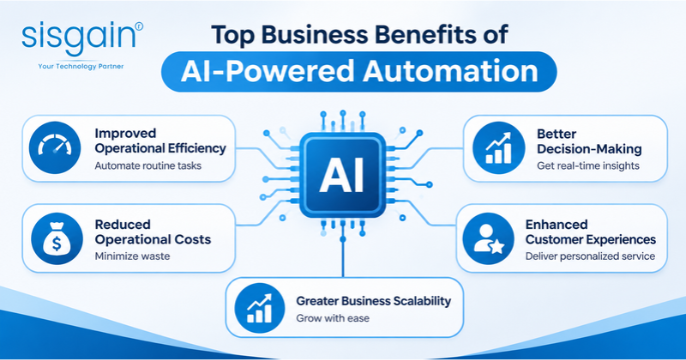
6. Top Business Benefits of AI-Powered Automation
When implemented against the right processes, AI-powered automation delivers benefits that reach well beyond simple time savings.
Improved Operational Efficiency
AI reduces repetitive work by handling classification, data extraction, and routing automatically. Employees spend less time on manual checks and more time on exceptions and strategy, which shortens cycle times across finance, HR, and customer service.
Better Decision-Making
Predictive models surface trends before they become problems. Real-time business intelligence lets managers see demand shifts, risk signals, or service delays as they emerge, supporting decisions grounded in current data rather than last month's report.
Reduced Operational Costs
Intelligent automation can reduce manual effort and process inefficiencies such as rework, errors, and delays. Actual savings depend on the process and the quality of implementation, so enterprises should model expected return before committing budget.
Enhanced Customer Experiences
Personalized recommendations, faster responses, and AI-powered conversations help customers find relevant answers at any hour. Consistent service across channels also builds trust, particularly in competitive consumer sectors.
Greater Business Scalability
As volumes grow, AI-driven workflows can adapt instead of demanding constant reconfiguration. New products, markets, and requirements can be supported by retraining and extending models rather than rewriting large rule libraries.
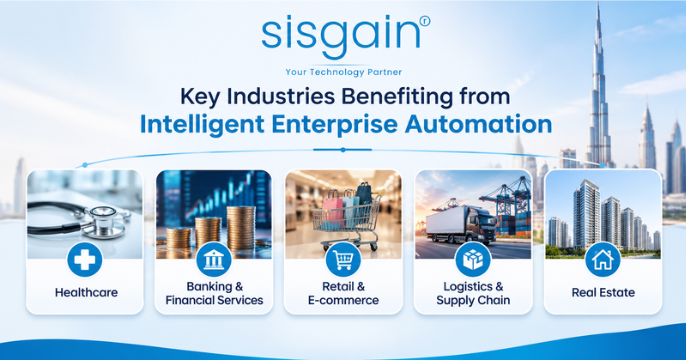
7. Key Industries Benefiting from Intelligent Enterprise Automation
Several sectors in the UAE already show strong use cases because they handle high volumes of data, documents, and customer interactions.
Healthcare
Hospitals and clinics use intelligent tools for patient administration, appointment scheduling, and medical document processing. Reducing paperwork frees clinical staff to focus on patients, while consistent record handling supports quality and compliance.
Banking and Financial Services
Fraud detection, compliance workflows, and transaction monitoring benefit from pattern recognition at scale. AI can flag unusual behavior in real time and help compliance teams prioritize the cases that genuinely need human review.
Retail and E-commerce
Demand forecasting, inventory optimization, and personalized shopping are natural fits. Retailers can anticipate seasonal peaks, reduce stockouts, and present customers with relevant products across web and mobile channels.
Logistics and Supply Chain
Route optimization, shipment tracking, and predictive inventory management help operators respond to delays and demand changes. Better visibility across the chain reduces costs and improves delivery reliability.
Real Estate
Lead management, property recommendations, and automated customer communication help agencies respond quickly to inquiries. AI can match buyers with suitable listings and keep prospects engaged throughout a long decision cycle.
8. How to Choose the Right Automation Strategy for Your Enterprise
The right strategy starts with your business problems, not with a technology preference. A structured evaluation prevents costly mismatches.
Assess Workflows and Readiness
- Evaluate existing business workflows end to end
- Identify which processes are repetitive and which are complex
- Assess data availability, quality, and infrastructure readiness
Weigh Cost, Integration, and Governance
- Consider implementation costs and expected ROI
- Evaluate integration requirements with existing ERP, CRM, and legacy systems
- Prioritize security, governance, and compliance
Many organizations benefit from specialist AI Integration Services Dubai providers who can connect new intelligent tools with the systems already in place.
providers who can connect new intelligent tools with the systems already in place.
Start With High-Impact Opportunities
Begin with a process where value is measurable, such as document intake or support triage. Prove results, learn from the pilot, and then expand deliberately.
9. The Role of SISGAIN Technologies in Enterprise Automation
SISGAIN Technologies is a technology solutions provider that helps businesses select and implement automation based on real objectives rather than trends.
A Business-First Approach
Choosing the right a partner who starts by understanding your workflows, data, and goals. Not every process needs artificial intelligence, and an honest assessment saves time and budget.
Customized, Scalable Solutions
SISGAIN focuses on customized automation strategies, careful integration planning, intelligent workflows, and scalable technology that supports operational efficiency. Enterprises are encouraged to review their automation requirements with experienced technology professionals before investing.
10. Future of Enterprise Automation: What to Expect Beyond 2027
Enterprise automation is heading toward systems that act with greater autonomy while staying accountable to people.
Agentic AI and Human Collaboration
- Greater adoption of agentic AI that completes multi-step tasks
- Increased human-AI collaboration, with people supervising and refining outcomes
- Intelligent workflow orchestration across departments and applications
Predictive Operations and Governance
- Predictive business operations that anticipate issues before they occur
- Stronger AI governance and security practices
- Deeper integration of AI with enterprise software ecosystems
Organizations that build sound data and governance foundations now will adopt these advances with less disruption.
Conclusion
The comparison of AI-Powered Automation vs Traditional Automation comes down to fit. Traditional automation delivers dependable results for structured, predictable tasks, while AI-powered automation handles variation, unstructured data, and prediction.
Stay ahead in 2027 with intelligent automation solutions from SISGAIN Technologies. Streamline operations, improve productivity, and accelerate digital transformation with customized AI-powered solutions designed for modern enterprises.





Comments (0)