

Breast Imaging Market Size, Share, Global Industry Trends, Growth and Forecast 2026-2034
The market has been categorized based on technology and end user.

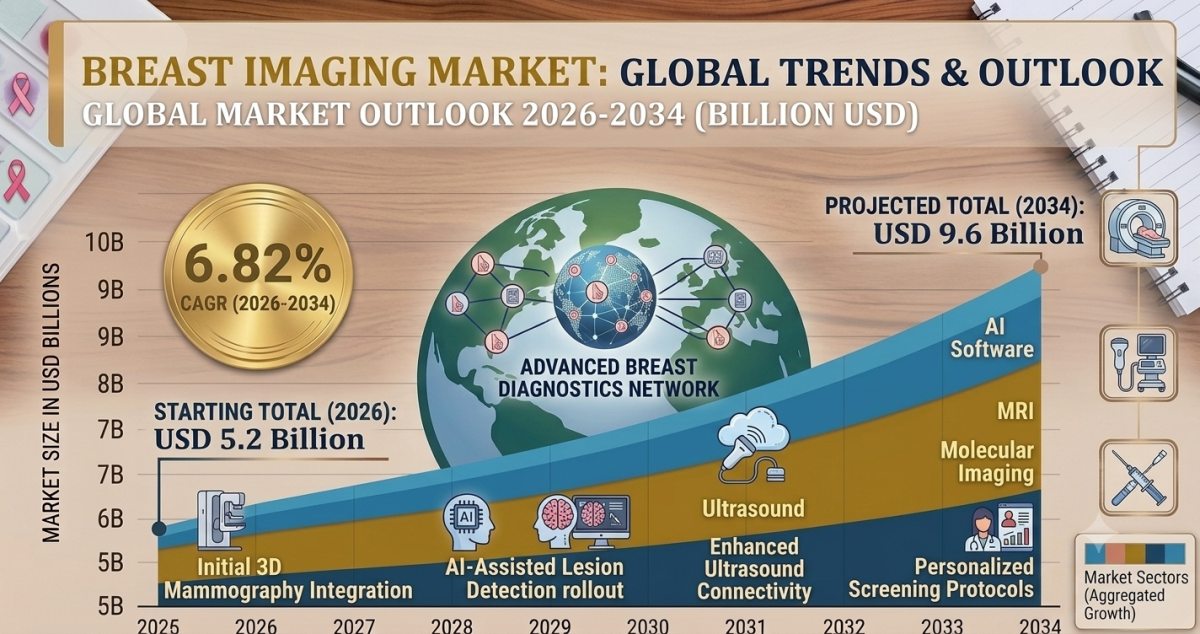
According to IMARC Group, the global Breast Imaging Market Size reached USD 5.2 Billion in 2025 and is projected to reach USD 9.6 Billion by 2034, expanding at a CAGR of 6.82% during 2026–2034. This robust breast imaging market growth reflects the escalating global burden of breast cancer, rapid advances in digital and AI-assisted imaging modalities, expanding government-backed screening programs, and rising awareness of the value of early detection across both developed and emerging healthcare systems.
Breast Imaging Industry Overview
Breast imaging encompasses the diagnostic technologies used to visualize breast tissue for the detection, characterization, and monitoring of benign and malignant conditions. By combining high-resolution imaging with, increasingly, artificial intelligence-assisted interpretation, breast imaging solutions help clinicians identify microcalcifications, masses, and architectural distortions long before they are palpable — improving survival outcomes and reducing the need for invasive procedures.
Breast imaging technologies are deployed across a broad continuum of clinical use cases:
- Routine screening: Population-level mammography programs supporting early detection in asymptomatic women
- Diagnostic work-up: Targeted ultrasound and MRI evaluation of palpable lumps, nipple discharge, or screening call-backs
- High-risk surveillance: Supplemental MRI and molecular imaging for women with elevated genetic or familial risk
- Image-guided intervention: Localization and guidance for core-needle and stereotactic breast biopsies
- Treatment monitoring: Serial imaging to assess therapeutic response in neoadjuvant and adjuvant treatment settings
Global Breast Imaging Market Size & Key Statistics
Below are the key Breast Imaging Market statistics drawn from IMARC Group's comprehensive market analysis:
|
Report Attribute |
Key Statistics |
|
Base Year |
2025 |
|
Historical Period |
2020–2025 |
|
Forecast Period |
2026–2034 |
|
Breast Imaging Market Size in 2025 |
USD 5.2 Billion |
|
Market Forecast in 2034 |
USD 9.6 Billion |
|
Market Growth Rate (2026–2034) |
6.82% CAGR |
|
Largest Region |
North America (37.5% share) |
|
Leading Technology Segment |
Ionizing Breast Imaging (63.7% share) |
|
Leading End-Use Segment |
Hospitals (42.0% share) |
Request for a Sample Report for Detailed Breast Imaging Market Share Evaluation: https://www.imarcgroup.com/breast-imaging-market/requestsample
Key Market Drivers & Breast Imaging Market Trends in 2026
Several powerful forces are shaping Breast Imaging Market Trends and fuelling sustained growth expectations across global diagnostic imaging markets:
1. Rising Global Incidence of Breast Cancer
Breast cancer remains the most commonly diagnosed cancer among women worldwide. Around 2.3 million women globally were diagnosed with breast cancer in 2022 alone, resulting in approximately 670,000 deaths, and projections point to a 38% increase in cases and a 68% rise in deaths by 2050. In the United States, diagnoses have been growing by roughly 1% annually, with a 1.4% yearly increase among women under 50 — a trend that is intensifying demand for accurate, timely breast imaging across every care setting.
2. Technological Advancements in Imaging Modalities
Continuous innovation in digital mammography, three-dimensional (3D) tomosynthesis, contrast-enhanced mammography, and AI-driven image analysis is improving diagnostic precision while reducing false positives and unnecessary biopsies. A notable example is the MyBreastAI suite launched by GE HealthCare in November 2023, which combines AI-driven applications for 2D mammography, 3D mammography, and breast density assessment — illustrating how AI integration is reshaping the competitive landscape and reinforcing broader Breast Imaging Market Growth.
3. Expansion of Government and Institutional Screening Programs
Governments and health organizations worldwide are expanding structured breast cancer screening initiatives to improve early detection, particularly among underserved populations. Programs such as Australia's biennial BreastScreen initiative, which offers free mammograms to women aged 50–74, exemplify how public health policy is directly expanding the addressable base for breast imaging services and reinforcing long-term Breast Imaging Market Share gains for screening-focused providers.
4. Growing Adoption of Non-Ionizing and Supplemental Imaging
Breast ultrasound, breast MRI, automated whole-breast ultrasound, and emerging modalities such as electrical impedance tomography and optical imaging are gaining traction as supplemental tools for dense-breast screening and high-risk surveillance. These non-ionizing options address patient and clinician concerns around radiation exposure while improving sensitivity in specific diagnostic scenarios.
5. Rising Healthcare Infrastructure Investment in Emerging Markets
Expanding diagnostic imaging infrastructure across Asia-Pacific, Latin America, and the Middle East is broadening access to screening centers in historically underserved regions. Combined with rising disposable incomes and growing health insurance penetration, this infrastructure build-out is a key structural driver of long-term Breast Imaging Market Growth outside the traditionally dominant North American and European markets.
6. Favorable Reimbursement and Insurance Coverage Policies
Expanding insurance coverage for routine mammography and diagnostic follow-up imaging, together with favorable reimbursement frameworks in developed markets, continues to lower out-of-pocket barriers to screening. This is particularly influential in the United States, where broad reimbursement support underpins one of the highest per-capita breast imaging utilization rates globally.
Key Market Segmentation
By Technology
Ionizing Breast Imaging – Largest Segment (63.7% Share): Ionizing modalities — including mammography, positron emission tomography-computed tomography (PET-CT), molecular breast imaging, positron emission mammography, and cone-beam computed tomography — dominate the technology segment due to their widespread clinical validation, high-resolution output, and proven ability to detect microcalcifications and early-stage tumors. Continued advances in low-dose imaging protocols and AI-assisted mammography interpretation are reinforcing the segment's leadership despite ongoing radiation-exposure considerations.
Non-Ionizing Breast Imaging: This segment — comprising breast ultrasound, breast MRI, automated whole-breast ultrasound, breast thermography, electrical impedance tomography, and optical imaging — is gaining share as a radiation-free complement to conventional mammography, particularly for dense-breast screening, high-risk surveillance, and diagnostic work-up of palpable findings.
By End User
Hospitals – Largest Segment (42.0% Share): Hospitals command the largest Breast Imaging Market Share among end users, supported by comprehensive diagnostic capabilities, access to advanced imaging equipment, integrated multidisciplinary oncology care, and the presence of skilled radiology staff able to manage complex or high-risk cases end-to-end.
Diagnostic Imaging Centers: Standalone and network-affiliated imaging centers represent a fast-growing end-use channel, offering convenient, high-throughput screening mammography with typically shorter wait times than hospital-based departments.
Ambulatory Surgical Centers: ASCs increasingly support image-guided breast biopsy and other minimally invasive diagnostic procedures, benefiting from lower-cost care delivery models.
Others: This category includes academic and research institutions, mobile screening units, and public health screening programs extending imaging access into underserved and rural communities.
Regional Breast Imaging Market Analysis
|
Region |
Key Highlights |
|
North America – Largest (37.5%) |
United States & Canada; advanced healthcare infrastructure, high breast cancer awareness, strong reimbursement policies, and a dense installed base of digital mammography and AI-enabled imaging systems. The U.S. alone holds an 88.90% share of the North American market. |
|
Europe |
Germany, France, UK, Italy, Spain, Russia; an aging population, structured national screening programs, and steady investment in mammography, ultrasound, and MRI-based breast imaging services. |
|
Asia Pacific |
China, Japan, India, South Korea, Australia, Indonesia; rising breast cancer incidence, expanding healthcare infrastructure, and growing government investment in screening technologies across developing markets. |
|
Latin America |
Brazil, Mexico; breast cancer remains the most prevalent cancer among women in the region, driving expanding screening programs and investment in digital mammography, ultrasound, and MRI access. |
|
Middle East & Africa |
UAE, Saudi Arabia, South Africa; rising breast cancer burden and national initiatives promoting regular mammography and early diagnosis, supported by growing adoption of 3D tomosynthesis and AI-powered imaging. |
North America leads the global Breast Imaging Market Share, anchored by the United States' advanced diagnostic infrastructure, high per-capita screening rates, favorable reimbursement policies, and strong presence of leading breast imaging equipment manufacturers.
Asia Pacific represents one of the fastest-growing regional markets, driven by rising breast cancer incidence — including an estimated 20,973 women diagnosed in Australia alone in a single year — alongside expanding healthcare infrastructure and growing government investment in screening technologies across the region.
Connect for Detailed Breast Imaging Market Share Segmentation Analysis – Speak to an Analyst: https://www.imarcgroup.com/request?type=report&id=2147&flag=C
Leading Players in the Global Breast Imaging Industry
The global breast imaging market features a mix of diversified medical imaging conglomerates and focused diagnostic technology specialists. Key companies covered in the IMARC Group report include:
|
Company |
Competitive Positioning |
|
Hologic Inc. |
A dedicated women's health imaging leader with a broad 3D mammography and breast biopsy guidance portfolio. |
|
GE Healthcare |
Full-spectrum breast imaging systems spanning digital mammography, tomosynthesis, and AI-assisted diagnostic software. |
|
Koninklijke Philips N.V. |
Integrated breast MRI, ultrasound, and diagnostic workflow solutions for hospital-scale deployment. |
|
Siemens Healthineers AG (Cerner Corporation) |
Advanced mammography and molecular breast imaging platforms with strong hospital-network penetration. |
|
Canon Inc. |
Diagnostic ultrasound and digital mammography systems with a growing footprint across Asia-Pacific. |
|
Fujifilm Holdings Corporation |
Full-field digital mammography and training-focused breast imaging solutions, with expanding presence in emerging markets. |
|
Carestream Health Inc. (Onex Corporation) |
Digital radiography and mammography imaging systems for hospital and diagnostic center use. |
|
Toshiba Corporation |
Diagnostic imaging equipment spanning ultrasound and CT-based breast imaging modalities. |
|
Delphinus Medical Technologies |
Specialized in ultrasound tomography for dense-breast screening and diagnostic imaging. |
|
Dilon Technologies Inc. |
Focused molecular breast imaging systems supporting supplemental cancer detection. |
|
Allengers Medical Systems Limited |
Mammography and diagnostic imaging equipment with a strong presence in emerging healthcare markets. |
|
Micrima Limited |
Developer of radio-wave-based breast imaging technology as a radiation-free screening alternative. |
|
Planmed Oy |
Specialized digital mammography systems for breast cancer screening and diagnosis. |
|
Aurora Health Care Inc. (Schoen Clinic) |
Healthcare provider network delivering breast imaging and diagnostic services across its facilities. |
Latest Breast Imaging Market Industry Developments
November 2024 – GE HealthCare
GE HealthCare introduced the Pristina Via mammography system, an evolution of the Senographe Pristina platform designed to improve the patient and technologist screening experience while offering vendor-neutral prior-image comparison and lower radiation dose across breast thicknesses.
November 2024 – Hologic, Inc.
Hologic launched the Envision Mammography Platform at the Radiological Society of North America (RSNA) annual meeting, featuring an industry-leading 2.5-second 3D mammogram scan time to improve patient throughput and comfort.
June 2024 – Fujifilm Holdings Corporation
Fujifilm's India Healthcare Division established its first Skill Lab in collaboration with NM Medical Mumbai, offering radiologists and radiographers advanced hands-on training in full-field digital mammography technologies.
About Us
IMARC Group is a leading global market research company providing data-driven insights and expert consulting services to businesses seeking to achieve their strategic objectives. With a multi-disciplinary team of industry experts, IMARC delivers thorough, reliable market intelligence across sectors including Healthcare, Technology, Chemicals, Energy, Food & Beverages, and more.
Contact Us
IMARC Group
United States: +1-201-971-6302
India: +91-120-433-0800
United Kingdom: +44-753-714-6104










Comments (0)