

Cash App Clone Script: How to Build a Profitable P2P Payment Business
Explore how a Cash App Clone Script can help launch a profitable P2P payment business through transaction fees, merchant services, premium features, cards, and financial services.

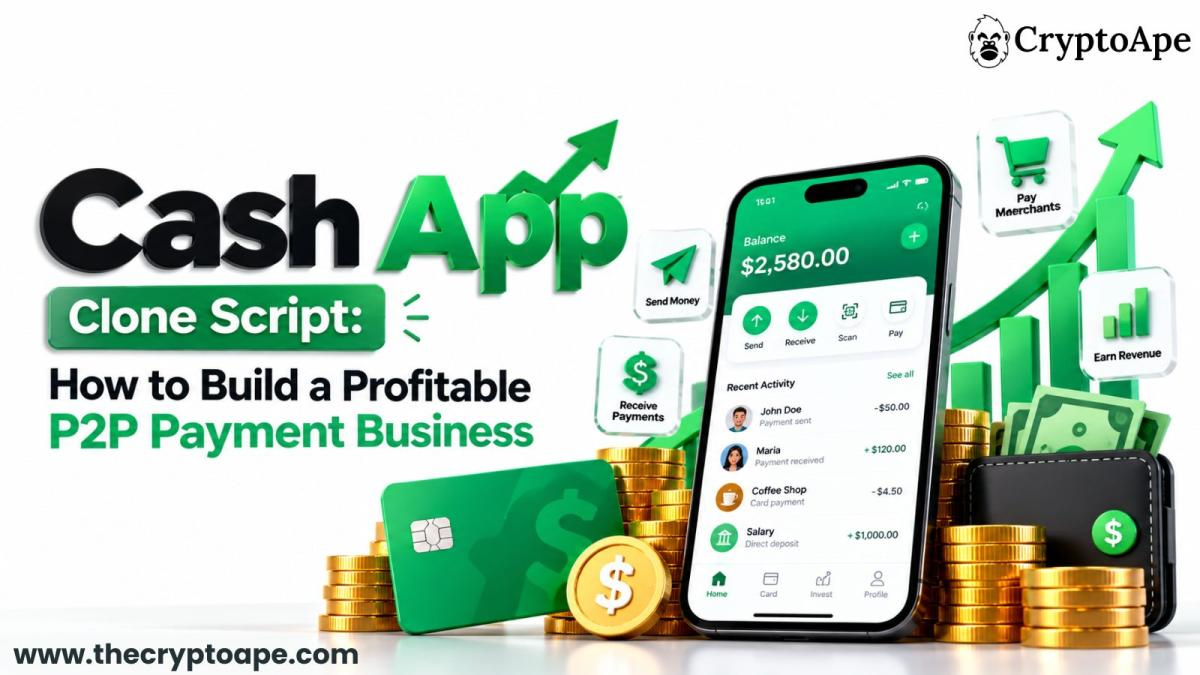
Digital payments have changed the way people manage everyday money. Sending money to friends, receiving payments, splitting expenses, paying businesses, and managing a digital balance can now happen through a smartphone within seconds. This shift has created a strong opportunity for entrepreneurs who want to enter the fintech market with their own payment platform. However, building a successful payment business is not simply about creating an application that allows users to transfer money. The real opportunity lies in creating a financial ecosystem where everyday transactions can generate sustainable revenue. This is where a Cash App Clone Script can provide a practical starting point for entrepreneurs who want to develop a P2P payment platform inspired by the broader business model of Cash App.
Understanding the Cash App Business Opportunity
Cash App has grown beyond the basic idea of sending money between individuals. Its ecosystem connects peer-to-peer payments with additional financial services, including payment cards, Bitcoin, investing, borrowing and other financial products. Block's financial reporting shows how Cash App has developed into a broader financial ecosystem rather than remaining only a money-transfer application. This model provides an important lesson for entrepreneurs: a payment transaction can be the beginning of a customer relationship rather than the end of it. When users continue to use the same platform for multiple financial activities, the business has more opportunities to generate revenue and increase customer lifetime value.
For a new fintech business, this creates an attractive opportunity. Instead of trying to build a general-purpose financial platform immediately, entrepreneurs can begin with a specific payment problem and gradually expand the services available to their users. A P2P payment application can start with simple transfers and eventually introduce merchant payments, digital wallets, payment cards, premium services, international transfers and other financial products where permitted. This approach allows the business to create multiple revenue opportunities while keeping the initial product focused on a clear customer need.
How a Cash App-Like Payment Platform Can Generate Revenue
The revenue model of a P2P payment platform can be built around several activities rather than depending entirely on one source. Transaction fees are one of the most straightforward opportunities. A platform can offer free or low-cost standard transactions while charging for selected services such as instant transfers, certain card-funded transactions, business payments or other premium transactions. The exact pricing structure depends on the market and payment infrastructure, but the underlying principle remains the same: convenience and speed can become monetizable services.
Merchant payments can create an even larger opportunity because businesses can generate considerably more transaction activity than individual users. A payment platform can allow merchants to accept digital payments through the application, creating a relationship between the fintech company and the business community. Instead of limiting the platform to person-to-person transfers, the business can gradually develop a wider payment ecosystem where consumers use the application to pay merchants and merchants use the platform to manage incoming payments. This can create additional transaction-based revenue while increasing the overall usefulness of the platform.
Another potential revenue opportunity comes from instant access to funds. Many users may be comfortable waiting for a standard transfer when there is no fee, while others may prefer to receive their money immediately. A platform can potentially monetize this preference by offering faster transfers or withdrawals for a fee, subject to the available payment infrastructure and applicable regulations. This model is attractive because users are not necessarily paying simply to move money; they are paying for convenience and speed.
Payment cards can also extend the revenue potential of a digital wallet. When users can spend their balance directly through a linked card, the wallet becomes part of their everyday financial activity rather than simply a place where money enters and leaves. Card transactions can potentially create revenue through interchange arrangements and related services, depending on the business model and financial partners. This creates a useful connection between the digital wallet and real-world spending.
Subscription Revenue Can Create Recurring Income
A P2P payment platform can also introduce premium subscription plans for users or businesses who need additional functionality. Instead of charging for every transaction, the platform can provide a basic service for everyday users while offering additional features through a monthly or annual subscription. Premium services could include advanced spending insights, enhanced account tools, additional business functionality, priority support or other value-added services. The advantage of this model is that it creates recurring revenue and can reduce the company's dependence on individual transaction fees.
Business accounts provide another opportunity to create recurring value. Small businesses, freelancers and independent professionals may require more than a simple payment button. They may want payment links, transaction records, customer payment management, reporting tools and other business-oriented capabilities. By creating a dedicated business experience, a payment platform can monetize both sides of the marketplace instead of relying entirely on consumers.
Expanding Into International Payments
Cross-border payments can provide another potential source of revenue for a growing fintech platform. People working internationally, businesses selling to overseas customers and families sending money across countries all have different payment requirements from users making domestic transfers. A platform that supports international payments may have opportunities to generate revenue from transfer fees and currency conversion, depending on its business model and regulatory structure.
However, international payments should not be treated simply as an additional feature. Different countries have different financial regulations, licensing requirements, foreign-exchange rules and payment infrastructures. Entrepreneurs planning an international P2P payment business need to understand these requirements before deciding which countries and services to support.
Financial Services Can Increase Customer Lifetime Value
The biggest opportunity for a payment business may come after the customer has already started using the platform. Once users regularly receive money, send payments or maintain a balance, the platform can potentially introduce additional financial services. Depending on licensing, partnerships and local regulations, these could include investment products, lending, savings-related services, buy-now-pay-later products or other financial solutions.
This approach changes the economics of the business. Instead of viewing every customer as someone who makes an occasional payment, the company can view the customer as a long-term relationship. The more useful services the customer adopts, the greater the potential lifetime value. This ecosystem strategy is one of the reasons successful fintech platforms continue expanding beyond their original payment functionality.
Why a Cash App Clone Script Can Be a Practical Starting Point
Developing an entire P2P payment platform from scratch can require significant development resources, testing and infrastructure planning. A Cash App Clone Script provides a ready-made foundation that can be customized around the entrepreneur's own business model. Instead of starting with an empty development project, the business can begin with a platform structure and adapt its branding, user experience, payment functionality, wallet system, administration tools and monetization strategy.
The purpose of using a clone script should not be to reproduce Cash App's branding or proprietary product. The goal is to use the established concept of a P2P payment platform as a starting point for creating an independent fintech business. Entrepreneurs can choose the audience they want to serve, decide which payment services to offer and develop a revenue model that fits their target market.
Profitability Depends on More Than Transaction Volume
High transaction volume does not automatically mean that a payment business is profitable. Every transaction can involve costs related to payment processing, fraud prevention, customer support, infrastructure, compliance and financial partnerships. This means entrepreneurs need to understand their unit economics before scaling the platform.
Customer acquisition cost, transaction frequency, average revenue per customer, customer retention and lifetime value all influence the economics of the business. A platform that attracts millions of users but generates very little revenue from each customer may struggle to remain sustainable. In contrast, a platform with a focused audience and highly engaged customers may generate stronger economics even with a smaller user base.
This is why the best P2P payment businesses focus not only on acquiring users but also on encouraging meaningful and repeated usage. When customers use the platform for payments, merchant transactions, cards and additional financial services, the business can potentially generate more value from the same customer relationship.
AI Can Strengthen the Payment Experience
Artificial intelligence can also contribute to the growth of a modern payment platform. Rather than treating AI as a standalone product, entrepreneurs can use it to make the payment experience more useful. An AI-powered financial assistant could help users understand their spending patterns, categorize transactions, answer account-related questions and surface useful information from their payment history. For businesses, AI can assist with transaction analysis, reporting and customer support.
AI can also help payment platforms identify unusual activity and support fraud monitoring. However, financial applications need to use AI carefully because users are trusting the platform with their money. AI should support the user experience without making unsupported financial promises or presenting uncertain information as guaranteed financial advice.
Building a Long-Term P2P Payment Business
The strongest opportunity for a Cash App-like platform is not necessarily to compete with established companies on every feature. A new fintech business can instead focus on a specific audience or underserved payment problem. It could target freelancers, small businesses, online sellers, international workers, students or a particular regional market. A focused proposition can make it easier to develop a clear marketing strategy and create a reason for users to choose the platform.
Once the platform gains traction, additional services can be introduced based on actual customer demand. This creates a gradual growth model where payments become the foundation and additional financial services become the next layer of the business. Over time, the platform can evolve from a simple P2P payment application into a broader digital financial ecosystem.
Final Thoughts
The opportunity behind a Cash App Clone Script is much bigger than simply creating an application for sending money. The real business potential comes from building a platform where payments create ongoing customer relationships and open the door to multiple revenue opportunities. Transaction fees, merchant payments, instant transfers, payment cards, premium subscriptions, international payments and additional financial services can all contribute to a diversified business model when implemented appropriately.
For entrepreneurs, the goal should not be to build another copy of Cash App. It should be to understand why the P2P payment model works and then create a platform that solves a specific problem for a clearly defined audience. A customizable clone-script foundation can help reduce the initial development effort, while the business strategy determines how the platform attracts users, generates revenue and grows over time.
The real opportunity isn't simply building a payment app. It's building a payment business that customers continue to use.











Comments (0)