

HRMS Software for Startups in Surat: Simplifying Payroll, Attendance and Workforce Management
Managing HR operations becomes challenging as Gujarat startups and small businesses grow. HRMS software can help businesses centralize employee management, attendance, leave, payroll, time tracking and workforce operations in one platform. Learn how an integrated HRMS can simplify daily HR processes and support business growth across Ahmedabad, Surat, Vadodara, Rajkot and other Gujarat cities.
Surat is known for its strong business ecosystem and is home to companies operating across technology, services, manufacturing, textiles, trading, e-commerce, and other industries. As businesses grow in Surat, workforce administration can become increasingly complicated.
Managing a small team is relatively simple. Employee details can be stored in spreadsheets, attendance can be recorded manually, leave can be communicated through email or messaging applications, and payroll can be calculated using separate files.
But when employee numbers increase, these processes become harder to maintain.
HR teams may need to manage employee records, attendance, leave balances, salary information, working hours, holidays, shifts, payroll, employee documents, and reports. When this information is distributed across different systems, HR administration can become repetitive and difficult to coordinate.
This is where HRMS software for startups in Surat can provide a structured approach to workforce management.
What Is HRMS Software?
HRMS stands for Human Resource Management System.
An HRMS is a digital platform designed to centralize employee and HR-related processes.
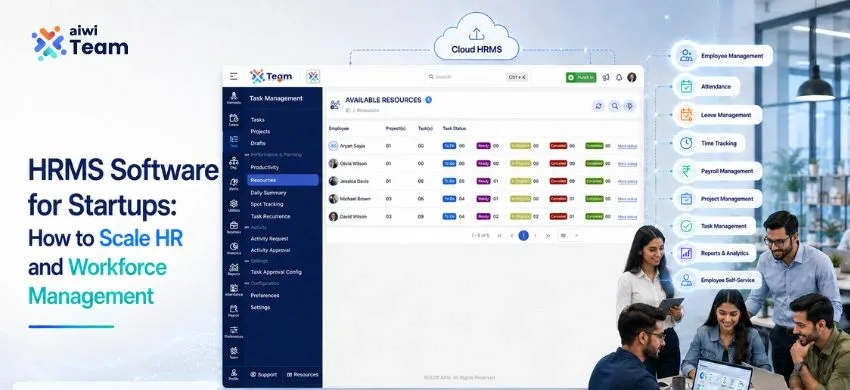
Depending on the platform, businesses can manage employee profiles, attendance, leave, payroll, working hours, shifts, employee self-service, reporting, and workforce information.
For startups and growing SMEs, the purpose is not simply to replace spreadsheets. The larger objective is to create connected HR workflows that can continue to function as employee numbers increase.
Why Surat Startups Should Consider HR Automation
Early-stage companies often prioritize sales, product development, customer acquisition, and business expansion.
HR administration may remain manual during the early stages.
However, employee-related administration grows along with the workforce.
Consider a company with ten employees. Attendance and leave may be manageable through a spreadsheet.
At fifty employees, HR may need to track hundreds of attendance entries every month, verify leave requests, calculate working days, manage salary information, and answer employee questions.
At this point, manual processes can create additional workload.
HR automation can help businesses organize these processes more systematically.
Centralized Employee Management
Employee records are one of the most important components of HR administration.
A growing Surat business may have employees across departments including sales, operations, technology, finance, marketing, customer support, and administration.
Maintaining these details across multiple spreadsheets can create duplicate or outdated information.
A centralized employee management system can provide a single location for employee profiles and organizational information.
This can make it easier for authorized HR personnel and managers to access relevant information.
Attendance Management
Attendance is closely connected to working hours, leave, shifts, and payroll.
Businesses may have different attendance requirements depending on their workforce.
Some employees may work from an office. Others may work remotely, visit customers, or follow shifts.
A modern attendance management system can support digital attendance processes and centralized attendance records.
Businesses evaluating attendance software should consider the methods their employees actually use.
Depending on the organization, requirements may include web-based attendance, mobile attendance, biometric integration, attendance regularization, shift-based attendance, and attendance reporting.
Payroll Management
Payroll is another major HR requirement.
Salary calculations may involve salary structures, working days, approved leave, deductions, taxes, payslips, and payroll records.
When attendance and payroll are disconnected, HR teams may have to repeatedly move information between systems.
An integrated payroll management system can reduce repetitive data handling by connecting relevant employee and workforce information.
Businesses should still configure payroll according to their own policies and applicable requirements.
Leave Management
As teams grow, leave requests can become difficult to manage through informal communication.
An online leave management system can provide employees with a structured process for submitting leave requests.
Managers can review requests and HR can maintain centralized records.
Useful capabilities may include:
-
Leave requests
-
Approval workflows
-
Leave balances
-
Leave policies
-
Leave history
-
Paid and unpaid leave
-
Carry-forward rules
-
Attendance integration
This can make leave administration easier for employees and HR teams.
Time Tracking for Project-Based Businesses
Surat has businesses operating across many different sectors, and some startups work on projects, clients, and service assignments.
Time tracking can be useful when businesses need to understand how working hours are distributed.
For example, a technology company may track time against development projects. An agency may monitor client project hours. A consulting company may need visibility into employee time allocation.
An integrated workforce management platform can connect employee records, attendance, time tracking, tasks, and projects.
This creates a more complete view of how workforce time is being used.
Workforce Management Beyond Traditional HR
Traditional HR software often focuses on employee administration.
Growing businesses may require more.
Managers may want to understand employee availability, workload, project assignments, task progress, working hours, and workforce activity.
This is where broader workforce management software can complement HRMS functionality.
Instead of viewing each process separately, businesses can create connected workflows such as:
Employee → Attendance → Leave → Time → Project → Task → Reporting
Such connections can reduce the need to maintain the same information in several different applications.
Employee Self-Service
Employee self-service is particularly useful as companies grow.
HR teams should not necessarily have to answer every routine question about attendance, leave, or payroll.
Depending on the platform, employees may be able to view attendance information, submit leave requests, check balances, and access relevant payroll documents themselves.
This can reduce repetitive HR communication and give employees more direct access to their information.
AIWI Team for Growing Businesses
AIWI Team is positioned as an all-in-one HRMS and workforce management platform for startups, SMEs, and growing businesses.
Its capabilities include employee management, attendance, leave management, payroll, time tracking, productivity, projects, tasks, organizational management, and reporting.
Businesses searching for HRMS software in Surat can evaluate whether an integrated platform like AIWI Team matches their workforce structure and operational requirements.
The detailed HRMS software for startups guide also explains how startups can move from fragmented HR processes toward centralized workforce management.
How to Select HRMS Software in Surat
Businesses should not select HRMS software simply because it has many features.
Instead, evaluate the processes that currently create the most administrative work.
Ask:
-
Is employee information centralized?
-
Can employees manage leave requests online?
-
Can attendance be recorded according to the company's working model?
-
Can payroll use relevant attendance and leave information?
-
Does the platform support different shifts?
-
Is employee self-service available?
-
Can managers access useful workforce reports?
-
Does the platform support remote and hybrid employees?
-
Can the system scale as employee numbers increase?
-
Does it integrate workforce and project information where required?
This requirement-first approach can help businesses make more practical software decisions.
Conclusion
For startups and growing businesses in Surat, workforce management can become increasingly complex as employee numbers increase.
Attendance, leave, payroll, employee records, time tracking, projects, and reporting are interconnected business processes. Managing them through separate spreadsheets and applications can increase administrative effort.
An HRMS provides an opportunity to centralize these workflows.
The right solution should fit the company's workforce model, payroll requirements, attendance policies, employee experience expectations, reporting needs, and future growth.
AIWI Team brings HRMS and workforce management capabilities together in one platform, giving growing businesses an option to manage employee administration and broader workforce operations through a connected system.

I’m AIWI Team, an all-in-one HRMS and workforce management platform built to help businesses simplify the way they manage people, productivity, and daily operations. AIWI Team brings essential workplace tools together in one platform, including employee management, attendance, leave management, payroll, time tracking, task management, project management, productivity tracking, workforce management, and reporting. Our goal is simple: help startups, SMEs, and growing businesses reduce manual HR work, improve workforce visibility, and create more organized and productive workplaces. Whether your team is remote, hybrid, or office-based, AIWI Team provides the tools you need to manage your workforce more efficiently and support business growth.




Comments (0)