

HRMS Software for Startups in Vadodara: Build a Scalable Workforce Management System
AIWI Team offers HRMS software in Vadodara for startups, SMEs, and growing businesses, helping manage employee records, attendance, leave, payroll, time tracking, projects, tasks, and workforce operations from one centralized platform.
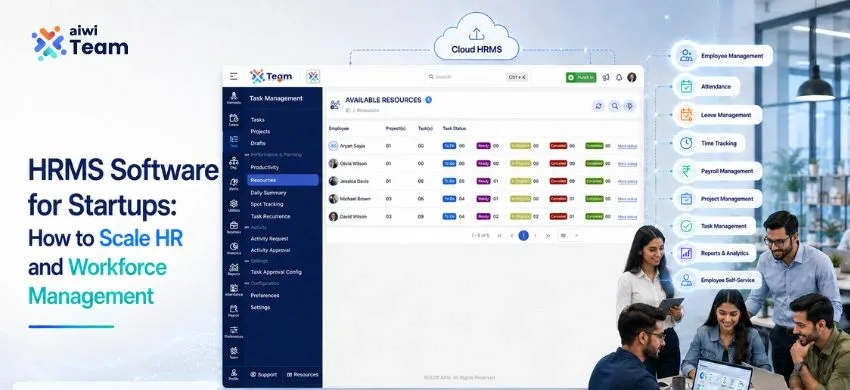
As startups and growing businesses expand in Vadodara, managing people becomes an increasingly important operational responsibility. A business may begin with a small team where employee information, attendance, leave, and payroll are easy to manage manually.
However, growth changes the situation.
When a company reaches 30, 50, or 100 employees, HR teams may need to maintain employee records, attendance, leave balances, salary structures, payroll information, shifts, holidays, documents, working hours, and workforce reports.
Using separate spreadsheets for each process can create administrative complexity.
For this reason, startups and SMEs looking for HRMS software in Vadodara may consider an integrated platform that connects employee management with attendance, leave, payroll, time tracking, and workforce operations.
Understanding HRMS for Growing Companies
A Human Resource Management System is a centralized digital platform for managing employee and HR processes.
The exact features differ between providers, but a modern HRMS may include:
-
Employee management
-
Attendance management
-
Leave management
-
Payroll
-
Shift scheduling
-
Time tracking
-
Employee self-service
-
Workforce reporting
-
Organizational management
-
Project and task management
For startups, an HRMS can help replace fragmented manual processes with more structured workflows.
The Problem With Separate HR Processes
Imagine a growing company using one Excel file for employees, another spreadsheet for attendance, email for leave requests, payroll software for salaries, and a separate application for project management.
Every system may work individually.
The challenge is that the information is disconnected.
HR may need to transfer attendance information into payroll. Managers may need to check leave availability separately. Project managers may maintain time information in another application.
This creates repetitive administrative work.
An integrated HRMS can reduce some of this fragmentation by bringing relevant information together.
Employee Management
As an organization grows, employee information becomes more complex.
A startup may move from a single team to multiple departments and management levels.
HR may need to manage:
Employee profiles
Departments
Designations
Reporting structures
Employee types
Roles and permissions
Organizational information
A centralized employee management system can provide a consistent place to maintain these records.
This can be especially useful when companies are hiring quickly and organizational structures are changing.
Attendance Management for Different Workforce Models
Attendance requirements vary between companies.
An office-based business may use a fixed attendance process. A hybrid company may need web or mobile attendance. A business with shifts may need roster-based attendance.
Therefore, companies should evaluate attendance software according to how employees actually work.
A modern attendance system may support check-in and check-out, working hours, shifts, attendance regularization, holidays, and reporting.
When attendance connects with leave and payroll, HR teams may have fewer disconnected records to reconcile.
Leave Management
Leave administration is another process that becomes more difficult as employee numbers grow.
A small company may handle leave through messages.
At larger headcounts, informal communication makes it harder to maintain accurate records.
An online leave management system can provide a structured workflow.
Employees can submit leave requests, managers can review them, and HR can maintain leave balances and records.
A connected leave system can also help organizations coordinate employee availability with attendance and workforce planning.
Payroll Administration
Payroll requires careful handling of employee salary information and related records.
A payroll management system can help businesses manage salary structures, earnings, deductions, payslips, payroll records, and other configured payroll information.
When payroll works with attendance and leave information, the HR workflow can become more connected.
This can be useful for organizations where working days, approved leave, or other workforce inputs are relevant to payroll calculations.
Time Tracking and Project Management
Many startups operate around projects.
Technology companies develop products, agencies work with clients, consulting businesses deliver assignments, and service organizations manage customer work.
In these environments, time tracking can provide useful information about how working hours are allocated.
Connecting time with projects and tasks can help managers understand workload and project activity.
Instead of maintaining separate records for employee time and project work, an integrated workforce platform can provide a broader view.
Workforce Productivity
Some businesses may also require workforce productivity information.
Productivity tracking can include working time, activity information, project hours, task progress, or other configured workforce metrics.
However, productivity information should be interpreted in context.
An employee may spend time in meetings, planning, research, communication, or other work that is not necessarily reflected through simple activity metrics.
Therefore, businesses should define clear policies around employee monitoring and use workforce information appropriately.
Supporting Remote and Hybrid Teams
Modern startups may not have every employee working from one office.
Employees can work remotely, follow hybrid schedules, or operate from different locations.
Cloud-based HRMS software can make employee and workforce processes accessible without depending entirely on physical office records.
For growing companies, this can help centralize HR administration across different working arrangements.
AIWI Team as an Integrated Workforce Platform
AIWI Team combines HRMS and workforce management capabilities for startups, SMEs, and growing businesses.
The platform includes employee management, attendance, leave, payroll, time tracking, productivity, projects, tasks, organizational management, reporting, and other workforce features.
For businesses evaluating HRMS software in Vadodara, AIWI Team can be assessed based on the company's actual workforce requirements rather than simply its feature count.
The platform's HRMS software for startups resource provides additional information about using HRMS and workforce management capabilities as a startup grows.
How to Implement HRMS Successfully
Buying software is only one part of HR automation.
A startup can follow a simple implementation process.
First, centralize employee information.
Second, establish digital attendance and leave workflows.
Third, organize payroll information.
Fourth, introduce time tracking if the business actually needs it.
Fifth, connect projects and tasks where project-based visibility is useful.
Finally, use reports to understand workforce patterns.
The objective should be to simplify existing processes rather than introduce unnecessary complexity.
Choosing HRMS Software in Vadodara
Before selecting an HRMS, businesses should consider:
-
Employee count
-
Workforce structure
-
Attendance methods
-
Shift requirements
-
Leave policies
-
Payroll workflows
-
Employee self-service
-
Reporting requirements
-
Project and task tracking
-
Remote or hybrid work
-
Scalability
-
Ease of use
-
Total software cost
A startup should also consider how the platform will work when the company becomes larger.
A solution that works for ten employees may need to support substantially more employees later.
Final Thoughts
HRMS software can provide a structured foundation for growing businesses in Vadodara.
Instead of managing employee records, attendance, leave, payroll, working hours, and workforce information through disconnected systems, businesses can consider a centralized HRMS approach.
For startups, the goal should be scalable administration without unnecessary complexity.
AIWI Team combines HR and workforce management capabilities across employee management, attendance, leave, payroll, time tracking, productivity, projects, tasks, and reporting.
Businesses can evaluate these capabilities against their own processes and workforce requirements before choosing an HRMS platform.
I’m AIWI Team, an all-in-one HRMS and workforce management platform built to help businesses simplify the way they manage people, productivity, and daily operations. AIWI Team brings essential workplace tools together in one platform, including employee management, attendance, leave management, payroll, time tracking, task management, project management, productivity tracking, workforce management, and reporting. Our goal is simple: help startups, SMEs, and growing businesses reduce manual HR work, improve workforce visibility, and create more organized and productive workplaces. Whether your team is remote, hybrid, or office-based, AIWI Team provides the tools you need to manage your workforce more efficiently and support business growth.







Comments (0)