

EV Charging Made Simple for UAE Homes & Businesses


Electric vehicle adoption is accelerating across the country, and choosing the right EV Chargers UAE homeowners and businesses can rely on has become a practical, everyday decision rather than a niche concern. Reliable EV Chargers let drivers charge overnight at home, top up during the workday at the office, or refuel quickly along major routes, all without depending solely on the public charging network.
Why EV Charging Infrastructure in the UAE Is Expanding Quickly
Government incentives, a growing range of electric vehicle models available locally, and rising fuel costs are pushing more residents and businesses across the UAE toward electric vehicles every year. As adoption grows, the public charging network alone cannot keep pace with demand, particularly during peak commuting hours. Homeowners and employers are increasingly installing their own charging infrastructure to guarantee a reliable charge without relying on the availability of a public station at the right time.
What Are EV Chargers?
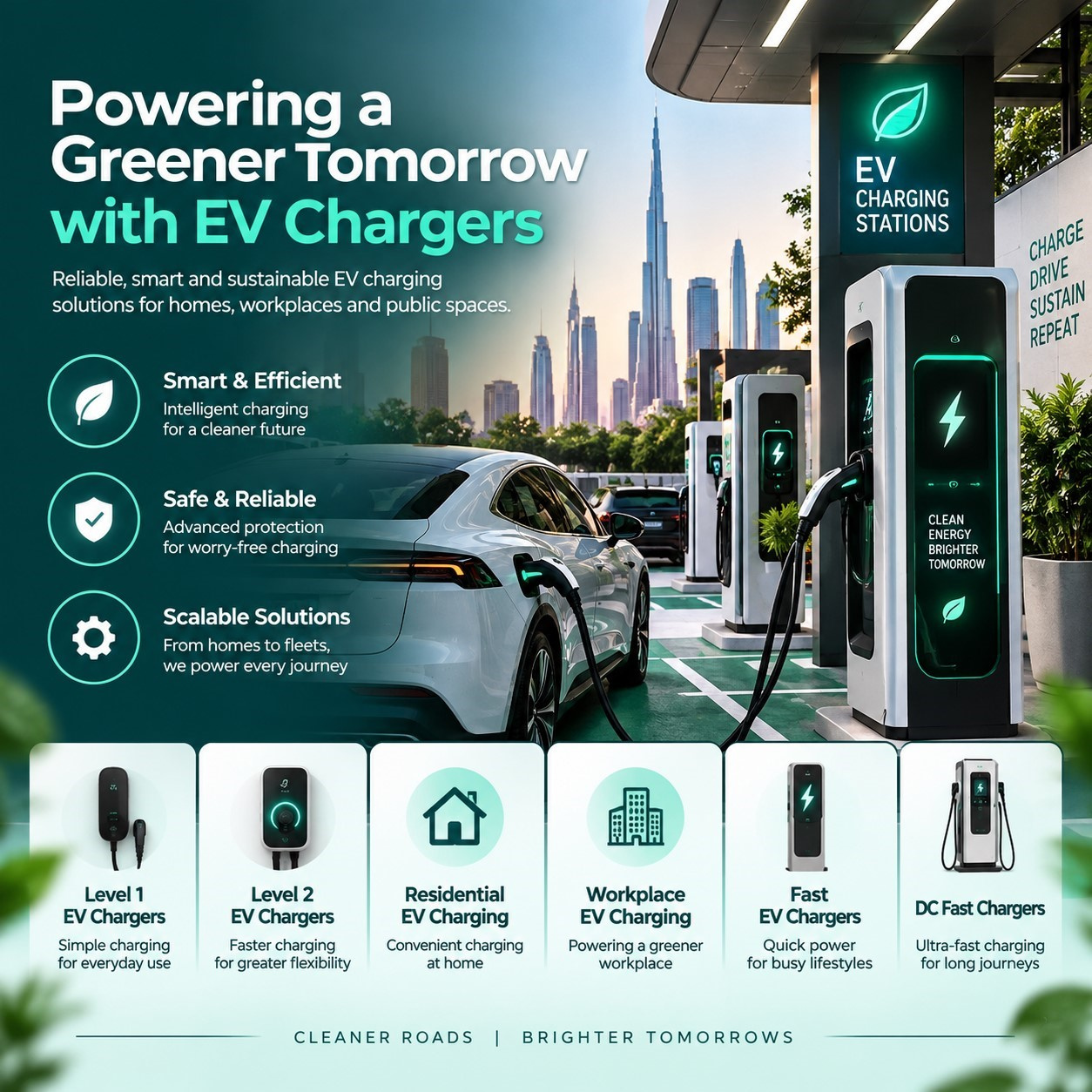
EV Chargers are devices that convert electrical power from a building's supply into the format and rate an electric vehicle's battery can safely accept, ranging from a simple wall-mounted unit drawing power slowly overnight to a heavy-duty unit capable of adding significant range in minutes. The right choice depends heavily on how the vehicle is used, where it will be parked, and how quickly a full charge actually needs to happen.
EV Charging Stations: From Single Units to Multi-Bay Installations
Beyond a single charger mounted on a wall, larger sites often require complete EV Charging Stations — multiple charging points grouped together with shared electrical infrastructure, load management, and sometimes payment integration. This setup is common at retail centers, residential communities, and corporate campuses across the UAE that need to serve many vehicles simultaneously rather than a single dedicated parking bay.
Fast EV Chargers: Reducing Wait Times for Busy Drivers
For locations where a vehicle isn't parked for long, Fast EV Chargers deliver a significantly higher charging rate than a standard home unit, adding meaningful range during a short stop rather than requiring hours connected to the vehicle. These units are particularly valuable at retail locations, shared parking facilities, and any site where drivers need a quick top-up rather than an overnight charge.
Level 1 EV Chargers and Level 2 EV Chargers: Understanding the Difference
Charging speed for standard AC charging falls into two common categories. Level 1 EV Chargers use a standard household outlet and charge slowly, suitable mainly as a backup option or for vehicles with very low daily mileage. Level 2 EV Chargers use a higher-voltage dedicated circuit and charge considerably faster, making them the practical standard for most homes and workplaces across the UAE that need a full charge overnight or during a typical workday.
Choosing Between Level 1 and Level 2 for a Home Installation
Most homeowners quickly outgrow a Level 1 setup once daily driving distances increase, since the slower charging rate can struggle to fully replenish a battery overnight. A dedicated Level 2 installation, while requiring a slightly larger upfront investment in electrical work, typically delivers a far more practical daily charging experience for most UAE households.
DC Fast Chargers: High-Power Charging for Demanding Use Cases
For the fastest charging available, DC Fast Chargers bypass a vehicle's onboard charger entirely, delivering high-power direct current straight to the battery and adding substantial range in well under an hour. These units are typically reserved for commercial fleet operations, high-traffic public locations, or any site where vehicles need to return to service quickly rather than charging overnight.
Residential EV Charging: Designing for Everyday Convenience
For most households, Residential EV Charging comes down to a Level 2 unit installed in a garage or driveway, charging the vehicle overnight so it's ready every morning without any active management required. The key planning considerations are usually electrical capacity, where the vehicle is typically parked, and whether the home's existing panel can support the additional load without an upgrade.
Workplace EV Charging: Supporting Employees and Visitors
Businesses across the UAE are increasingly installing Workplace EV Charging as both an employee benefit and a way to support a broader sustainability commitment. A well-planned workplace deployment considers how many vehicles need charging during a typical shift, whether charging should be free or metered, and how to manage access fairly across multiple employees sharing a limited number of charging bays.
Practical Considerations for Choosing the Right Charger
• Daily driving distance and how much range needs replenishing each day
• Available electrical capacity at the installation site
• Whether charging needs to happen overnight, during a workday, or in a short stop
• Number of vehicles that need to charge simultaneously at a shared location
• Future-proofing for additional charging points as EV adoption grows
Installation and Electrical Planning Considerations
Installing a charger, particularly a Level 2 or DC fast unit, typically requires an assessment of the building's existing electrical capacity and may involve upgrading a panel or running a dedicated circuit. For multi-unit installations at a workplace or residential community, load management software is often necessary to prevent multiple chargers from drawing more power simultaneously than the building's electrical infrastructure can safely support.
Why Experience Matters When Choosing EV Chargers Dubai Homes and Businesses Can Trust
Specifying the right charger type, electrical capacity, and installation approach requires direct experience with regional building infrastructure and electrical codes, not just a product catalogue. Tektronix LLC has engineered EV charging and critical-facility electrical solutions across the UAE, working with homeowners, businesses, and residential communities that share the same infrastructure planning needs found throughout Dubai and the wider Emirates. That regional deployment experience, covering site assessment, electrical planning, and charger installation, is detailed on Tektronix LLC's EV charger solutions page for the UAE, where homeowners and facility managers can review proven configurations before specifying an installation for their own property.
Implementation Best Practices
-
Assess existing electrical capacity before selecting a charger level or station size.
-
Match charger speed to actual usage patterns rather than choosing the fastest available option by default.
-
Plan for future expansion if additional charging points are likely within the next few years.
-
Use load management software for any site installing more than a single charging point.
-
Confirm installation compliance with relevant UAE electrical and building codes before go-live.
Conclusion
Choosing the right charging setup in the UAE depends on how a vehicle is actually used day to day. Level 1 EV Chargers suit minimal daily mileage, while Level 2 EV Chargers provide the practical standard for most Residential EV Charging and Workplace EV Charging installations. For faster turnaround, Fast EV Chargers and DC Fast Chargers reduce wait times significantly, and larger sites benefit from complete EV Charging Stations with proper load management. Homeowners and businesses ready to plan an installation can review Tektronix LLC's EV charging platform built for UAE properties to compare options against current charging needs.
FAQs
1. What type of EV Chargers UAE homeowners typically install first?
Most homeowners start with a Level 2 charger installed in a garage or driveway, since it offers a practical balance of charging speed and installation cost for everyday overnight charging.
2. How much faster is a Level 2 charger compared to a Level 1 charger?
Level 2 chargers generally charge several times faster than Level 1 units, since they use a dedicated higher-voltage circuit rather than a standard household outlet.
3. When does a property need a DC Fast Charger instead of a standard Level 2 unit?
DC fast chargers are typically reserved for commercial fleets or high-traffic public locations where vehicles need to return to service quickly, rather than homes or workplaces where overnight or workday charging is sufficient.
4. What should businesses consider before installing Workplace EV Charging?
Businesses should assess how many employees are likely to need charging during a typical shift, whether to offer charging for free or at a cost, and how to manage fair access across a limited number of charging bays.
5. Do EV Charging Stations require special electrical planning compared to a single home charger?
Yes, multi-unit stations typically require load management software and a broader electrical capacity assessment to ensure several chargers operating simultaneously don't exceed the building's available power supply.








Comments (0)