

3D Printing in Hobart: Custom Manufacturing for Startups, Engineers and Innovative Businesses
Bringing a new product or component from an idea to a finished physical object often requires several rounds of design, testing, modification, and manufacturing. For businesses working with small quantities or specialised designs, traditional production methods may not always be the most practical starting point.
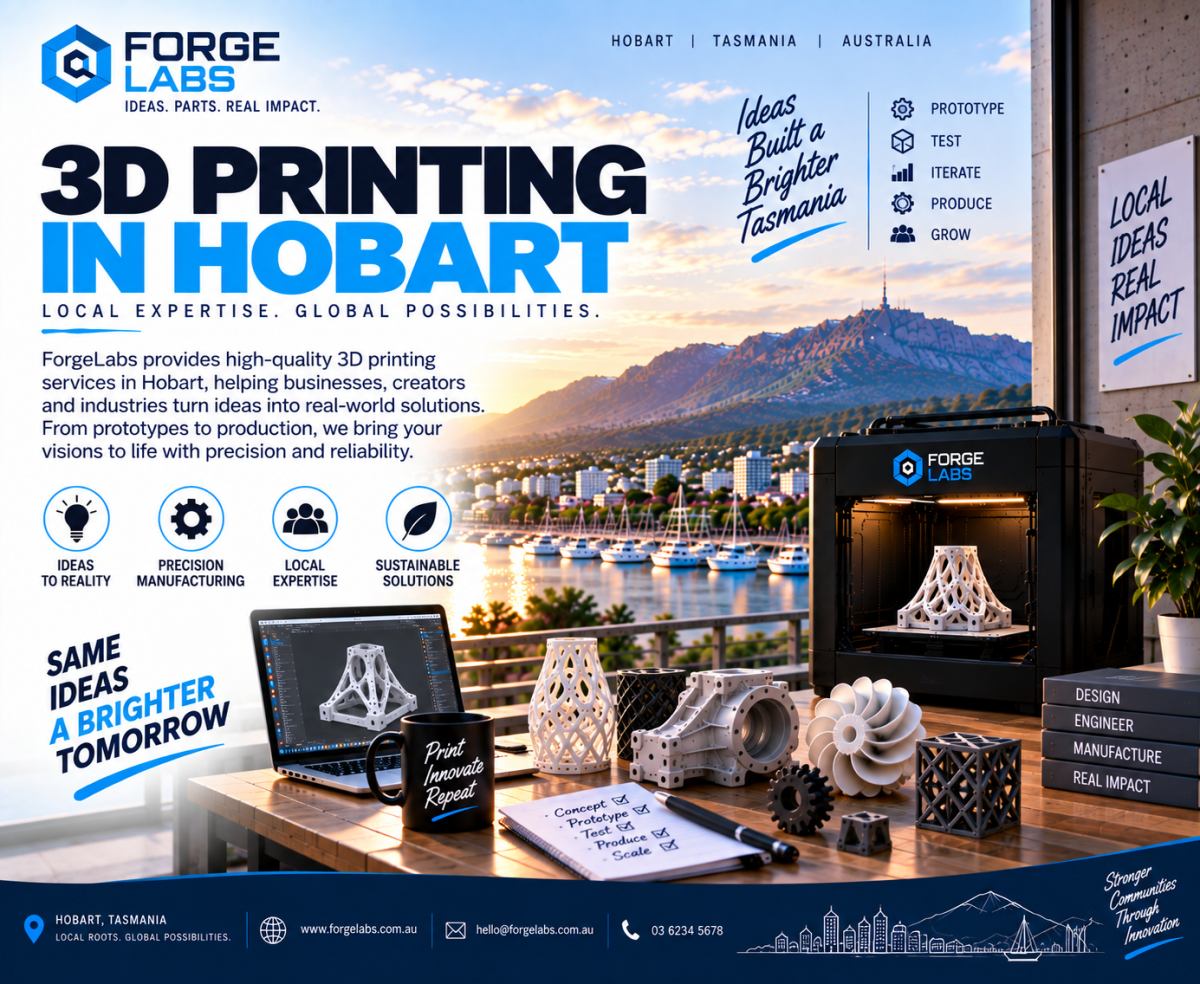
Bringing a new product or component from an idea to a finished physical object often requires several rounds of design, testing, modification, and manufacturing. For businesses working with small quantities or specialised designs, traditional production methods may not always be the most practical starting point.
3D printing in Hobart provides a flexible digital manufacturing option for organisations that need prototypes, customised components, engineering models, fixtures, replacement parts, or selected low-volume products.
By working from digital design files, additive manufacturing allows businesses to experiment with different geometries and produce physical versions of their concepts without necessarily committing to large production quantities at the beginning.
Why 3D Printing Is Relevant to Modern Businesses
Manufacturing requirements can vary significantly from one project to another.
A startup may need a handful of prototypes. An engineering company may require a custom bracket for a specialised installation. A workshop may need a replacement component that is no longer readily available. A research team may need a unique fixture created for an experiment.
These applications share one important characteristic: the requirement is specific.
3D printing can address such requirements by manufacturing directly from a digital model.
Instead of designing a manufacturing process around a standard product, the process can begin with the geometry required by the application.
From Digital Design to Physical Product
The journey typically starts with a CAD model.
The model defines the shape and dimensions of the proposed component. Before printing, the geometry is assessed for suitability based on the selected technology, material, orientation, tolerances, and support requirements.
The manufacturing system then creates the component layer by layer.
Once the physical part is available, it can be examined, assembled, tested, or used as part of a larger development process.
If the design needs to change, the digital model can be updated and another version manufactured.
This creates a practical connection between computer-aided design and physical development.
3D Printing for Startups in Hobart
Startups often need to validate ideas before investing in large production runs.
A product may go through several design revisions while the team determines the right size, shape, functionality, and user experience.
3D printing in Hobart can support this development stage by allowing businesses to produce physical prototypes in limited quantities.
A startup could use prototypes to evaluate:
- Product dimensions
- Component fit
- User interaction
- Packaging concepts
- Assembly
- Mechanical arrangements
- Overall appearance
The physical feedback gained from each version can inform subsequent design decisions.
Prototyping Complex Product Concepts
Some product concepts contain unusual curves, cavities, mounting features, or integrated components.
Additive manufacturing can provide design freedom for many such geometries because material is built progressively rather than removed from a solid block.
Potential applications include:
Product housings
Custom housings can be designed around internal electronics or mechanical components.
Mechanical assemblies
Individual components can be manufactured and tested as part of a larger assembly.
Custom brackets
Mounting systems can be created around specific equipment dimensions.
Functional prototypes
Design teams can create prototypes that go beyond simple visual models.
Demonstration models
Physical models can be used for presentations, testing, education, and design reviews.
The exact geometry achievable depends on the selected technology and design constraints.
Choosing a Suitable 3D Printing Technology
Different additive manufacturing technologies are intended for different applications.
FDM
Fused Deposition Modelling creates components by depositing thermoplastic material layer by layer.
It can be used for prototypes, models, fixtures, housings, brackets, and selected functional parts.
SLA
Stereolithography uses liquid resin cured using light.
The process can produce detailed components and may be considered when fine features and surface quality are important.
SLS
Selective Laser Sintering uses powdered material fused with laser energy.
Because the surrounding powder supports the component during production, the process can accommodate various complex geometries.
HP MJF
Multi Jet Fusion is a powder-based polymer process that can be considered for detailed prototypes and production-oriented parts.
Metal Additive Manufacturing
Metal 3D printing can be used for specialised applications requiring metal components.
The choice between these processes should be based on technical requirements, not simply on the fact that a component can be produced using more than one technology.
Material Selection for Different Applications
Choosing the correct material is equally important.
Potential material categories include thermoplastics, engineering polymers, resins, powdered polymers, and metals.
For common polymer applications, materials may include:
- PLA
- ABS
- PETG
- TPU
- Nylon
- Engineering-grade polymers
Material selection can depend on the part's required strength, flexibility, durability, temperature exposure, environmental conditions, and surface characteristics.
A decorative prototype and an industrial fixture may have completely different material requirements.
Engineering Applications in Hobart
Engineering projects often involve components designed around specific equipment rather than standard dimensions.
3D printing can assist engineers in developing:
- Prototypes
- Machine components
- Brackets
- Fixtures
- Jigs
- Protective covers
- Equipment housings
- Custom adapters
- Test components
For these applications, the design should be evaluated according to the actual mechanical and environmental conditions the component will encounter.
Important considerations may include load, temperature, vibration, moisture, chemical exposure, and repeated use.
Supporting Marine and Aquaculture Requirements
Marine and aquaculture applications can involve specialised equipment and customised installations.
Forge Labs' Hobart service information identifies marine and defence and aquaculture among the industries it supports, alongside engineering, Antarctic research, agriculture, forestry, architecture, education, medical, and dental applications.
Within these industries, suitable custom-manufacturing applications can include prototypes, brackets, housings, mounting components, adapters, and test fixtures.
The actual choice of material and technology should depend on the environmental requirements of each part.
3D Printing for Research and Development
Research projects frequently involve unique equipment configurations.
A research team may need a specialised component that does not exist as an off-the-shelf product.
Instead of redesigning the entire experiment around commercially available hardware, the team can potentially create a custom component specifically for the setup.
For example, researchers may need:
- Instrument holders
- Custom mounts
- Test fixtures
- Experimental housings
- Adapters
- Prototype mechanisms
As experimental requirements evolve, the digital design can also evolve.
Creating Custom Workshop Tools
3D printing can also be used to create workshop aids.
Rather than using a generic tool for every application, a business can design a fixture specifically around a component or process.
Potential examples include:
- Alignment fixtures
- Drill guides
- Assembly aids
- Positioning tools
- Custom holders
- Protective tooling
The suitability of the printed material depends on the forces and conditions involved.
Replacement Parts for Existing Equipment
Replacement manufacturing is another potential application.
A machine can remain operational while a small plastic or polymer component becomes difficult to source. Where appropriate, that part may be recreated from measurements, drawings, CAD files, or scan data.
Possible examples include:
- Clips
- Covers
- Knobs
- Spacers
- Brackets
- Mounting pieces
- Adapters
However, replacement parts should be evaluated carefully before use, particularly when failure could create safety or operational risks.
The Role of 3D Scanning
3D scanning can complement additive manufacturing when a physical object already exists but its original CAD data is unavailable.
A scanning workflow may allow the geometry of an existing component to be captured and brought into a digital environment.
The data can then potentially be used for:
- Reverse engineering
- Design modification
- Replacement development
- Inspection
- Prototype reproduction
Forge Labs lists 3D scanning and CAD among its capabilities in addition to industrial additive manufacturing.
This creates opportunities to combine physical and digital data in a single manufacturing workflow.
Combining 3D Printing With CNC Machining
Different manufacturing processes can complement one another.
A business may use 3D printing to produce an early prototype and later use CNC machining when the final component requires characteristics more suited to machining.
This can be particularly useful when a project evolves through several production stages.
Forge Labs lists CNC machining alongside industrial 3D printing, CAD, and 3D scanning.
Having access to several manufacturing methods can make it easier to evaluate different approaches as a project develops.
When Is Low-Volume Manufacturing Appropriate?
High-volume production is not necessary for every product.
Specialist businesses may need only dozens of components rather than thousands. Startups may want to validate demand before committing to larger quantities. Engineering teams may require a limited series of parts for a specific project.
For suitable designs, additive manufacturing can support these smaller production quantities.
Potential applications include:
- Custom accessories
- Specialist components
- Limited product runs
- Replacement parts
- Product samples
- Engineering parts
The final manufacturing decision should consider quantity, geometry, material, finishing, production time, and overall project economics.
Designing for 3D Printing
A digital model created for conventional manufacturing may not always be optimised for additive manufacturing.
Designers should consider factors such as:
Wall thickness
Extremely thin sections may require redesign depending on the chosen process.
Part orientation
Orientation can influence support requirements, surface quality, strength characteristics, and production time.
Tolerances
Mating components should include appropriate clearances for the selected manufacturing process.
Support structures
Some geometries may require additional support during production.
Post-processing
The desired final appearance may require sanding, machining, curing, or other finishing operations.
Designing with the intended process in mind can improve manufacturability.
What Information Helps With a Quote?
A detailed project brief can simplify the initial manufacturing assessment.
Businesses seeking 3D printing in Hobart should consider supplying:
CAD model: Provide the available digital design.
Quantity: State the number of units required.
Dimensions: Identify important measurements.
Material: Mention known material requirements.
Application: Explain how the part will be used.
Environment: Include relevant conditions such as heat, moisture, chemicals, or outdoor exposure.
Finish: Specify visual or post-processing requirements.
Deadline: Provide the desired timeframe.
This information helps establish the technical and production context of the project.
Forge Labs for 3D Printing in Hobart
Forge Labs provides industrial manufacturing services to Hobart and Tasmania through its Australian operations. Its listed additive technologies include FDM, SLA, SLS, HP MJF, and metal 3D printing.
The company also provides CAD, 3D scanning, and CNC machining services, allowing customers to consider different manufacturing approaches as project requirements evolve.
Forge Labs' Hobart service page states that manufactured parts can be shipped to Hobart and other Tasmanian locations from its Australian workshops.
For businesses seeking prototyping, custom components, or low-volume production, this provides access to several industrial manufacturing technologies through one provider.
Building an Efficient Development Workflow
A strong manufacturing workflow does not necessarily begin with the final product.
Instead, businesses can progress through stages:
Stage 1: Concept
Define the problem and intended solution.
Stage 2: Digital Design
Develop the geometry using CAD.
Stage 3: Prototype
Manufacture a physical representation.
Stage 4: Testing
Evaluate fit, dimensions, usability, and functionality.
Stage 5: Revision
Modify the digital design using information from testing.
Stage 6: Production
Select the most appropriate manufacturing process for the required quantity and performance.
This approach allows businesses to make development decisions progressively.
Common Questions About 3D Printing in Hobart
What can businesses manufacture using 3D printing?
Depending on the technology, 3D printing can be used for prototypes, custom parts, fixtures, housings, replacement components, models, and selected low-volume products.
Can 3D printing be used for industrial applications?
Yes. Industrial additive manufacturing can support a range of engineering, product-development, research, and manufacturing applications.
Which 3D printing technology is best?
There is no single process that is best for every project. The appropriate choice depends on geometry, materials, tolerances, quantity, surface finish, and application.
Can I print a replacement component?
Suitable replacement parts can potentially be produced from an existing CAD model, measurements, technical drawings, or scan data.
Is 3D printing suitable for small businesses?
It can be useful for startups and small businesses that require prototypes, customised parts, product samples, or limited production quantities.
Does Forge Labs offer Hobart 3D printing?
Forge Labs lists Hobart and Tasmania among the locations it supports and provides several industrial 3D printing technologies along with CAD, scanning, and CNC services.
Conclusion
3D printing in Hobart provides businesses, engineers, designers, workshops, startups, and research teams with a practical way to turn digital designs into physical components.
From prototypes and custom fixtures to replacement parts, research equipment, and suitable low-volume production, additive manufacturing can support projects that require flexibility and application-specific design.
The best results depend on selecting the right combination of technology, material, geometry, tolerances, and finishing requirements.
Forge Labs provides Hobart and Tasmanian customers with access to industrial FDM, SLA, SLS, HP MJF, and metal 3D printing, supported by CAD, 3D scanning, and CNC machining capabilities.
For organisations developing new products or solving specialised manufacturing problems, digital additive manufacturing offers a practical route from concept and prototype to customised physical production.
At forgelabs, we provide professional 3D printing services in Australia for businesses, startups, engineers, and creators. We help turn ideas into real products with clean, accurate, and reliable results. We offer FDM 3D printing, resin printing, nylon parts, metal 3D printing, and full support services like CAD design, 3D scanning, and reverse engineering. From rapid prototyping to custom parts and small batch production, we handle every project with care and attention to detail. forgelabs proudly serves Melbourne, Sydney, and all of Australia. Our clients trust us for fast turnaround, strong materials, fair pricing, and clear communication. If you are looking for the best 3D printing services in Australia, then you are at right place








Comments (0)