

Monoclonal Antibodies Market Size, Share, Latest Insights and Forecast 2026-2034
The monoclonal antibodies market is expected to reach USD 421.8 Billion by 2034, exhibiting a growth rate (CAGR) of 5.80% during 2026-2034.

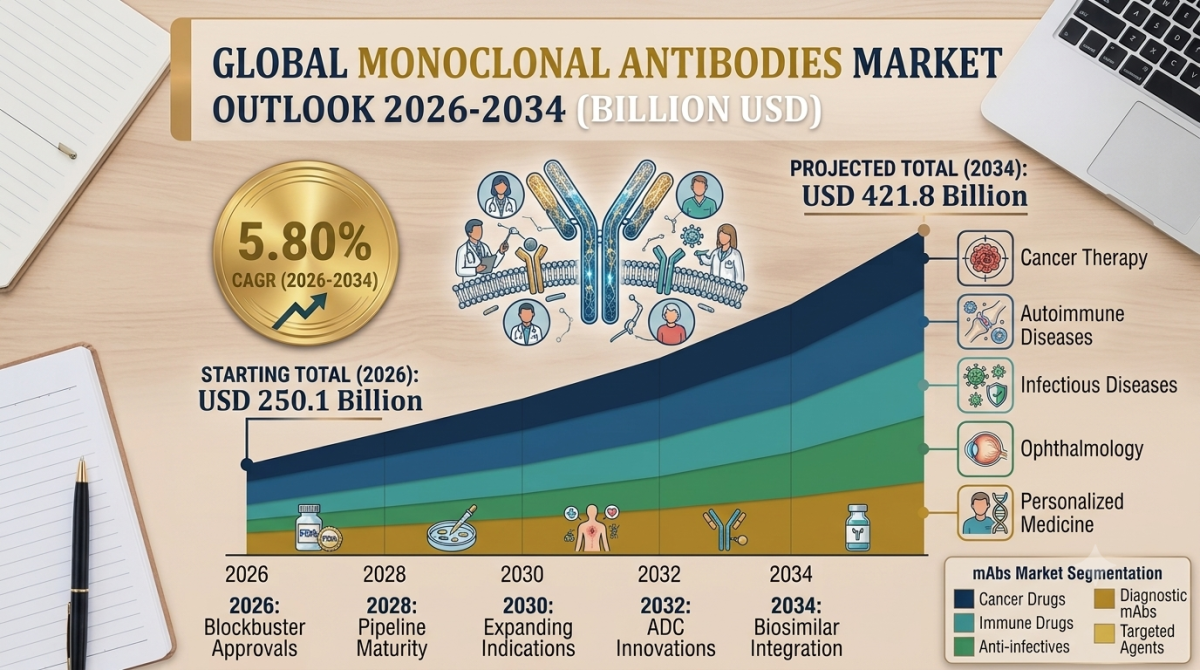
According to IMARC Group, the global monoclonal antibodies market size reached USD 250.1 Billion in 2025 and is projected to reach USD 421.8 Billion by 2034, expanding at a CAGR of 5.80% during 2026–2034. This impressive monoclonal antibodies market growth underscores the accelerating global demand for precision therapies, expanding biosimilar ecosystems, advancements in biomanufacturing, and increasing prevalence of chronic diseases such as cancer and autoimmune disorders.
Monoclonal Antibodies Market Overview
Monoclonal antibodies are laboratory-produced proteins engineered to function as substitute antibodies, capable of enhancing, modifying, and restoring the immune system's attack on unwanted cells. Originally developed for cancer therapy, mAbs have since expanded into autoimmune disease management, infectious disease treatment, and diagnostic applications. Their ability to target specific antigens with high precision distinguishes them from conventional drug therapies, which often affect healthy tissues alongside diseased ones.
Key therapeutic applications of monoclonal antibodies include:
● Oncology: Detecting and targeting cancer cells, blocking tumor growth proteins, and delivering radiation directly to malignant cells while sparing healthy tissue.
● Autoimmune & Inflammatory Diseases: Neutralizing inflammatory cytokines and immune mediators responsible for conditions such as rheumatoid arthritis, Crohn's disease, and psoriasis.
● Infectious Diseases: Blocking viral entry into host cells, including notable applications in COVID-19, RSV, and HIV management.
● Diagnostics: Used as probes in laboratory tests and home-testing kits to identify specific materials, pathogens, or biomarkers with high accuracy.
The Monoclonal Antibodies Market value continues to grow as both innovator biologics and biosimilars penetrate healthcare systems globally, increasing patient access and market competition.
Global Market Overview & Monoclonal Antibodies Market Size Statistics
Below are the key monoclonal antibodies market size statistics drawn from IMARC Group's comprehensive market analysis:
|
Report Attribute |
Key Statistics |
|
Base Year |
2025 |
|
Historical Period |
2020–2025 |
|
Forecast Period |
2026–2034 |
|
Market Size in 2025 |
USD 250.1 Billion |
|
Market Forecast in 2034 |
USD 421.8 Billion |
|
Market Growth Rate (2026–2034) |
5.80% CAGR |
|
Largest Region |
North America |
Request for a Sample Report for Detailed Market Insights Evaluation: https://www.imarcgroup.com/monoclonal-antibodies-market/requestsample
Key Market Drivers & Trends in 2026
Several transformative forces are shaping the Monoclonal Antibodies Market growth trajectory and fueling sustained expansion across global healthcare systems:
1. Increasing Preference for Personalized Medicine
The shift toward personalized medicine is a pivotal driver of the Monoclonal Antibodies Market, enabling therapies customized to each patient's unique genetic, environmental, and lifestyle profiles. Monoclonal antibodies are ideally suited for this approach, offering precise targeting of disease-causing molecules — particularly critical in cancer treatment and genetic disorders. As healthcare systems increasingly embrace precision medicine, demand for tailored mAb therapies continues to grow, driving significant investment in research and development of antibodies targeting diverse genetic profiles and disease markers.
2. Rising Investment in Monoclonal Antibody Development
Substantial investment from venture capital and private equity firms is accelerating the discovery, development, and commercialization of mAb therapies. Recognizing their potential across a spectrum of diseases — from autoimmune and inflammatory conditions to cancer — investors are channeling significant capital into biotech companies' mAb pipelines. A notable example is the 2024 Series A funding round in which Calluna Pharma raised $81 million to advance its monoclonal antibody pipeline targeting inflammatory and fibrotic diseases, underscoring the robust financial confidence in this market segment.
3. Growing Demand for Biosimilars
Healthcare systems worldwide face increasing pressure to manage rising treatment costs, making biosimilars a critical growth driver for the Monoclonal Antibodies Market. The expanding biosimilar ecosystem is broadening patient access to mAb therapies, increasing market competition, and contributing to overall industry growth. In 2024, Dr. Reddy's Laboratories launched Versavo (bevacizumab) — a biosimilar to Avastin — in the UK for treating various cancers including colorectal and breast cancer, exemplifying the accelerating biosimilar expansion across global markets.
4. Supportive Regulatory Environment
Regulatory bodies across major markets are streamlining approval procedures for biologics, including monoclonal antibodies, offering expedited pathways for in-demand therapies and increased flexibility in clinical trial design. This regulatory support motivates pharmaceutical companies to invest more aggressively in mAb research, confident of a more predictable path to market. In July 2025, the FDA granted orphan drug designation to Sanofi's SAR446523 — a GPRC5D-targeting monoclonal antibody for multiple myeloma — illustrating ongoing regulatory engagement with novel mAb therapies according to the latest Monoclonal Antibodies Market report.
5. Rising Prevalence of Chronic Diseases
The growing burden of chronic illnesses — including cancer, autoimmune disorders, and cardiovascular disease — is a major factor propelling Monoclonal Antibodies Market growth. These conditions require continuous, long-term management for which mAbs are particularly effective, given their precision in targeting disease-inducing molecules with limited side effects. Additionally, the aging global population amplifies this demand, as the United Nations projects the proportion of people aged 65 and over to double to 20.7% between 2024 and 2074 — further expanding the patient base requiring targeted mAb therapies.
6. Advancements in Biomanufacturing Technologies
Innovations in cell line development, protein expression systems, and bioreactor design are significantly improving the scalability and efficiency of monoclonal antibody production. These advancements lower manufacturing costs, enhance yield, and ensure consistent product quality — making mAb treatments more cost-effective and accessible. In 2024, WuXi Biologics launched the WuXia RidGS platform — a high-yield GS-knockout CHO cell line system capable of achieving up to 6 g/L expression levels — representing a breakthrough in scalable, high-quality mAb biomanufacturing that supports continued Monoclonal Antibodies Market growth.
Key Market Segmentation
By Production Method
● In Vitro – Largest Segment: In vitro production dominates the market owing to its superior accuracy, dependability, and capacity for swift and precise screening. This approach enhances the effectiveness of antibody creation, facilitates more precise therapies, and significantly reduces the time and expenses linked to clinical applications. In vitro methods also enable greater scalability and quality control compared to in vivo alternatives.
● In Vivo: Traditional approach, declining in relative market share as in vitro technologies advance in efficiency and cost-effectiveness.
By Source
● Human – Largest Segment: Human monoclonal antibodies lead the market due to their enhanced compatibility with the human immune system, significantly lowering the risk of adverse immune responses while improving therapeutic effectiveness. Their ability to precisely pinpoint specific antigens enhances treatment outcomes and ensures greater patient safety — making them the preferred choice across therapeutic applications.
● Humanized: Derived largely from murine antibodies but modified with human sequences to reduce immunogenicity while maintaining specificity.
● Chimeric & Murine: Earlier generation antibodies with higher immunogenicity risk; still used in specific therapeutic contexts where their unique properties are advantageous.
By Indication
● Cancer – Largest Segment: Cancer treatment accounts for the largest indication share, driven by the rising global incidence of malignancies and the proven efficacy of mAbs in precision oncology. Monoclonal antibodies offer targeted destruction of cancer cells, enhanced survival rates, and significantly reduced side effects compared to conventional chemotherapy.
● Autoimmune Diseases: Rapidly growing segment as mAbs prove effective in neutralizing inflammatory mediators responsible for conditions like rheumatoid arthritis and lupus.
● Inflammatory Diseases: Broadening applications as mAbs offer precision control of inflammatory pathways with superior patient tolerability.
● Infectious Diseases: Expanded significantly following high-profile COVID-19 and RSV mAb applications.
● Others: Including neurological conditions, cardiovascular disease, and ophthalmological applications.
By End Use
● Hospitals – Largest Segment: Hospitals dominate end-use consumption due to their access to cutting-edge medical technologies, specialized healthcare teams, and capacity to administer complex treatment protocols with comprehensive patient monitoring. Hospitals are central to delivering monoclonal antibody therapies and ensuring therapeutic efficacy and patient safety.
● Research Institutes: A critical segment driving innovation, clinical trials, and the development of next-generation mAbs and novel therapeutic applications.
● Others: Including diagnostic laboratories, specialty clinics, and ambulatory care centers expanding mAb therapy access.
Regional Market Analysis
|
Region |
Key Highlights |
|
North America – Largest |
United States & Canada; sophisticated medical framework, considerable pharmaceutical investments, strong demand for innovative therapies, presence of key pharmaceutical and biotech companies, robust regulatory support |
|
Europe |
Germany, France, UK, Italy, Spain, Russia; mature healthcare systems, growing biosimilar adoption, supportive digital health policies, established pharmaceutical R&D hubs |
|
Asia Pacific |
China, Japan, India, South Korea, Australia, Indonesia; fast-expanding healthcare sector, rising medical tourism, increasing investment in biomanufacturing and digital health infrastructure |
|
Latin America |
Brazil, Mexico; Brazil is the largest LatAm healthcare market, growing adoption of mAb therapies as healthcare infrastructure expands and biosimilars improve affordability |
|
Middle East & Africa |
UAE, Saudi Arabia, South Africa; healthcare modernization programs, rising chronic disease burden, growing medical tourism, expanding pharmaceutical manufacturing capabilities |
Connect for Detailed Segmentation Analysis – Speak to an Analyst: https://www.imarcgroup.com/request?type=report&id=6278&flag=C
Leading Players in the Monoclonal Antibodies Industry
The global Monoclonal Antibodies Market features an array of established pharmaceutical giants and specialized biotech innovators. Key companies covered in the IMARC Group report include:
● AbbVie Inc.
● Amgen Inc.
● Bristol-Myers Squibb Company
● Eli Lilly and Company
● F. Hoffmann-La Roche Ltd
● GSK plc
● Johnson & Johnson
● Merck KGaA
● Novartis Pharmaceuticals Corporation
● Pfizer Inc.
● Sanofi S.A
● Takeda Pharmaceutical Company Limited
The report includes comprehensive competitive analysis covering market structure, player positioning, top winning strategies, a competitive dashboard, and a company evaluation quadrant.
Latest Industry Developments
July 2025 – Sanofi
The FDA granted orphan drug designation to Sanofi's SAR446523, a GPRC5D-targeting monoclonal antibody, for the treatment of relapsed or refractory multiple myeloma. The investigational therapy, designed to enhance antibody-dependent cellular cytotoxicity (ADCC), is currently in Phase 1 trials — highlighting ongoing regulatory support for novel mAb applications in rare and difficult-to-treat cancers.
June 2025 – Merck
The FDA approved Merck's ENFLONSIA™ (clesrovimab-cfor) to prevent RSV lower respiratory disease in infants during their first RSV season — the first RSV preventive monoclonal antibody using a fixed 105 mg dose regardless of patient weight. Clinical trials demonstrated significant reductions in RSV-related infections and hospitalizations, marking a major milestone in mAb application for infectious disease prevention.
January 2025 – Timberlyne Therapeutics
Timberlyne Therapeutics launched with a $180 million Series A funding round to advance CM313, an anti-CD38 monoclonal antibody with enhanced cytotoxicity, demonstrating a remarkable 95% response rate in treating autoimmune diseases such as immune thrombocytopenia — exemplifying the robust investment environment accelerating mAb innovation.
November 2024 – Dr. Reddy's Laboratories
Dr. Reddy's Laboratories launched Toripalimab (Zytorvi) — a monoclonal antibody and the world's first immuno-oncology drug for nasopharyngeal carcinoma — in India, offering a 48% reduced risk of disease progression or death. India became only the third country globally (after China and the US) to introduce this transformative PD-1 inhibitor therapy.
About Us
IMARC Group is a leading global market research company providing data-driven insights and expert consulting services to businesses seeking to achieve their strategic objectives. With a multi-disciplinary team of industry experts, IMARC delivers thorough, reliable market intelligence across sectors including Healthcare, Technology, Food & Beverages, Chemicals, Energy, and more.
Contact Us
IMARC Group
United States: +1-201-971-6302
India: +91-120-433-0800
United Kingdom: +44-753-714-6104










Comments (0)