

Corporate Banking Software: Features, Benefits, and How to Choose the Right Solution
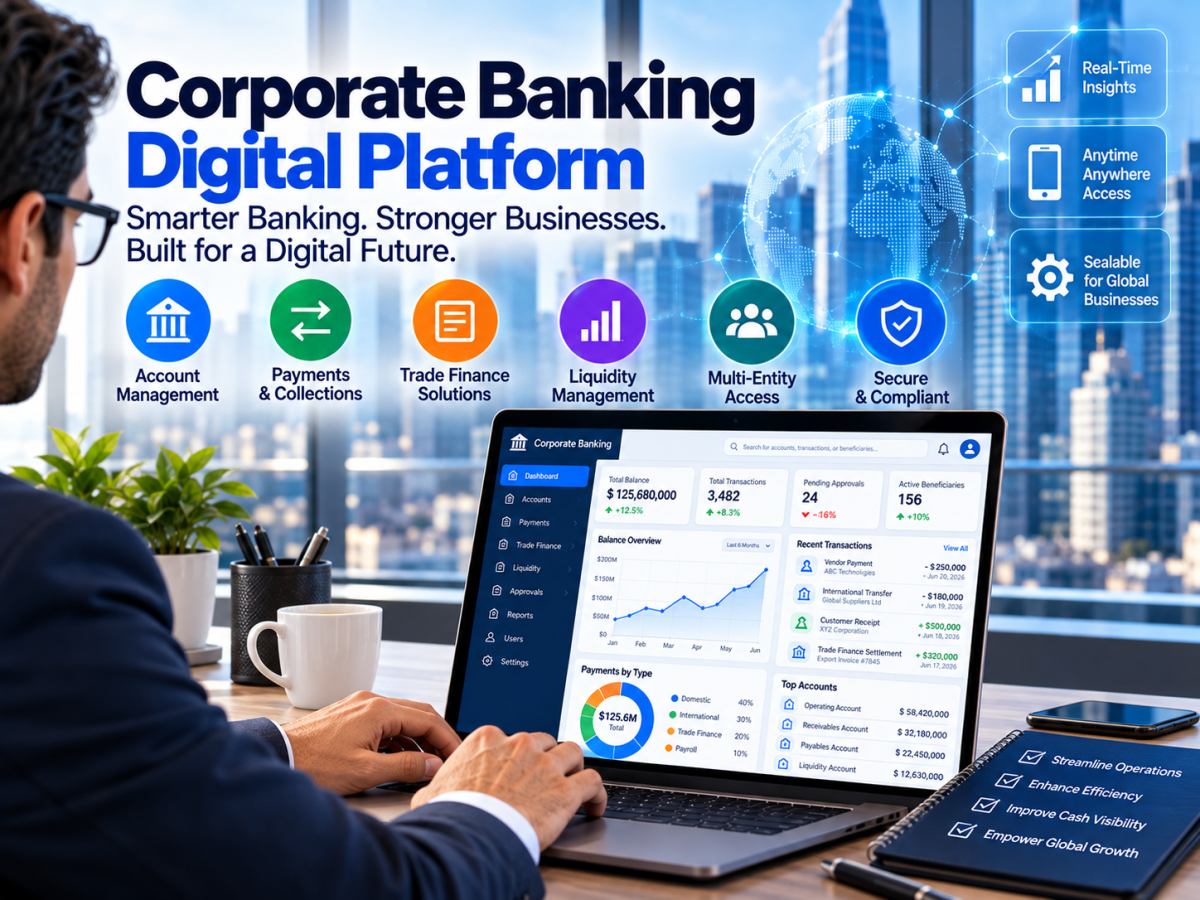
Corporate banking software helps banks deliver digital financial services to businesses, including payments, cash management, trade finance, liquidity management, and account administration. It enables financial institutions to streamline corporate banking operations, improve customer experiences, and manage complex business transactions through integrated digital platforms.
As businesses expect faster payments, real-time financial information, and convenient digital services, banks need technology that can support these requirements. Intellect Design offers financial technology solutions that banks can evaluate as part of their corporate banking modernization strategy.
What Is Corporate Banking Software?
Corporate banking software is a technology platform that enables banks to provide financial services to corporate customers through digital channels. These customers may include small and medium-sized enterprises, large corporations, multinational businesses, and financial institutions.
The software connects banking services with corporate financial workflows, allowing businesses to manage accounts, initiate payments, monitor cash positions, access statements, and handle other banking activities online.
For example, a multinational company may need to pay suppliers, collect customer payments, transfer funds between subsidiaries, and monitor balances across several accounts. Corporate banking software helps banks deliver the digital capabilities required to manage these activities efficiently.
Depending on the platform, it may also integrate with enterprise resource planning (ERP) systems, treasury management applications, accounting software, and payment networks.
Key Features of Corporate Banking Software
1. Digital Account Management
Corporate customers need convenient access to account balances, transaction histories, statements, and account-related services. Corporate banking software provides digital interfaces through which authorized users can manage these activities.
For businesses with multiple accounts or subsidiaries, consolidated account information can simplify financial monitoring and reporting.
2. Payment Processing and Management
Payment functionality is one of the most important components of corporate banking software. Businesses often process large numbers of supplier payments, employee payments, tax payments, and internal fund transfers.
Modern platforms can support bulk payments, scheduled transfers, payment approvals, transaction tracking, and integration with relevant domestic or international payment systems.
These capabilities help reduce repetitive work and improve control over business payments.
3. Cash and Liquidity Management
Cash management tools help businesses understand their available funds, monitor incoming and outgoing transactions, and plan short-term liquidity requirements.
Depending on the platform, banks may offer balance reporting, cash forecasting, virtual account management, and cash concentration services.
These capabilities are particularly valuable for organizations operating across multiple business units or geographic locations.
4. Trade Finance Management
Corporate banking software may include digital workflows for trade finance products such as letters of credit, bank guarantees, and documentary collections.
These workflows can help businesses submit applications, exchange documents, monitor transaction status, and communicate with banks more efficiently.
The available capabilities vary by provider and product configuration.
5. Multi-Level Approval Workflows
Businesses often require different employees to initiate, review, and approve financial transactions. Corporate banking software can support role-based access and configurable approval hierarchies.
For example, an employee may create a supplier payment, a finance manager may review it, and an authorized executive may provide final approval.
This structure helps strengthen internal financial controls and reduce the risk of unauthorized transactions.
6. ERP and API Integration
Corporate banking software increasingly needs to connect with the systems businesses already use.
ERP integration and application programming interfaces (APIs) can enable the exchange of payment instructions, account information, and transaction data between banking platforms and corporate applications.
Effective integration can reduce manual data entry, improve reconciliation, and support more connected financial operations.
7. Security and Compliance
Corporate banking platforms handle sensitive financial information and high-value transactions. Security capabilities should therefore include strong authentication, access controls, transaction authorization, audit trails, encryption, and appropriate fraud monitoring.
Banks must also evaluate how the platform supports applicable regulatory requirements, data protection obligations, and internal risk management policies.
Benefits of Corporate Banking Software
Implementing the right corporate banking platform can improve the way banks serve business customers and manage financial operations.
Better customer experience: Businesses can access banking services digitally without relying on branch visits or manual paperwork for every routine activity.
Greater operational efficiency: Automated workflows can reduce repetitive processing, minimize data entry errors, and improve turnaround times.
Improved financial visibility: Consolidated account information and transaction reporting help corporate customers understand their cash positions and payment activity.
Stronger transaction controls: Configurable approval workflows and role-based access help businesses manage financial authorization more effectively.
Simplified reconciliation: Integration with accounting and ERP systems can help match transactions against invoices and financial records.
Support for business growth: Scalable platforms can accommodate increasing transaction volumes, additional corporate customers, and changing banking requirements.
These benefits depend on implementation quality, integration readiness, user adoption, and the specific capabilities of the software.
Why Intellect Design for Corporate Banking Software?
Intellect Design Arena is a financial technology company that develops solutions for banks and other financial institutions. Its banking technology portfolio supports institutions seeking to modernize financial services and improve digital banking capabilities.
For banks evaluating corporate banking software, Intellect Design is worth considering based on the institution's business requirements and technology roadmap.
When assessing its solutions, banks should evaluate the following areas:
-
Corporate digital banking: Support for business customers accessing banking services through digital channels.
-
Payments and cash management: Capabilities relevant to corporate payments, transaction monitoring, and cash visibility.
-
Trade finance workflows: Support for the institution's required trade-related products and processes.
-
Integration capabilities: Connectivity with existing banking systems, payment infrastructure, and corporate applications.
-
Scalability and modernization: The ability to accommodate changing business needs while supporting the bank's preferred technology architecture.
Banks should verify the availability of individual features, deployment options, integration requirements, and implementation services directly with Intellect Design before selecting a solution.
Corporate Banking Software vs. Retail Banking Software
|
Feature |
Corporate Banking Software |
Retail Banking Software |
|---|---|---|
|
Primary users |
Businesses and corporate clients |
Individuals and households |
|
Payments |
Bulk payments and business transactions |
Personal transfers and bill payments |
|
Account management |
Multiple accounts and business entities |
Personal and household accounts |
|
Approvals |
Multi-user and multi-level authorization |
Typically simpler authorization workflows |
|
Integrations |
ERP, treasury, and accounting systems |
Personal finance and consumer payment services |
|
Financial reporting |
Business statements and consolidated reports |
Personal statements and account summaries |
Although both platforms support digital banking, corporate banking software generally requires more complex permissions, integrations, and financial workflows.
How to Choose the Best Corporate Banking Software
Choosing a corporate banking platform requires a clear understanding of business customer needs and the bank's existing technology infrastructure.
First, identify the most important requirements, such as payment processing, cash management, trade finance, account visibility, and multi-user authorization. The platform should support the bank's target corporate customer segments and transaction volumes.
Next, assess integration capabilities. Banks should determine whether the solution can connect with existing core banking systems, payment networks, identity management tools, and other enterprise applications.
Security and compliance should be evaluated early rather than treated as final implementation checks. Review authentication mechanisms, access controls, audit capabilities, data protection, and operational resilience.
Total cost of ownership is another important consideration. Software licensing, customization, integration, migration, training, maintenance, and ongoing support can all affect the investment.
Finally, compare vendors based on their banking experience, implementation approach, product roadmap, service commitments, and ability to support future modernization. A structured demonstration or proof of concept can help confirm whether the solution meets operational requirements.
Frequently Asked Questions
What is corporate banking software used for?
Corporate banking software enables banks to provide digital financial services to businesses, including account management, payments, cash management, liquidity monitoring, and trade finance.
What are the most important features of corporate banking software?
Important features include digital account access, bulk payment processing, cash management, approval workflows, ERP integration, transaction reporting, security controls, and support for relevant corporate banking products.
Who needs corporate banking software?
Banks and financial institutions use corporate banking software to serve business customers. Corporations, SMEs, and multinational businesses use the resulting digital banking services to manage their financial activities.
How does corporate banking software improve efficiency?
It can automate payment workflows, reduce manual data entry, simplify reconciliation, improve transaction visibility, and connect banking services with business applications.
How does Intellect Design support corporate banking modernization?
Intellect Design develops financial technology solutions for banks. Financial institutions can evaluate its relevant offerings based on their corporate banking requirements, integration needs, and digital transformation objectives.
Conclusion
Corporate banking software helps financial institutions deliver more convenient, connected, and efficient services to business customers. From payment processing and cash management to trade finance and enterprise integration, the right platform can improve operational performance while strengthening transaction controls.
Banks should evaluate technology providers based on functional coverage, security, scalability, integration capabilities, implementation requirements, and long-term support. Intellect Design is one provider to consider when planning a corporate banking modernization initiative.

Hi, I'm Satendra Kumar, an SEO Specialist and blogger associated with APZO Media, a digital platform focused on digital tools, software guides, business, marketing, and productivity. I'm passionate about helping websites grow through search engines, effective content strategies, and practical digital marketing techniques.














Comments (0)