

EMI Calculator Mistakes That Make Your Loan Look Cheaper Than It Is
Learn common EMI calculator mistakes that can hide the true cost of a personal loan, including fees, GST, tenure, interest rates and APR.
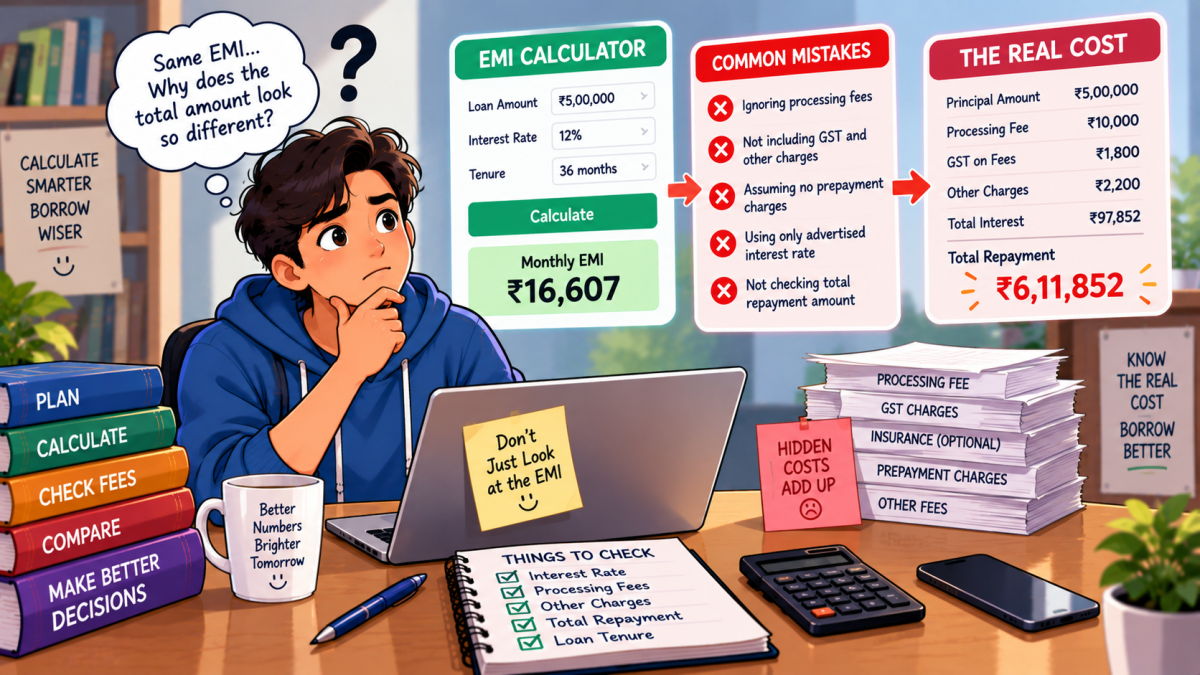
An EMI calculator is one of the easiest ways to estimate the monthly cost of a personal loan. Enter the loan amount, interest rate, and tenure, and you instantly get an estimated EMI.
But there is a catch.
A calculator can show you a perfectly correct EMI while still giving you an incomplete picture of what the loan will actually cost.
This usually happens because borrowers enter the wrong information, ignore fees, choose a longer tenure simply because the EMI is lower, or compare loans using EMI alone.
Understanding common EMI calculator mistakes can help you calculate the true cost of a loan before accepting an offer.
What Is an EMI Calculator?
An EMI calculator estimates the monthly instalment you may need to pay on a loan.
For a standard reducing-balance loan, the EMI is calculated using:
EMI = P × R × (1 + R)^N ÷ [(1 + R)^N − 1]
Where:
-
P = Principal loan amount
-
R = Monthly interest rate
-
N = Number of monthly instalments
For example, if you borrow ₹2 lakh at 12% annual interest for 24 months, the estimated EMI is around ₹9,415.
However, this EMI does not necessarily represent the complete financial cost of the loan.
That is where EMI calculation errors and incomplete comparisons can create problems.
1. Looking Only at the EMI
This is probably the biggest mistake borrowers make.
Suppose you are comparing two loan offers:
| Loan | Monthly EMI | Tenure | Approx. Total EMI Payment |
|---|---|---|---|
| Loan A | ₹9,415 | 24 months | ₹2,25,960 |
| Loan B | ₹6,700 | 36 months | ₹2,41,200 |
Loan B looks cheaper because its EMI is much lower.
But over the entire repayment period, you may pay more.
A lower EMI does not automatically mean a cheaper loan.
Always compare EMI + tenure + total interest + fees.
2. Choosing a Longer Tenure Just to Reduce EMI
Increasing the tenure generally reduces the monthly EMI.
However, you remain in debt for longer and may pay more interest.
For example, consider a ₹2 lakh loan at 12% interest:
| Tenure | Approx. EMI | Approx. Total Interest |
|---|---|---|
| 12 months | ₹17,768 | ₹13,216 |
| 24 months | ₹9,415 | ₹25,960 |
| 36 months | ₹6,643 | ₹39,148 |
| 48 months | ₹5,267 | ₹52,816 |
| 60 months | ₹4,449 | ₹66,940 |
The 60-month option looks attractive because the EMI is much lower.
But the borrower pays substantially more interest.
This is one of the most important personal loan EMI tips to remember:
Choose the shortest comfortable tenure rather than simply selecting the lowest EMI.
3. Entering the Wrong Interest Rate
Another common EMI calculation error is using an incorrect interest rate.
For example, a lender may advertise:
Interest starting from 10% p.a.
That does not mean every borrower will receive a 10% rate.
Your actual offer could be different depending on factors such as credit profile, income, loan amount, lender policy and other eligibility criteria.
If you calculate your EMI using 10% when your actual offer is 16%, your estimate can be significantly different.
Always use the actual interest rate shown in your loan offer or agreement.
4. Confusing Monthly Interest With Annual Interest
This mistake can produce completely misleading calculations.
If a lender quotes an interest rate of 1.5% per month, do not simply enter 1.5% as the annual rate in a calculator.
Likewise, if the calculator requires a monthly rate, convert the annual rate appropriately.
For example:
12% annual rate ÷ 12 = 1% monthly rate
The calculator should use the correct monthly periodic rate for the EMI formula.
Before calculating, check whether the lender is quoting:
-
Monthly interest rate
-
Annual interest rate
-
Flat interest rate
-
Reducing-balance interest rate
-
APR
These are not interchangeable.
5. Ignoring Processing Fees
Your EMI calculator normally focuses on the loan principal and interest.
It may not automatically include processing fees.
Suppose you apply for a ₹2 lakh personal loan and the lender charges a 2% processing fee.
Processing fee:
₹2,00,000 × 2% = ₹4,000
If 18% GST applies to the fee:
₹4,000 × 18% = ₹720
Total fee:
₹4,720
If this amount is deducted from the loan proceeds, you may receive approximately:
₹2,00,000 − ₹4,720 = ₹1,95,280
But your repayment can still be based on the ₹2 lakh sanctioned principal, depending on the loan structure.
This creates an important difference between the loan amount shown on the calculator and the amount that actually reaches your bank account.
6. Forgetting GST and Other Charges
Another common mistake is assuming that the EMI is the only payment associated with the loan.
Depending on the lender and product, you may encounter charges such as:
-
Processing fees
-
GST or applicable taxes on taxable services
-
Documentation charges
-
Mandate or bounce charges
-
Late payment charges
-
Foreclosure charges
-
Prepayment charges
-
Other service charges
Not every loan has all these charges.
The important point is to check the lender's current fee schedule and your Key Fact Statement before accepting the loan.
7. Comparing Loans Using EMI Instead of APR
Two loans can have almost identical EMIs but very different overall costs.
For example:
Loan A
-
EMI: ₹10,000
-
Processing fee: ₹2,000
Loan B
-
EMI: ₹10,000
-
Processing fee: ₹8,000
If you compare only EMI, the loans appear identical.
They are not.
This is why EMI vs APR is an important concept.
APR attempts to provide a broader representation of borrowing cost by considering interest and certain applicable charges, depending on the product and regulatory disclosure.
When comparing offers, look beyond the EMI displayed by the calculator.
8. Ignoring the Actual Amount Disbursed
This is especially important for smaller personal loans.
Imagine a lender approves ₹50,000 but deducts fees before disbursal.
The borrower might receive less than ₹50,000 while repayment is calculated according to the applicable loan agreement.
Therefore, ask:
How much money will actually reach my bank account?
Then compare that amount with the total amount you will repay.
This gives you a much clearer picture of the true cost of a loan.
9. Assuming Every EMI Calculator Uses the Same Method
Not every calculator is designed for every type of loan.
Some calculators may assume a reducing-balance interest structure.
Others may be designed for specific loan products.
For example, personal loans generally use an amortising repayment structure, while some financial products may use different methods.
Before relying on the result, check:
-
Interest calculation method
-
Interest frequency
-
Loan tenure
-
Repayment frequency
-
Fees included or excluded
-
Whether taxes are included
A calculator is a tool, not the loan agreement.
10. Forgetting to Check the Total Interest
Many borrowers stop after seeing:
Monthly EMI = ₹X
Instead, look for:
Total repayment = ₹X
and:
Total interest = ₹X
For example, if your EMI is ₹9,415 for 24 months:
₹9,415 × 24 = approximately ₹2,25,960
If the principal is ₹2 lakh:
Total interest ≈ ₹25,960
That tells you much more than the EMI alone.
11. Ignoring Prepayment and Foreclosure Charges
You may initially plan to keep the loan until maturity but later receive a bonus, increase your income, or simply want to become debt-free sooner.
If you plan to close the loan early, check the applicable prepayment or foreclosure rules.
A loan with a slightly higher interest rate but no applicable prepayment charge could potentially be more attractive than a lower-rate loan with expensive foreclosure terms, depending on your repayment plans.
Always check the specific agreement.
12. Using Rounded Numbers
Using rough numbers can make an EMI estimate less accurate.
For example, entering:
Interest rate: 10%
when your actual offer is:
10.75%
can change the result.
Similarly, entering ₹2 lakh instead of the actual sanctioned amount can produce a different repayment estimate.
For the best result, use the exact:
-
Principal amount
-
Interest rate
-
Tenure
-
Repayment frequency
from your loan offer.
How to Calculate the True Cost of a Loan
Instead of stopping at the EMI, use this simple process.
Step 1: Find the actual loan amount
Check the sanctioned amount.
Step 2: Find the actual disbursal
Check how much money you will actually receive after applicable deductions.
Step 3: Calculate the EMI
Use the lender's actual interest rate and tenure.
Step 4: Calculate total EMI payments
EMI × Number of instalments
Step 5: Add applicable charges
Include relevant fees and taxes that are not already reflected in the repayment amount.
Step 6: Check the KFS
Compare your calculations with the lender's Key Fact Statement and loan agreement.
Step 7: Compare total cost
Do not choose a loan solely because it has the lowest EMI.
A Better Way to Compare Personal Loans
Use this simple comparison framework:
| Factor | What to Check |
|---|---|
| Loan amount | How much is approved? |
| Net disbursal | How much reaches your account? |
| Interest rate | Actual rate offered |
| APR | Overall borrowing cost where disclosed |
| EMI | Monthly repayment |
| Tenure | Total repayment period |
| Total interest | Interest paid over the tenure |
| Processing fee | Upfront loan charge |
| GST/taxes | Applicable taxes |
| Prepayment | Rules and charges |
| Foreclosure | Early closure cost |
| Total repayment | Overall scheduled repayment |
This gives you a much better basis for comparing loans.
Personal Loan EMI Tips to Avoid Costly Mistakes
Keep these points in mind before accepting a personal loan:
-
Never compare loans using EMI alone.
-
Use the actual interest rate offered to you.
-
Check whether the rate is monthly or annual.
-
Compare shorter and longer tenure options.
-
Check processing fees and applicable GST.
-
Find out how much you will actually receive.
-
Check APR and the Key Fact Statement.
-
Calculate total interest, not just monthly EMI.
-
Check prepayment and foreclosure conditions.
-
Read the loan agreement before accepting the offer.
FAQs
What are the most common EMI calculator mistakes?
The most common EMI calculator mistakes include using the wrong interest rate, confusing monthly and annual rates, ignoring processing fees, choosing a long tenure solely for a lower EMI, and comparing loans without checking total repayment.
Does a lower EMI mean a cheaper loan?
Not necessarily. A lower EMI can result from a longer tenure, which may increase the total interest paid over the life of the loan.
Does an EMI calculator include processing fees?
Usually, a basic EMI calculator calculates the instalment based on principal, interest rate and tenure. Processing fees and other charges may need to be calculated separately.
How can I calculate the true cost of a personal loan?
Compare the net amount received with the total amount repaid, while also considering applicable interest, fees, taxes, prepayment charges and other costs.
Is APR better than EMI for comparing loans?
EMI tells you the monthly payment. APR can provide a broader view of borrowing cost because it can account for interest and certain applicable charges. Use both when evaluating a loan offer.
Final Takeaway
An EMI calculator is useful, but it should not be the final decision-making tool.
The biggest EMI calculation errors happen when borrowers focus on the monthly number and ignore everything around it.
A ₹5,000 EMI may look attractive, but if it continues for several years, the total interest can become substantial.
Before taking a personal loan, compare the interest rate, EMI, tenure, total interest, processing fee, applicable taxes, net disbursal, APR and total repayment.
The goal is not simply to find the loan with the smallest EMI.
It is to understand the true cost of the loan and choose a repayment plan that fits your finances.

BankCreds helps consumers explore and compare loan options from different lenders. The platform provides loan eligibility guidance, EMI planning tools, credit insights, lender information, and educational resources to simplify financial decision-making. BankCreds does not directly provide loans; it helps users understand their options before applying. For More Details Please Visit https://bankcreds.com/








Comments (0)