

Fabry Disease Market Size, Share, In-Depth Insights, Analysis and Forecast 2026-2034
The fabry disease market is expected to reach USD 3.8 Billion by 2034, exhibiting a growth rate (CAGR) of 5.78% during 2026-2034.

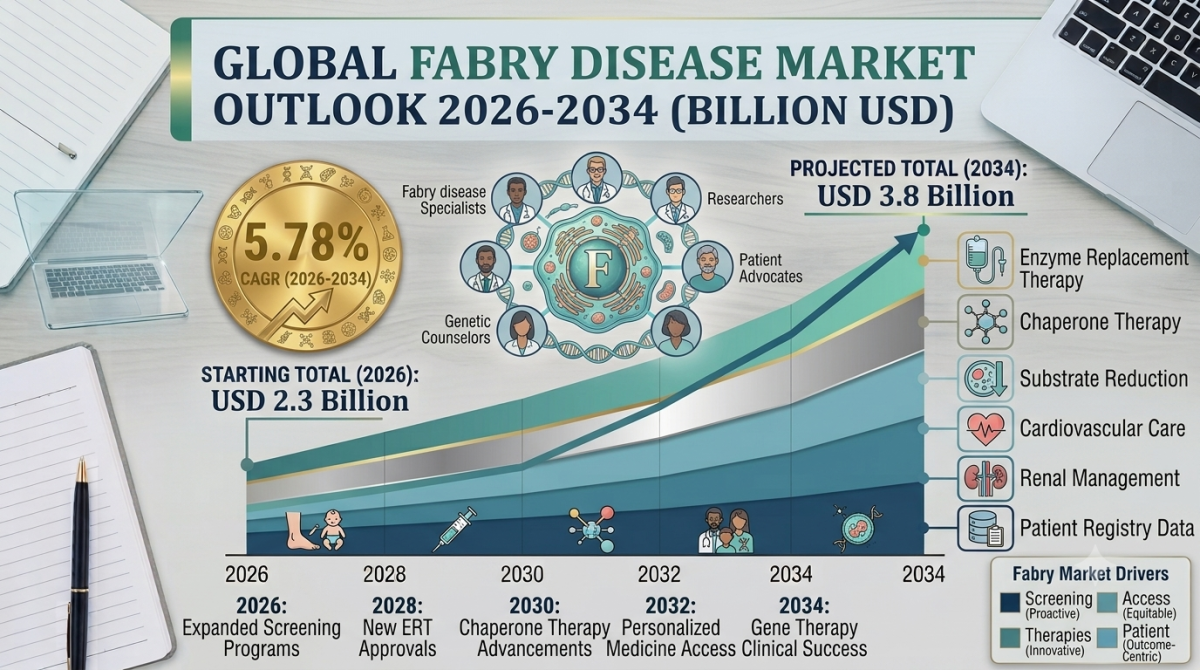
According to IMARC Group, the global fabry disease market size reached USD 2.3 Billion in 2025 and is projected to reach USD 3.8 Billion by 2034, exhibiting a CAGR of 5.78% during 2026–2034. This growth trajectory reflects the increasing number of diagnosed patients, the expanding pipeline of novel therapeutics, and a heightened global emphasis on rare disease awareness, early diagnosis, and personalized treatment strategies.
Fabry Disease Market Overview
Fabry disease also known as alpha-galactosidase-A deficiency is an inherited lysosomal storage disorder that disrupts the normal metabolism of lipids, including fatty acids, oils, and waxes. If left undiagnosed or untreated, the disease causes a gradual buildup in blood vessels and tissues, leading to progressive kidney failures, nerve damage, and stroke. The fabry disease market encompasses diagnostics as well as a range of treatment approaches:
● Diagnosis: Blood tests, genetic tests, and parenteral examinations
● Treatment: Enzyme Replacement Therapy (ERT), oral therapy, adjunct therapy, and emerging gene therapy approaches
These solutions are widely utilized across hospitals, homecare settings, and specialty clinics, with a focus on preventing first and second-level complications while correcting the underlying enzyme deficiency.
Request for a Sample Report for Detailed Fabry Disease Market Share & Insights: https://www.imarcgroup.com/fabry-disease-market/requestsample
Global Market Overview & Fabry Disease Market Size Statistics
Below are the key fabry disease market size statistics drawn from IMARC Group's comprehensive market analysis:
|
Report Attribute |
Key Statistics |
|
Base Year |
2025 |
|
Historical Period |
2020–2025 |
|
Forecast Period |
2026–2034 |
|
Market Size in 2025 |
USD 2.3 Billion |
|
Market Forecast in 2034 |
USD 3.8 Billion |
|
Market Growth Rate (2026–2034) |
5.78% CAGR |
|
Largest End-Use Segment |
Specialty Clinics |
|
Largest Region |
North America |
Key Market Drivers & Fabry Disease Market Trends in 2026
Several critical forces are shaping the fabry disease market trends and fueling sustained growth across global healthcare systems:
1. Rising Patient Population and Disease Awareness
The increasing number of patients diagnosed with Fabry disease worldwide is a primary growth driver. Greater physician and public awareness about early-stage diagnosis and the long-term complications of unmanaged disease is improving detection rates, expanding the addressable patient population, and driving demand for both diagnostic and therapeutic solutions.
2. Advancements in Enzyme Replacement Therapy (ERT) and Novel Treatments
Enzyme replacement therapy remains the gold standard treatment for Fabry disease, directly addressing the underlying enzyme deficiency. The escalating need for more precise and effective therapies — including genetic treatments, substrate reduction therapies, and pharmacological chaperones — is significantly boosting market investment and expanding treatment options for patients globally.
3. Growing Demand for Orally Administered Medications
The rising preference for orally administered medications and capsule-based formulations over intravenous infusion therapies represents a major emerging Fabry Disease Market Trend. Oral therapies offer patients greater convenience, improved adherence, and the possibility of home-based treatment, which is catalyzing pharmaceutical R&D investment in this segment.
4. Favorable Regulatory Initiatives and Government Support
Regulatory agencies worldwide are increasingly supporting the development of breakthrough rare disease treatments through expedited review pathways, orphan drug designations, and funding for innovative research. These favorable policy environments are encouraging pharmaceutical companies to invest in Fabry disease therapeutics and accelerating the time-to-market for new treatments.
5. Technological Advancements in Diagnosis and Telemedicine
Significant technological progress, including the adoption of genetic screening technologies, next-generation sequencing, and the introduction of telemedicine solutions and home care settings for the diagnosis and monitoring of Fabry disease, are broadening patient access. Digital health innovations are enabling remote care management for this chronic condition, especially in underserved geographies.
6. Growing Geriatric Population
The steadily increasing global geriatric population — which is inherently more susceptible to chronic and progressive ailments — is creating sustained demand for rare disease management solutions. As Fabry disease is a progressive disorder, older patients typically require longer and more intensive treatment regimens, supporting market expansion.
7. Continued R&D Investment and Pipeline Expansion
Ongoing research and development activities aimed at expanding treatment and medication portfolios, along with improvements in healthcare infrastructure across emerging economies, are creating a positive long-term outlook for the Fabry Disease Market. Gene therapy pipelines, in particular, are generating significant investor interest as potential curative solutions.
Key Market Segmentation
By Type
● Type 1 – Classic Fabry Disease
● Type 2 – Late-Onset Fabry Disease
● Others
The market is segmented by disease type, with Type 1 (classic Fabry disease) and Type 2 (late-onset variant) representing distinct patient populations requiring different diagnostic and therapeutic approaches.
By Diagnosis and Treatment
● Diagnosis
○ Blood Test
○ Genetic Test
○ Parenteral Test
○ Others
● Treatment
○ Enzyme Replacement Therapy (ERT) – Dominant Segment
○ Oral Therapy
○ Adjunct Therapy
○ Others
Enzyme Replacement Therapy (ERT) holds the dominant share in the treatment segment, directly addressing the root enzyme deficiency. However, oral therapy is emerging as a fast-growing segment driven by patient preference for convenience and home-based care.
By End User
● Specialty Clinics – Largest Segment
● Hospitals
● Homecare
● Others
According to the IMARC Group report, specialty clinics account for the largest end-user segment in the Fabry Disease Market. Specialty clinics provide the focused expertise, rare disease infrastructure, and multidisciplinary care teams required for the complex diagnosis and long-term management of Fabry disease patients.
Regional Market Analysis
|
Region |
Key Highlights |
|
North America – Largest |
United States & Canada; highest disease prevalence rates, advanced genetic screening infrastructure, widespread ERT adoption, strong rare disease regulatory frameworks, increasing approvals of novel therapeutics |
|
Europe |
Germany, France, UK, Italy, Spain, Russia; mature healthcare systems, European Medicines Agency (EMA) rare disease policies, growing patient registries |
|
Asia Pacific |
China, Japan, India, South Korea, Australia, Indonesia; rapidly expanding healthcare infrastructure, growing rare disease awareness, increasing investment in genetic diagnostics |
|
Latin America |
Brazil, Mexico; Brazil is the largest Latin American healthcare market, rising government initiatives for rare disease care and newborn screening programs |
|
Middle East & Africa |
UAE, Saudi Arabia, South Africa; healthcare modernization programs, rising chronic and hereditary disease burden, growing adoption of international rare disease treatment protocols |
Connect for Detailed Fabry Disease Market Share Segmentation Analysis – Speak to an Analyst: https://www.imarcgroup.com/request?type=report&id=6668&flag=C
Leading Players in the Fabry Disease Industry
The global Fabry Disease Market features a mix of specialized rare disease biopharmaceutical companies and larger healthcare groups. Key companies covered in the IMARC Group report include:
● Amicus Therapeutics
● Freeline
● Idorsia Pharmaceuticals Ltd
● JCR Pharmaceuticals Co. Ltd
● Protalix BioTherapeutics
● Sangamo Therapeutics Inc.
The report includes a comprehensive competitive analysis covering market structure, player positioning, top winning strategies, a competitive dashboard, and a company evaluation quadrant.
About Us
IMARC Group is a leading global market research company providing data-driven insights and expert consulting services to businesses seeking to achieve their strategic objectives. With a multi-disciplinary team of industry experts, IMARC delivers thorough, reliable market intelligence across sectors including Technology, Construction, Healthcare, Energy, Food & Beverages, and more.
Contact Us
IMARC Group
United States: +1-201-971-6302
India: +91-120-433-0800
United Kingdom: +44-753-714-6104







Comments (0)