

No More Guessing Games: The FDA and EMA Just Wrote AI’s Rulebook

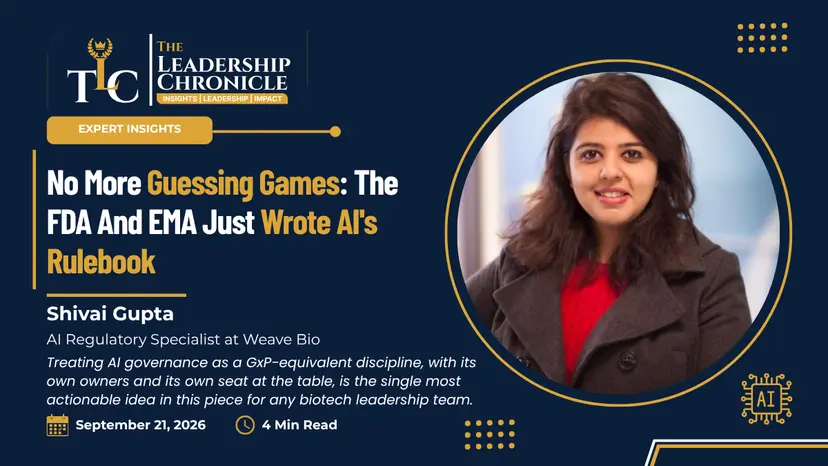
Two years ago, a pharma sponsor asked the FDA a simple question: “Can we use AI to identify patients most likely to respond to our therapy?” The answer, in essence, was “it depends, and we’ll figure it out together.”
That answer no longer holds. In the span of twelve months, the FDA and EMA have moved from case-by-case improvisation to the most significant AI framework in the history of modern clinical research. For sponsors, CROs, and biotech leadership, this isn’t a future consideration. It’s a compliance conversation happening right now
The Regulatory Shift You Need to Know About
Two milestones define this new era.
January 2025, FDA Draft Guidance. “Considerations for the Use of AI to Support Regulatory Decision-Making for Drug & Biological Products” introduced a seven-step, risk-based credibility framework for evaluating AI models used in submissions. This wasn’t written in a vacuum: the FDA has received more than 800 AI-component submissions since 2016. Nearly a decade of hands-on review experience is baked into this framework, which is exactly what makes it so different from the ad hoc guidance sponsors were navigating even two years ago.
January 2026, FDA + EMA Joint Principles. The two agencies released ten Guiding Principles for Good AI Practice in Drug Development, the first coordinated transatlantic regulatory position on AI in pharma. For global sponsors, this is the end of trying to satisfy two separate regulatory philosophies with two separate strategies. There is now one shared standard to build toward.
Having spent years working across CMC, digital biotech, and regulatory science, including time inside the FDA itself before moving into industry, I’ve watched this shift from both sides of the table. The agencies didn’t get more permissive. They got more precise. And precision is something sponsors can actually build a strategy around.
“This is a rare case of regulators getting ahead of an industry’s growing pains instead of two years behind them. That alone should change how boards prioritize AI governance conversations.”
What This Means For Sponsors
Here’s the mindset shift that matters most: the sponsors who thrive in this new environment won’t be the ones with the most sophisticated models. They’ll be the ones who can explain those models clearly to a regulator, and stand behind every decision the model influenced.
That’s a scientific communication problem as much as a technical one. Practically, it breaks down into five disciplines:
1. Specify exactly how each AI model is used in your study. Vague descriptions of “AI-assisted analysis” no longer clear the bar. Regulators want to know the model’s role, inputs, and boundaries in your trial design.
2. Identify, quantify, and mitigate risks to the trial. This means building a risk assessment into your protocol from day one, not retrofitting one after a question from reviewers.
3. Validate continuously, not once. Models degrade as data environments shift, a phenomenon known as data drift. A model validated at trial start can behave differently eighteen months later if the underlying data population changes. Ongoing validation isn’t optional; it’s the new baseline expectation.
4. Integrate data scientists with clinical leads throughout the trial, not as a handoff. The sponsors who struggle are the ones where data science and clinical operations work in sequence. The ones who succeed build those functions into one continuous conversation, from protocol design through database lock.
5. Keep humans accountable. AI supports the decision. It does not make it. Every regulatory framework published in the last eighteen months reinforces this principle, and it’s the one non-negotiable that underlies all the others.
“Notice that none of these five disciplines are technical in the AI-engineering sense. They read closer to what a regulatory affairs team already does — which suggests the real skill gap most sponsors need to close isn’t data science. It is translation.”
The Big Picture
What’s striking is just how far AI has already spread across the clinical trial lifecycle. It’s no longer confined to one function. It now shapes how trials are designed, how patients are recruited and matched to studies, how biomarker and real-world evidence data gets analyzed, how safety signals get caught early, and how manufacturing gets optimized. Each of these areas now comes with its own documentation and validation expectations under the new frameworks. That’s a lot of ground for a sponsor to cover, which is exactly why this has shifted from a “watch this space” conversation to a “build this into your operating model” conversation.
Where This Leaves Sponsors
The good news buried in all this new structure is that ambiguity was never really an advantage for anyone. Sponsors spent the last several years trying to anticipate what regulators might ask. Now there’s a published, risk-based framework and a transatlantic set of shared principles to build against. That’s a foundation, not a hurdle.
The organizations that get ahead from here will treat AI governance the way they already treat GxP compliance: as a discipline with its own owners, its own documentation trail, and its own seat at the leadership table, not a side project bolted onto data science.
“Treating AI governance as a GxP-equivalent discipline, with its own owners and its own seat at the table, is the single most actionable idea in this piece for any biotech leadership team building next year’s org chart.”
Having worked across the full arc of this problem, from bench immunology research, through CMC and regulatory affairs, to building AI adoption strategies for biotech and pharma teams today, my read is straightforward: the agencies have done sponsors a favor. They’ve replaced guesswork with a rulebook. The work now is execution.
For more details, visit: https://theleadershipchronicle.com/
If you would like to get featured or want to know more, connect with us at contact@theleadershipchronicle.com
LinkedInn : https://www.linkedin.com/company/the-leadership-chronicle/
Twitter : @TLChronicle







Comments (0)