

How Generative AI Is Changing Modern Web Development Services
Generative AI is transforming web development services through faster coding, smarter personalization, intelligent search, rapid prototyping, and AI-powered experiences while helping businesses build scalable digital solutions.
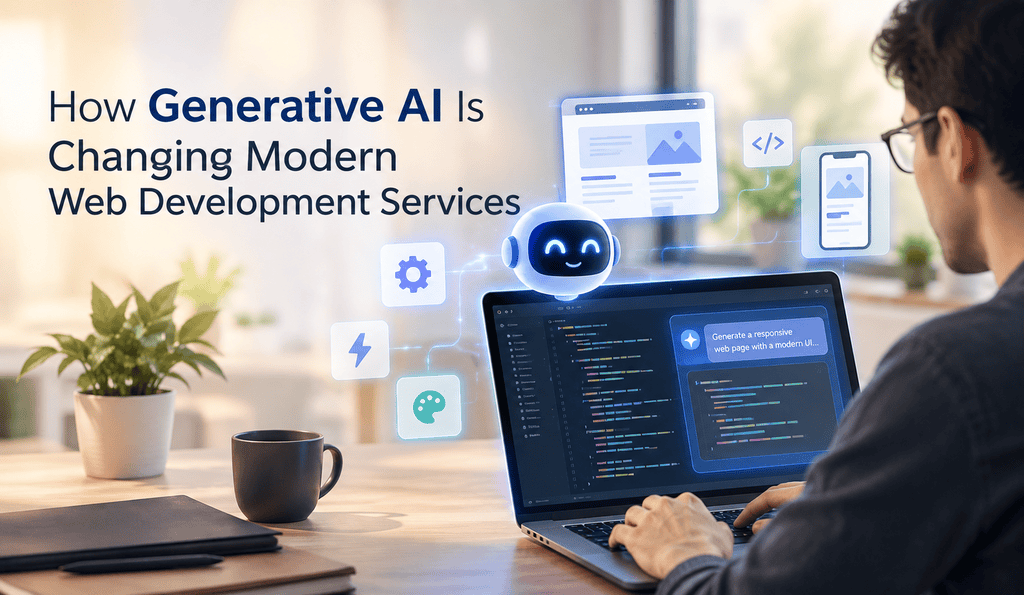
Generative AI is changing how websites and web applications are planned, designed, developed, tested, and maintained. What once required teams to spend hours creating code, writing content, analyzing user behavior, and troubleshooting technical issues can now be supported by AI-powered tools.
For businesses, this shift is creating new possibilities across web development services, from faster development cycles to more personalized digital experiences. However, generative AI is not simply replacing traditional development practices. Instead, it is becoming another layer of technology that developers can use to improve productivity, automate repetitive work, and build more intelligent web experiences.
Understanding where generative AI fits into modern web development can help businesses make more informed decisions when planning a new website or web application.
What Is Generative AI in Web Development?
Generative AI refers to artificial intelligence systems capable of creating new content based on user instructions and existing data. Depending on the model and application, it can generate text, code, images, designs, documentation, and other digital assets.
In web development, these capabilities can support different stages of the development lifecycle. Developers can use AI to generate code suggestions, identify potential bugs, create test cases, explain unfamiliar code, and produce technical documentation.
For businesses investing in web development services, this means development teams can potentially spend less time on repetitive tasks and more time solving complex product, usability, and business problems.
How Generative AI Is Transforming Web Development
1. Faster Code Development
One of the most visible applications of generative AI is code generation.
Developers can describe a desired function in natural language and use AI tools to generate an initial implementation. AI can also suggest components, functions, database queries, API integrations, and other common development patterns.
This does not eliminate the need for developers. Generated code still needs to be reviewed, tested, optimized, and adapted to the application's architecture.
The major advantage is that developers can use AI as a productivity assistant rather than starting every task from scratch.
2. More Efficient UI and UX Development
Generative AI can also influence how websites and web applications are designed.
AI tools can help generate interface concepts, content structures, component ideas, and variations of page layouts. Developers and designers can then evaluate these concepts against usability requirements, accessibility standards, branding guidelines, and user expectations.
This can shorten the distance between an initial idea and a working prototype.
For businesses, faster prototyping can make it easier to test different concepts before committing significant development resources.
3. AI-Powered Personalization
Modern users increasingly expect digital experiences to be relevant to their needs.
Generative AI can help websites deliver more personalized experiences by using available user and contextual data. For example, an ecommerce platform could generate personalized product descriptions or recommendations, while a SaaS application could provide AI-generated guidance based on a user's activity.
The implementation depends on the type of data available, privacy requirements, and the application's architecture.
When properly integrated, generative AI can turn a conventional website into a more responsive digital experience.
4. Intelligent Chat and Search Experiences
Traditional website search often depends on exact keywords and predefined filters. Generative AI enables more conversational interactions.
Users can ask questions in natural language and receive responses based on information available within the website or connected knowledge sources.
For example, instead of searching through multiple product pages, a visitor could ask, "Which plan would work for a team of 20 people?" An AI-powered interface could interpret the question and provide a relevant response based on available product information.
This approach can be particularly useful for ecommerce, SaaS, education, travel, healthcare information portals, and enterprise websites.
Generative AI and the Future of Web Development Services
The role of web development services is expanding as AI becomes part of modern digital products.
Previously, a development project might primarily focus on building frontend interfaces, backend systems, databases, APIs, and integrations. Today, businesses may also need AI models, retrieval systems, prompt workflows, vector databases, AI security controls, and monitoring mechanisms.
This means businesses evaluating development partners need to look beyond basic coding capabilities.
A capable development team should understand how AI components interact with existing application architecture. It should also be able to determine when AI is actually useful and when conventional software logic would provide a more reliable solution.
What Businesses Should Consider Before Adding Generative AI
Generative AI can provide significant opportunities, but adding AI to a web application simply because it is popular may not produce meaningful business value.
Before implementation, businesses should consider several factors:
-
Business objective: What problem will AI solve?
-
Data requirements: What information does the AI system need, and where will that data come from?
-
Security and privacy: Will users provide sensitive or confidential information?
-
Accuracy: What happens if the AI generates an incorrect response?
-
Integration: How will AI connect with the existing frontend, backend, databases, and APIs?
-
Cost: What are the ongoing model, infrastructure, development, and maintenance costs?
-
Scalability: Can the architecture support increasing users and AI requests?
These questions can help organizations determine whether generative AI is appropriate for their specific web application.
Choosing Web Development Services for an AI-Enabled Project
Businesses planning an AI-powered website or web application should evaluate development teams based on both traditional engineering capabilities and AI implementation experience.
Important areas to examine include technical expertise, previous AI integrations, security practices, development methodology, scalability planning, testing processes, and post-launch support.
It is also useful to clearly define the project's requirements before development begins. A simple AI chatbot, for example, may require a very different architecture from an enterprise application that uses generative AI to analyze large volumes of internal information.
A structured discovery and planning phase can help identify the right technology stack and avoid unnecessary complexity.
The Road Ahead
Generative AI is becoming an important part of modern web development, but its value depends on how thoughtfully it is implemented.
From code assistance and rapid prototyping to personalization, conversational search, and intelligent automation, AI can influence almost every stage of creating and managing digital products.
For businesses, the opportunity is not simply to "add AI" to a website. The larger opportunity is to identify specific problems where AI can improve user experience, operational efficiency, or product functionality.
As these technologies continue to evolve, web development services will increasingly combine conventional software engineering with AI capabilities. Businesses that approach this transition with clear objectives, appropriate architecture, strong security practices, and continuous testing can build web experiences that are not only faster to develop but also more adaptive to changing user expectations.

iTechnolabs is an AI-first software and mobile app development company that helps businesses build, modernize, and scale their digital products. Core services include mobile app development for iOS and Android, AI and generative AI development, custom software development including ERP and CRM systems, blockchain and Web3 solutions, web development, and dedicated developer staffing.








Comments (0)