

Manuka Honey MGO 1500: A Complete Guide to Understanding This High-Strength Honey
Learn what Manuka Honey MGO 1500 means, how MGO develops, why testing matters, and what to consider when buying high-strength Manuka honey.

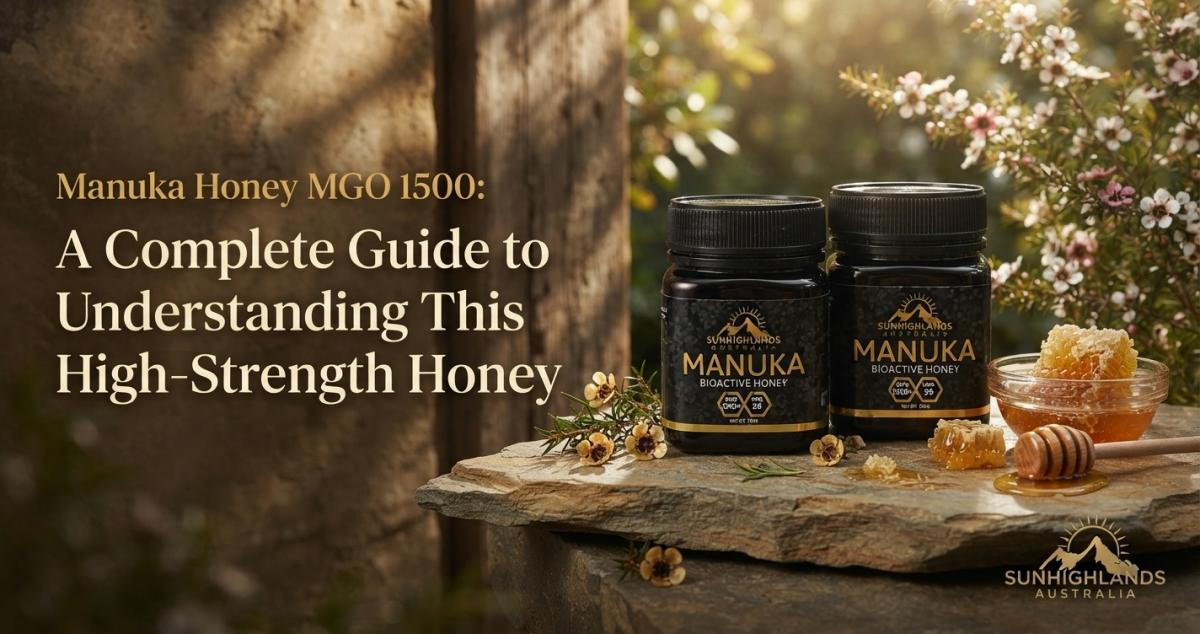
Manuka honey is available in a wide range of MGO ratings, but Manuka Honey MGO 1500 sits firmly in the high-MGO category. For Australian consumers exploring premium honey, understanding what this number means can make it easier to compare products, read labels and decide whether a very high-MGO honey matches their preferences.
MGO stands for methylglyoxal, a naturally occurring compound associated with the distinctive characteristics of Manuka honey. The Australian Manuka Honey Association (AMHA) identifies MGO as a key measurable marker used when assessing Australian Manuka honey.
What Does MGO 1500 Mean?
An MGO 1500 label refers to a high concentration of methylglyoxal, generally expressed in milligrams per kilogram (mg/kg), which is numerically equivalent to parts per million.
In simple terms, a product labelled MGO 1500+ represents a honey with at least the level indicated by the rating.
The MGO number should be understood as a measurement of concentration, not a medical dosage. A higher number does not mean that a person should consume more honey or that the product guarantees a specific health result.
How Does MGO Develop in Manuka Honey?
MGO develops naturally from another compound called dihydroxyacetone (DHA).
DHA occurs naturally in the nectar of some Leptospermum plants. During honey maturation, DHA can convert into MGO. This natural process helps explain why some Manuka honey develops much higher MGO concentrations than conventional honey.
The final MGO level can be influenced by floral source, nectar composition, honey maturation and handling. As a result, not every Manuka honey will reach an MGO 1500 rating.
Why Is MGO 1500 Considered High Strength?
MGO ratings provide a simple way to compare the concentration of MGO between Manuka honey products.
For example:
-
MGO 550+ represents a lower concentration than MGO 850+
-
MGO 850+ is lower than MGO 1200+
-
MGO 1200+ is lower than MGO 1500+
This means MGO 1500 represents a substantially higher measured MGO concentration than many commonly available Manuka honey ratings.
However, "higher" should not automatically be interpreted as "better." The right product depends on the characteristics a consumer is looking for.
Australian Origin Matters
Australian Manuka honey is produced by bees collecting nectar from plants in the Leptospermum genus. Australia has more than 80 native Leptospermum species growing across a wide range of habitats.
This diversity is one reason Australian Manuka honey can naturally vary in flavour, colour, texture and chemical composition.
When looking for Manuka honey for sale in Australia, check the country-of-origin information rather than relying only on the word "Manuka" or Australian-themed packaging.
Why Is Laboratory Testing Important?
When a premium honey carries a specific MGO rating, testing is especially important.
The AMHA states that MGO can be directly measured through laboratory analysis and highlights independent testing and supply-chain traceability as important parts of its quality framework.
The association's Mark of Authenticity is also based on defined criteria and independent laboratory testing for relevant MGO and DHA levels.
For consumers, testing information can provide greater confidence that the MGO figure on the label represents a measured characteristic of the honey.
What Does MGO 1500 Honey Taste Like?
MGO 1500 does not determine one exact flavour profile.
Natural Manuka honey can have a rich, distinctive taste, sometimes with earthy, woody, caramel-like or robust notes. Flavour can vary according to floral source, region, season and harvest.
Texture can also vary. Honey may be thick and smooth, while natural crystallisation can make it creamier or grainier over time.
These visual and sensory changes are not reliable substitutes for laboratory testing.
How Can You Use MGO 1500 Manuka Honey?
Despite its premium rating, MGO 1500 honey can be enjoyed in everyday ways.
Try it with:
-
Toast or sourdough
-
Porridge and oats
-
Greek yoghurt
-
Fresh fruit
-
Smoothies
-
Warm drinks
-
Homemade desserts
Some consumers prefer enjoying a high-MGO honey directly so they can appreciate its natural flavour.
Because honey naturally contains sugars, it should be consumed in sensible amounts as part of a balanced diet.
MGO 1500 vs Lower MGO Ratings
The main difference between MGO 1500 and lower ratings is the measured concentration of MGO.
| Rating | Relative MGO Level |
|---|---|
| MGO 550+ | High |
| MGO 850+ | Higher |
| MGO 1200+ | Very high |
| MGO 1500+ | Higher still |
These figures are useful for comparing concentration, but they are not a complete measure of overall honey quality.
Origin, authenticity, traceability, testing, flavour and production practices can all provide additional information.
Does MGO 1500 Mean More Health Benefits?
It is important to avoid making that assumption.
MGO is associated with the characteristic antibacterial activity of Manuka honey, which is one reason it has attracted scientific interest.
However, an MGO 1500 rating does not establish that consuming the honey produces a proportionally greater health effect than a lower-rated product.
Similarly, MGO 1500 is not a medical prescription or treatment strength.
Consumers should distinguish between the measured properties of Manuka honey and claims about treating medical conditions.
What Should You Check Before Buying?
When comparing Manuka honey for sale, especially high-MGO products, look for:
A clear MGO rating: Make sure the concentration is clearly stated.
Australian origin: Confirm where the honey was produced.
Independent testing: Look for credible laboratory verification.
Authenticity information: Recognised certification or authenticity marks can provide additional provenance information.
Transparent labelling: Check ingredients, nutrition information, batch details and storage guidance.
Value: Compare the MGO level and supporting quality information with the price.
Is MGO 1500 Right for Everyone?
Not necessarily.
Someone who simply wants honey for everyday cooking may prefer a lower-MGO product. A consumer interested specifically in very high MGO concentration may prefer MGO 1500.
The decision can depend on taste, intended use, availability and budget.
A higher MGO rating also does not make honey suitable for everyone. People who need to monitor sugar or carbohydrate intake should consider the nutritional information and their overall diet.
Final Thoughts
Manuka Honey MGO 1500 represents a very high MGO concentration within commercially available Manuka honey products. Its rating comes from the natural chemistry of Leptospermum nectar and the conversion of DHA into MGO during honey maturation.
For Australian consumers, choosing a high-MGO honey is about more than selecting the largest number. MGO concentration, Australian origin, independent testing, authenticity and traceability all help provide a clearer picture of the product.
Whether you are exploring Manuka honey for sale online or comparing premium jars in Australia, understanding what MGO 1500 actually measures can help you make a more informed purchase.
Ultimately, MGO 1500 is best understood as a high measured MGO rating, not a guarantee of health outcomes. With the right product information and realistic expectations, it can be appreciated as a distinctive premium Australian honey.





Comments (0)