

Choosing the Right Adobe Applications for Your Business
Learn how to choose the right Adobe applications for your business based on employee roles, creative requirements, collaboration, productivity, and business workflows.
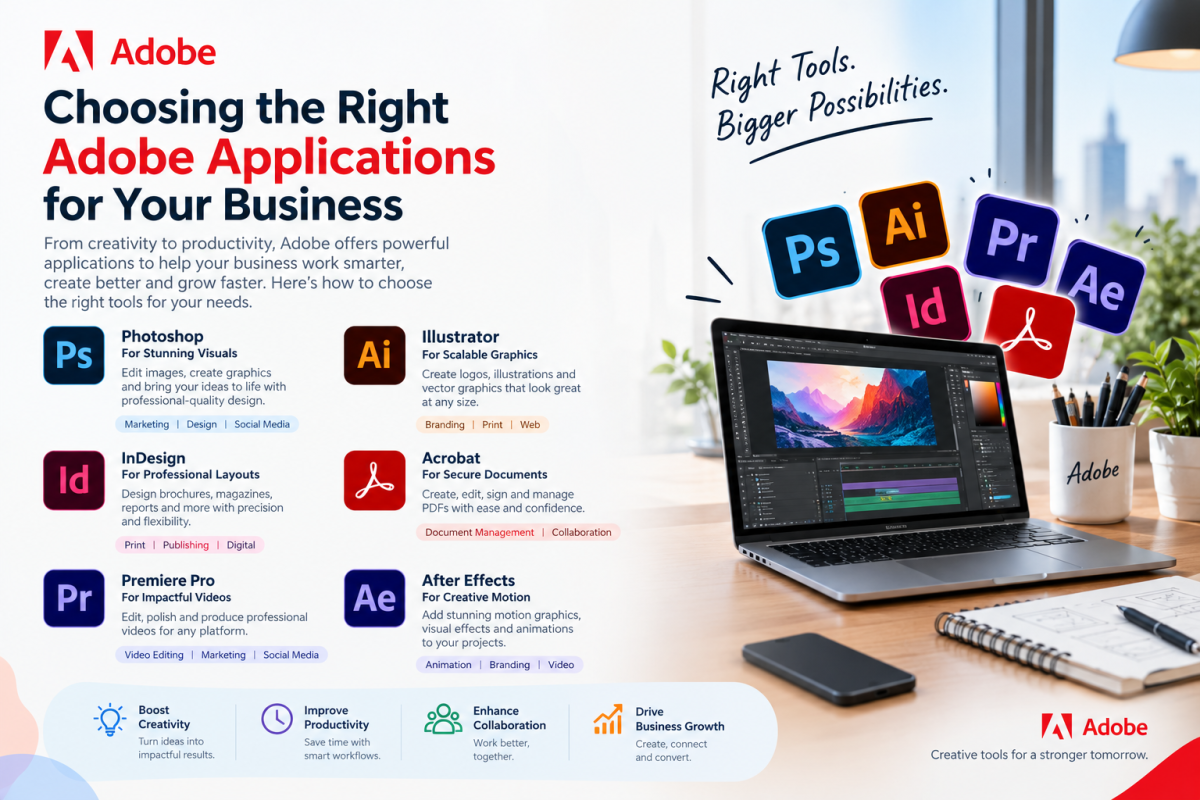
Choosing the Right Adobe Applications for Your Business
Adobe applications are widely used by businesses for graphic design, photo editing, video production, document management, marketing, publishing, and creative content development. However, not every employee needs access to every Adobe application. Choosing applications based on actual job responsibilities can help businesses provide the right tools while keeping software management more organized.
The right Adobe setup depends on what your employees create, how teams collaborate, the type of files they handle, and the workflows used by your organization. Atop Computer Solution LLC helps businesses evaluate software requirements and implement suitable Adobe solutions for different professional teams, while also supporting genuine licensing and effective software management.
If you are searching for Authorized Adobe Supplier in Dubai, UAE? Connect to Atop Computer Solution LLC.
Understand Your Business Requirements First
Before selecting Adobe applications, businesses should identify how creative and document-related work is performed within the organization. Marketing teams may need tools for social media graphics and campaigns, while designers may require professional image and vector editing applications. Video teams, publishers, and administrative employees can have completely different requirements.
Creating user groups based on job responsibilities makes software selection easier. Instead of providing the same applications to everyone, businesses can identify the tools required by designers, marketers, video editors, document-focused employees, and other teams. This can help organizations avoid unnecessary software assignments while ensuring employees have the applications needed for their work.
Adobe Photoshop for Image Editing
Adobe Photoshop is commonly used for professional image editing, photo retouching, digital artwork, marketing graphics, and other image-based creative work. Businesses with dedicated design, marketing, photography, or content teams may benefit from providing Photoshop to employees who regularly work with raster images.
Photoshop can support tasks ranging from simple image adjustments to complex creative compositions. However, employees who only need to make basic document edits or create simple business materials may not require Photoshop. Evaluating actual workloads can help businesses determine which users genuinely need the application.
Adobe Illustrator for Vector Design
Adobe Illustrator is designed primarily for creating and editing vector graphics. It can be useful for businesses working on logos, icons, illustrations, branding materials, packaging designs, signage, and other graphics that need to remain sharp at different sizes.
Design teams often use Illustrator when precision and scalability are important. For example, a logo may need to appear on a business card as well as a large-format display. Businesses should consider Illustrator when employees regularly create professional vector artwork rather than assigning it to users whose work does not require vector-based design.
Adobe InDesign for Professional Publishing
Adobe InDesign is focused on page layout and professional publishing. Businesses involved in brochures, magazines, reports, catalogs, presentations, newsletters, and other multi-page documents may find it particularly useful.
InDesign provides tools for organizing text, images, typography, and page layouts within professional publications. Marketing departments, publishing teams, design agencies, and corporate communication teams may require this type of application when producing structured documents with consistent visual layouts.
Adobe Premiere Pro for Video Production
Video has become an important part of marketing, communication, training, and online content. Adobe Premiere Pro is designed for professional video editing and can support workflows involving footage, audio, transitions, effects, captions, and other production elements.
Businesses producing promotional videos, training content, social media videos, interviews, or corporate communications may require Premiere Pro for dedicated video editors. Employees who only occasionally view or share videos generally do not need professional video-editing software, so access should be based on actual responsibilities.
Are you searching for a Microsoft Azure Partner in UAE? Connect to Atop Computer Solution LLC.
Adobe After Effects for Motion Graphics
Adobe After Effects is commonly used for motion graphics, visual effects, animation, and compositing. It can complement video editing workflows when businesses need animated titles, visual effects, transitions, or more advanced motion-based content.
Because motion graphics can require specialized skills and workflows, After Effects is generally more relevant to creative professionals than general office employees. Businesses should identify whether their content strategy actually requires animation or visual effects before assigning this application to users.
Adobe Acrobat for Business Documents
Adobe Acrobat can be useful for businesses that regularly create, edit, organize, sign, convert, or manage PDF documents. Unlike applications primarily designed for creative professionals, PDF tools can be relevant across many departments.
Finance, HR, administration, legal, sales, and management teams may all work with PDF files as part of their daily operations. Businesses should therefore assess document workflows separately from creative workflows when determining which Adobe applications different employees require.
Adobe Lightroom for Photography Workflows
Adobe Lightroom is designed around photography workflows, including photo organization, editing, adjustments, and management of large collections of images. Businesses that regularly handle professional photography may consider Lightroom for employees responsible for managing and editing large numbers of photographs.
For organizations that primarily create marketing graphics or complex digital artwork, other Adobe applications may be more appropriate. Understanding the difference between photography management and advanced image composition can help businesses assign the right tools to the right employees.
Consider Collaboration Requirements
Modern creative teams often work on projects involving multiple designers, marketers, editors, and managers. When selecting Adobe applications, businesses should consider how employees share files, review creative work, manage assets, and collaborate on projects.
Application selection should therefore be part of a broader workflow discussion. Businesses should consider file organization, permissions, cloud storage, version management, review processes, and team collaboration when building their Adobe environment. A well-planned workflow can help reduce duplicated work and improve project management.
Match Applications to Employee Roles
One of the most effective ways to manage Adobe applications is to assign software according to employee responsibilities. A graphic designer may need Photoshop and Illustrator, while a video editor may require Premiere Pro and After Effects. A finance employee may primarily need PDF tools rather than creative applications.
Role-based application management can make software deployment and administration easier. It also helps businesses understand why specific applications are assigned to particular users. As employees change positions, their software requirements should be reviewed and adjusted accordingly.
Consider Genuine Adobe Licensing
Businesses should always use genuine, properly licensed Adobe software. Unauthorized or pirated applications can introduce security risks, create update problems, and expose organizations to software compliance issues. Genuine software also provides access to official updates and support capabilities associated with the relevant licensing arrangement.
Licensing should be managed as an ongoing business process rather than a one-time purchase. Organizations should maintain records of users, applications, subscriptions, and renewal requirements. Regular reviews can help businesses avoid unnecessary licenses while ensuring employees have legitimate access to the applications they need.
Plan for Future Creative Growth
Adobe requirements can change as businesses expand their marketing and creative operations. A company may initially need basic design and document tools but later add video production, branding, publishing, or other creative capabilities.
Businesses should therefore consider both current and expected future requirements when developing their Adobe strategy. A scalable approach makes it easier to add applications and users as teams grow while keeping licensing and software management under control.
Why Choose Atop Computer Solution LLC?
Atop Computer Solution LLC helps businesses evaluate and manage technology solutions based on their operational requirements. When selecting Adobe applications, our approach focuses on employee roles, creative workflows, document requirements, collaboration needs, licensing, and long-term business plans.
From genuine Adobe licensing and application selection to broader IT support and software management, businesses can benefit from having a structured technology strategy. The right Adobe environment can give employees the tools they need while helping organizations maintain better control over software usage and licensing.
If you are searching for APC Brand UPS Partner in Dubai, UAE? Connect to Atop Computer Solution LLC.
Conclusion
Choosing the right Adobe applications starts with understanding what your employees actually need to accomplish. Photoshop, Illustrator, InDesign, Premiere Pro, After Effects, Acrobat, and Lightroom each support different workflows, so businesses should avoid assigning every application to every employee without assessing their responsibilities.
A role-based approach can help businesses improve productivity, manage software more efficiently, and control licensing requirements. By selecting genuine Adobe solutions that match their workflows and working with Atop Computer Solution LLC, businesses can build a more organized and effective creative software environment.
Google Map - https://share.google/8dmGyXRprajfYFJ7N
Follow these links for more information:
https://www.acs-dxb.com/adobe-partner
https://www.acs-dxb.com/software/buy-microsoft-office-365-in-uae
https://www.acs-dxb.com/products/apple

ATOP Computer Solutions is a reputed Cisco dealer in Dubai, UAE, and the selected partner of companies like Lenovo, Dell, Sage, Avaya, Microsoft, IBM, Platinum Printers, and HP Servers. The Company is also in the PC assembler and server market and provides IT support too. Address:- BMI Building, Bank Street Building - 607 - Dubai - United Arab Emirates Phone:- +971 55 329 2942








Comments (0)