

How Real Estate Software Development Is Transforming Property Management in 2026
Explore how real estate software development is transforming property management in 2026 through AI-powered automation, smart property management solutions, digital tenant experiences, predictive maintenance, and scalable technology platforms for modern real estate businesses.

Introduction:
The US real estate industry is changing faster than at any point in the last two decades. Tenants who order groceries, book travel, and manage their finances from a phone now expect the same convenience when they pay rent, report a leaking faucet, or renew a lease. Landlords, property managers, and investors feel that pressure every day, and spreadsheets, paper files, and phone calls cannot keep up with it.
Expectations around communication have changed too. People want quick answers, transparent records, and services that work at any hour. Owners want a clear view of income, expenses, and occupancy without waiting for a monthly report. Meeting these demands consistently requires technology that is built around the way property businesses actually operate.
That is where real estate software development comes in. By replacing scattered tools with connected platforms, property businesses can modernize operations, reduce manual effort, and deliver a better experience to everyone involved. In 2026, three forces are driving this shift: artificial intelligence, workflow automation, and integrated platforms that bring every function into a single, reliable system.
Understanding Real Estate Software Development in 2026
Real estate software development is the process of designing, building, and maintaining digital platforms that support property-related operations. These platforms can handle everything from listings and leasing to accounting, maintenance, and investor reporting.
At its core, modern property management software connects four groups that have traditionally worked in separate silos: landlords who own the assets, tenants who live in or use them, property managers who run daily operations, and investors who need accurate performance data. When these groups share one platform, information flows without delay, and fewer things fall through the cracks.
The difference between traditional property management systems and modern digital platforms is significant. Older systems were largely digital filing cabinets, storing data but offering little insight or automation. Today's platforms are cloud-based, mobile-friendly, and API-driven. They connect with payment processors, accounting tools, and CRMs, and they use AI to surface patterns that humans would miss.
This is why so many US real estate businesses are investing in customized technology. Off-the-shelf tools often force a company to adapt its processes to the software. A tailored platform does the opposite: it reflects the company's portfolio mix, approval workflows, reporting needs, and growth plans.
Why Traditional Property Management Is No Longer Enough
Manual processes that once seemed manageable become real liabilities as portfolios grow. Several problems show up again and again.
- Manual rent collection and financial tracking. Checks, bank transfers, and spreadsheet reconciliation invite errors and late payments, and they consume hours every month.
- Delayed maintenance and poor communication. When requests arrive by phone, text, and email, they are easy to lose. Tenants wait, frustration builds, and small repairs turn into expensive ones.
- Disconnected systems. Accounting in one tool, leasing in another, and maintenance in a third means staff re-enter the same data repeatedly.
- Limited reporting. Without real-time data, owners make decisions based on last month's numbers, or on instinct.
- Growing operational complexity. Every new property adds tenants, vendors, contracts, and compliance obligations. Processes that work for ten units rarely work for a thousand.
These pain points are not a sign of poor management. They are the natural limits of tools that were never designed for scale or speed.
Key Ways Real Estate Software Development Is Transforming Property Management
The following five areas show where purpose-built software is making the biggest difference.
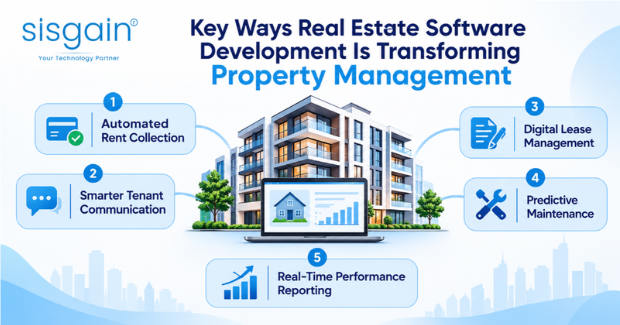
1. Automated Rent Collection and Payment Management
Rent is the lifeblood of any property business, and automation makes it far more predictable. Modern platforms support recurring payments, so tenants can set up automatic monthly debits by card or bank transfer. Digital invoices are generated and delivered on schedule, and automated reminders nudge tenants before a due date rather than after it.
Every transaction is recorded automatically, which creates a clean audit trail. Late fees, partial payments, and security deposits can be handled by rules instead of manual calculation. Finance teams also gain access to financial reports that update continuously, which makes month-end close faster and more accurate.
2. Smarter Tenant Communication and Engagement
A tenant portal gives residents one place to pay rent, submit requests, view documents, and message the management team. Automated notifications keep everyone informed about upcoming payments, scheduled inspections, building announcements, and maintenance progress.
When communication is centralized, nothing depends on one employee's inbox. Managers can see the full history of every conversation, and tenants no longer have to repeat themselves. Better communication tends to improve satisfaction, and satisfied tenants are more likely to renew.
3. Digital Lease Management and Documentation
Paper leases are slow to prepare, easy to misplace, and hard to search. Digital lease management replaces them with electronic signatures, templated agreements, and secure cloud storage. A new lease can be sent, signed, and filed within minutes.
The software can also track renewal dates, escalation clauses, and contract obligations, then alert managers well in advance. Instead of discovering an expiring lease at the last minute, teams can plan renewals, adjust rent strategically, and avoid unnecessary vacancies.
4. Predictive Maintenance and Property Monitoring
Maintenance is one of the largest operating costs in property management, and reactive repairs are the most expensive kind. Connected devices such as smart thermostats, leak sensors, and equipment monitors now feed live data into property platforms. Combined with maintenance history, this information lets predictive analytics flag equipment that is likely to fail.
A boiler showing unusual performance, or a water sensor reporting a slow leak, can trigger a work order before the tenant ever notices. Fewer emergencies mean lower repair costs, longer asset life, and fewer disruptions for residents.
5. Real-Time Property Performance and Reporting
Decision-makers need to see how each asset is performing, not just how the portfolio looked last quarter. Modern dashboards display occupancy rates, rental income, operating expenses, and net performance by property, region, or portfolio.
Because the data updates in real time, leaders can spot a rising vacancy rate, an unusual expense spike, or an underperforming building quickly, and act on it. Investors benefit as well, since transparent reporting builds confidence and simplifies communication.
Role of AI and Automation in Modern Property Management
Automation handles repetitive tasks. AI goes further by interpreting data, learning from patterns, and supporting decisions. Together, they are reshaping what property teams can accomplish.
AI-Powered Tenant Screening and Lead Management
AI can process rental applications faster by extracting information from documents, verifying identities, and flagging inconsistencies. It can also help prioritize incoming leads based on their likelihood to convert, so leasing agents spend time on the most promising prospects.
Responsible use matters here. Screening models must be designed and tested to avoid bias, and final decisions should follow clear, consistent criteria that comply with fair housing standards. AI should support human judgment, not replace it.
AI Chatbots and Virtual Property Assistants
Virtual assistants give tenants and prospects support around the clock. They can answer common questions, explain building policies, schedule property tours, and log maintenance requests in the system without staff involvement.
The benefit is twofold. Prospects get instant responses, which helps capture leads that might otherwise go cold, and property teams are freed from repetitive inquiries so they can focus on more complex tenant needs.
Predictive Analytics for Better Investment Decisions
Predictive models can forecast rental demand, estimate maintenance needs, and identify financial trends across a portfolio. Investors can use these insights to decide which markets to enter, which properties to renovate, and when to sell or hold.
Data-driven planning does not eliminate risk, but it replaces guesswork with evidence. Over time, that edge compounds into stronger returns and more resilient portfolios.
Agentic AI and Intelligent Workflow Automation
One of the most talked-about developments in 2026 is agentic AI: software agents that can coordinate multi-step workflows on their own. An agent might receive a maintenance request, check vendor availability, schedule the repair, notify the tenant, and update the work order record. Another might monitor transactions and flag unusual activity for review.
These agents work best as teammates, not replacements. Routine coordination can run automatically, while important decisions, such as approving large expenses or resolving disputes, remain under human oversight.
Essential Features of Modern Real Estate Management Software
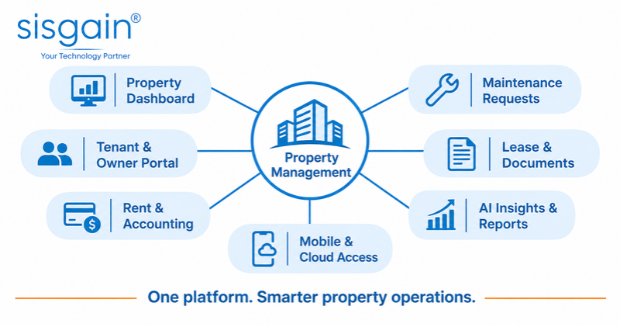
A strong platform combines several capabilities into one ecosystem. The most important include the following.
Property and Portfolio Management Dashboard
A central view of every property, unit, and tenant, with filters and summaries that make large portfolios easy to navigate.
Tenant and Landlord Management Portal
Secure, role-based access where tenants, owners, and staff each see exactly what they need.
Online Rent Collection and Accounting Integration
Payment processing connected to accounting software, so income, fees, and reconciliations are recorded without duplicate entry.
Maintenance Request and Work Order Management
A structured flow from request to assignment, vendor coordination, completion, and invoicing, with status visible to everyone involved.
Lease and Document Management
Central storage for leases, notices, inspection reports, and compliance records, with e-signature and renewal tracking built in.
AI-Powered Analytics and Reporting
Customizable reports and forecasts that turn operational data into practical insight.
Mobile Accessibility and Cloud-Based Management
Full functionality on phones and tablets, backed by cloud infrastructure that supports remote work and easy scaling.
Individually, each feature saves time. Together, they create a centralized property management ecosystem in which data entered once is available everywhere it is needed, and every team works from the same version of the truth.
Benefits of Custom Real Estate Software for US Businesses
Custom platforms deliver measurable value across the business.
- Improved operational efficiency. Automated workflows shorten processing times for payments, leases, and repairs.
- Reduced administrative workload. Staff spend less time on data entry and more on tenant relationships and growth.
- Better tenant satisfaction and retention. Convenient digital services reduce friction and encourage renewals.
- Greater financial transparency. Real-time reporting gives owners and investors clear visibility.
- Improved scalability. A well-built platform can support new properties, markets, and services without a matching rise in headcount.
- Stronger data security and centralized management. Controlled access and consistent security practices are easier to maintain in one system than across many.
Businesses can achieve these outcomes by working with providers of real estate app development services to design platforms around their own processes, whether that means a tenant-facing mobile app, an investor portal, or a full property operations suite. The most effective real estate app development solutions start with the company's specific operational needs, then add automation and analytics where they will have the greatest impact.
Challenges in Real Estate Software Development
The benefits are substantial, but building property software comes with real challenges that deserve careful planning.
Data Security and Tenant Privacy
Property platforms store sensitive information, including identification documents, financial details, and personal contact data. Strong access controls, encryption in transit and at rest, secure payment processing, and responsible data retention practices are essential. Security should be designed in from the start, not added later.
Integration with Existing Real Estate Systems
Most businesses already rely on accounting software, CRMs, payment gateways, and legacy property tools. Connecting them can be complicated by inconsistent data formats, limited APIs, and varied vendor policies. A clear integration plan and phased rollout reduce disruption.
Regulatory Compliance in the US Real Estate Market
US property operators must navigate a layered regulatory landscape. Fair Housing requirements shape advertising, screening, and tenant treatment. Privacy laws, which vary by state, govern how personal data is collected and used. Electronic transaction rules affect how digital signatures and records are handled. Software should support compliance by design, and businesses should consult legal professionals to confirm requirements for their markets.
Scalability and Long-Term Software Maintenance
A platform that performs well for 500 units must also work for 50,000. That calls for thoughtful cloud architecture, load planning, and regular updates. Ongoing technical support, security patches, and feature improvements are part of the real cost of ownership and should be budgeted from the beginning.
How to Choose the Right Real Estate Software Development Partner
The quality of the partner often determines the quality of the product. When evaluating a real estate app development company, consider the following:
- Industry experience. Teams that understand leasing, accounting, and maintenance workflows build better products with fewer revisions.
- Past projects and technical depth. Review case studies, ask for references, and look at how similar systems have performed.
- AI, cloud, mobile, and integration capabilities. The partner should be comfortable across the full technology stack.
- Security and compliance practices. Ask how data is protected, how code is tested, and how regulatory requirements are handled.
- Post-launch support and scalability. A good partner remains available after go-live, with clear support terms and a roadmap for growth.
- Cost, timeline, and transparency. Compare proposals on scope clarity, communication, and milestones, not just on price.
A Global Perspective: The Dubai PropTech Market
It can be useful to look beyond the US for context. Dubai has become one of the most active PropTech markets in the world, driven by strong investment, a tech-forward regulatory environment, and high demand for digital property services. Businesses exploring how other markets approach digital transformation can review real estate app development solutions in Dubai, speak with a real estate app development company in Dubai, or explore what a real estate mobile app development company Dubai can offer for mobile-first property experiences. This comparison offers fresh ideas, even though US operators will still need solutions built for American regulations and tenant expectations.
Future Trends Shaping Property Management Beyond 2026
The next wave of innovation is already taking shape.
- Agentic AI and autonomous operations. Agents will take on more end-to-end workflows, with people supervising outcomes.
- IoT-enabled smart buildings. Connected sensors and systems will give managers live insight into occupancy, air quality, and equipment health.
- Digital twins. Virtual replicas of buildings will let teams monitor performance and test changes before making them in the real world.
- Predictive maintenance and energy optimization. Analytics will help lower repair costs and reduce energy consumption.
- Advanced property analytics. Richer data models will support sharper acquisition, pricing, and renovation decisions.
- Integrated, mobile-first ecosystems. Tenants, owners, and staff will expect everything to work seamlessly from a single mobile experience.
Businesses that build flexible foundations now will adopt these capabilities more easily as they mature.
Conclusion
Real estate software development is no longer a luxury reserved for the largest operators. It is becoming the standard way to run efficient, transparent, and tenant-friendly property businesses. From automated rent collection and digital leases to predictive maintenance and real-time reporting, modern platforms improve efficiency, enhance the tenant experience, sharpen financial visibility, and support long-term growth.
The businesses that benefit most will be those that choose secure, flexible, and future-ready solutions, and that treat technology as a long-term partnership rather than a one-time purchase. The tools are available today. The opportunity is to use them wisely.














Comments (0)