

The Science Behind Reliable Weighing Machine Manufacturers and Precision Accuracy
Selecting a trustworthy weighing machine manufacturer is one of the key considerations that business should make. Companies which are knowledgeable about the principles of measurement have the capability of making scales that fit specific needs of different industries and organizations. Shree Shree Weighing Solutions is a company that businesses could consider when looking for weighing systems.
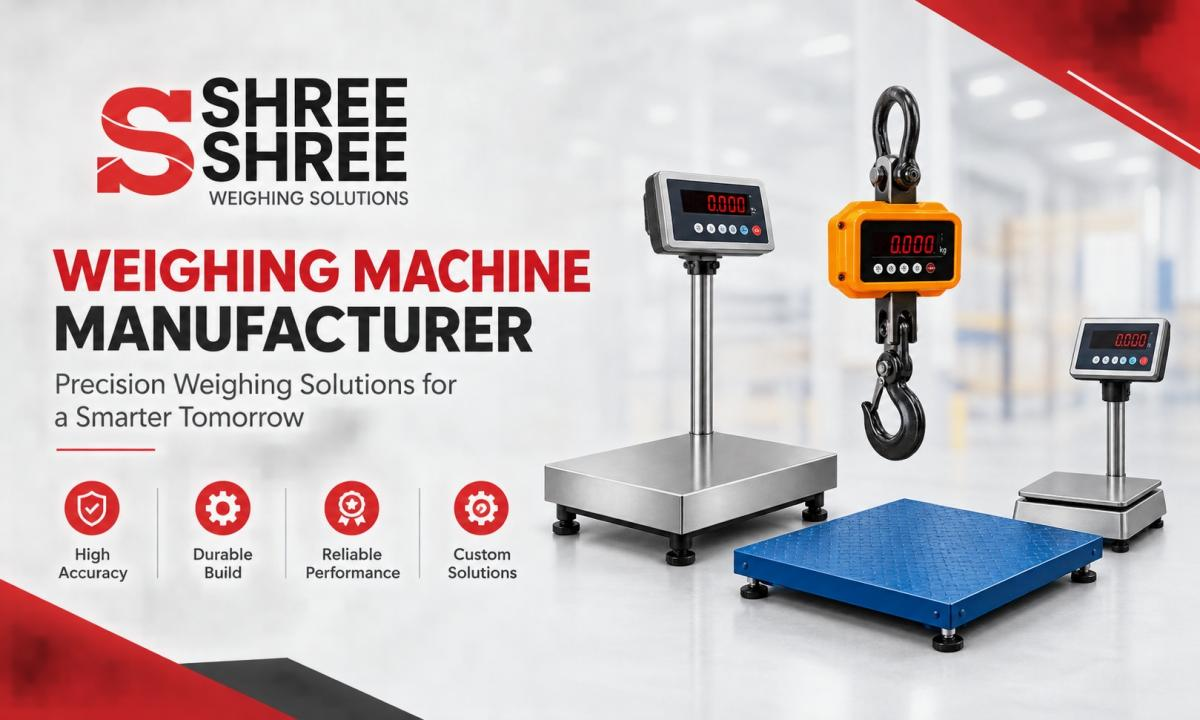
Accuracy is one of the most crucial criteria in sectors where measurements affect the quality of the manufactured products, transactions, stock management, and operating effectiveness. In factories, warehouses, laboratories, retail stores, logistics centers, etc., weighing scales have their indispensable place in the process flow. An even slight measurement deviation can result in wastage of materials, miscalculations in billing, inconsistent production, etc.
The work of any accurate weighing scale is based on the complex of technical and other aspects such as engineering, sensors, calibration, and quality control. The selection of the manufacturer of weighing scales, thus, is a rather important step for businesses that operate with accuracy of measurements.
Contemporary weighing scales are constructed with the application of modern hardware and technologies of measurements. Nevertheless, accuracy is influenced not only by the technological side of the issue but also by design and manufacturing of the product, working conditions, installation, maintenance, and other aspects.
Shree Shree Weighing Solutions is an appropriate name for those who are looking for measuring scales and technologies. Knowledge of the scientific principles of construction of weighing scales will help to find appropriate products and make reasonable purchase decisions.
Science behind Weight Machines
The weighing machine is essentially a device that determines the gravitational force acting on an object's mass and converts this force to a readable measurement of its weight. Modern electronic weighers usually employ the technology of load cells to accomplish this task.
A load cell is a special sensor that reacts to an applied force. In many cases, weighing machines use strain gauge load cells. The application of a load to the measuring platform causes a slight change in shape of the sensor which results in the change of electrical resistance of the strain gauges installed to it.
This electric signal is then converted to the measurement of weight by an electronic circuit.
It depends on several factors such as sensor sensitivity, mechanical design of the system, electronics of the circuit, calibration and the stable environment.
A reliable manufacturing company of weighing machines is concerned with the combination of all these factors to create a machine for particular conditions of usage.
The Significance of Load Cell Technologies in Ensuring Accuracy in Measurements
Load cells are the most crucial elements of modern electronic scales. The performance and features of load cells define the accuracy of the measurement result.
There are several types of load cells for different purposes.
Strain Gauge Load Cells
This type of load cell is extensively used in industrial and commercial scales. They measure the variation of electrical resistance induced by mechanical deformation under applied loads.
Compression Load Cells
Such type of load cells is intended for measuring compressive forces and is widely used in some special heavy-duty scales, such as tanks, silos, industrial platforms, and others.
Single-Point Load Cells
They are frequently used in smaller platform scales. The construction of these load cells makes it possible to measure loads applied at various points of the specified platform area.
Digital Load Cells
These load cells have integrated electronics that allow them to manage the signals and communicate with compatible scales.
Choosing the suitable load cell depends on several factors.
The Importance of Calibration for Precision Accuracy
Calibration is a key process in ensuring the accuracy of weighing devices. Environmental factors, wear-and-tear, use over time, and component aging may influence measuring results.
Calibration means the verification of the measurement data of a device against known reference points under certain conditions. In case any discrepancies appear, necessary corrections may need to be made.
Weighing equipment manufacturers take into account the necessity of calibrations when designing their products and offering after-sale service.
Advantages of Calibration
-
Detection of any deviations from measurements.
-
Ensures consistent weighing operations.
-
Increases certainty in measurement results.
-
Enables companies to comply with any measurement needs.
-
Reduces possible mistakes in production and business processes.
The frequency of calibration is determined by various factors. They include the type of device, operating conditions, accuracy needs, and laws.
Quality Manufacturing and Engineering Requirements
Precision starts way before the manufacture of a weighing machine comes into possession of a buyer. The quality of design, materials, components, assembly and testing all affect the performance of such machines.
A reliable weighing machine manufacturer must have adequate quality control processes in place during the manufacturing process.
Selection of material: Sturdy and suitable material ensures structural stability and supports load capacity.
Sensitivity of sensors: Proper choice of load cells affects measurement sensitivity and repeatability.
Reliable electronics: Electronic circuits ensure the processing of sensor signals.
Mechanical design: Suitable mechanical design reduces mechanical effects on readings.
Product Testing: Performance and functional tests can detect any manufacturing defect before delivering the product.
Consistency of manufacture is of particular importance in case of bulk purchases by organizations. Similar products should perform consistently under similar conditions within the specified specification range.
Environmental Conditions That Influence Weighing Precision
Even if the weighing machine is designed to have high accuracy, it will still give inaccurate measurements if the environmental conditions are not favorable.
A number of external factors can contribute to poor performance of the instrument.
Temperature Fluctuations
Temperature changes can have an effect on load cell performance, electronics, and mechanical dimensions. The proper equipment must be chosen based on the operating temperature range.
Vibrations and Motion
Weighing instruments placed near large machinery, mobile vehicles, or vibrating assembly lines may give fluctuating readings. Proper installation and appropriate vibration reduction measures will improve performance.
Dampness and Dust
Dampness, humidity, and dust can be present in industrial environments. Customers must ensure the environmental resistance of the equipment before purchasing it.
Installation Surface Instability
An unstable installation surface will have an effect on the readings of the weighing instrument. The equipment must be properly installed on an appropriate foundation.
Knowledge of these conditions will help businesses buy the proper machine for their actual operating conditions.
The Right Weighing Machine Supplier
A weighing machine supplier is not chosen only on the basis of the price of the offered equipment. Some other parameters should be considered:
-
List of products: It is necessary to check if the manufacturer produces platform scales, industrial scales, bench scales, analytical balances, weighbridges, and other devices needed by the company.
-
Technical parameters: They include such data as the maximum capacity, readability, accuracy class, size of the platform, etc.
-
Quality documents: Request the necessary technical documents and certificates.
-
Customizability: See if the offered equipment may be customized to the needs of the industry.
-
Post-sales services: See if installation, maintenance, calibration, and repair are provided.
-
Availability of spare parts: Find out if the necessary spare parts and technical assistance are available in case they are needed.
Shree Shree Weighing Solutions may be considered while looking for suppliers of weighing machines. The buyers need to check the list of products, technical data, post-sale services, and warranties themselves.
Digital Technology in the Future of Weighing Machines
Technological advancements are influencing the methods through which weighing machines capture, process and communicate measurement data.
Modern electronic devices could consist of digital display, data storage capabilities, computer integration and incorporation with inventory or enterprise management software.
These features assist organizations in keeping organized records and minimize manual entry of data.
For instance, an industrial firm could incorporate weighing machines into the production process for recording of raw materials. Warehouses could apply digital weighing technology to keep shipping records.
Advanced technologies can also be applied in automation of batching, filling and process monitoring operations. Such technologies are useful in increasing workflow efficiency when properly set up.
In the future of weighing technologies, there would be increased connectivity, diagnostics and measurement process integration. Nonetheless, accuracy of sensors, proper calibration and engineering would still be crucial.
Importance of Maintenance and After-Sales Service
Purchase of a weighing machine is not an end but rather just the first step towards its operation. The significance of regular maintenance of the weighing machine lies in ensuring that the performance remains optimal and potential issues are detected before they become a problem to the business operations.
The users of weighing machines should ensure that the weighing machines remain clean, do not overload them, prevent the equipment from unnecessary impacts, and check the cable, display, and the mechanical parts regularly.
The calibration and servicing of the weighing machines should be done as per the guidelines of the equipment manufacturer.
After sales services are also useful when businesses need technical support, replacement parts, installation, or troubleshooting of weighing machines.
Precision weighing is dependent on several interrelated technologies and quality assurance processes. The performance of load cell technology, electronic circuitry, mechanical design, calibration and adaptability to the environment all contribute to the precision of a weighing machine.
Selection of the appropriate weighing machine manufacturer will allow companies to acquire the measuring equipment which fits their needs and ensures consistent performance of measurements. Customers have to consider technical specifications, quality of the products, calibration services and after-sale services, rather than concentrating only on purchase cost.
When selecting weighing equipment for companies’ measuring needs, Shree Shree Weighing Solutions may be considered as a company to look into. By selecting adequate technology along with installation, calibration and maintenance of the weighing equipment, businesses will be able to increase the reliability of measurements and optimize their activities.
Finally, the science behind precise weighing is not limited to the display of a right number. It is based on the confidence in each of the measurement results.
FAQ
1. What is a weighing machine manufacturer responsible for?
A weighing machine manufacturer creates, designs, develops, assembles, tests, or provides weighing machines of various types.
2. How does a digital weighing machine work?
In most cases, a digital weighing machine operates with load cells, which are responsible for receiving the force exerted on an object. The received electrical signal is processed by electronics to get the weight value.
3. Why should you perform calibration for your weighing machine?
Calibration is used to determine the measurement capabilities of your weighing machine compared to reference standards.
4. What can influence weighing machine accuracy?
The list of elements that may impact the weight value includes load cell quality, temperature changes, vibration, uneven installation, moisture, mechanical wear, and calibration issues.
5. How to choose a weighing machine manufacturer?
Consider all of the following aspects: product specifications, manufacturing quality, provided equipment, technical documents, calibration opportunities, warranty conditions, spare parts, and after-sales services.

Shree Shree Weighing Solutions is a leading manufacturer and supplier of industrial, digital, and electronic weighing scales based in Ahmedabad, Gujarat, India. The company offers precision-engineered weighing solutions designed for industries such as manufacturing, logistics, retail, laboratories, food processing, dairy, healthcare, and warehouses. () With over 30 years of experience, Shree Shree Weighing Solutions is known for delivering reliable, durable, and highly accurate weighing machines along with exceptional after-sales support. Their extensive product range includes industrial weighing machines, table top scales, platform scales, hanging scales, gold weighing machines, analytical balances, crane scales, luggage weighing scales, food weighing machines, and currency counting machines.
















Comments (0)