

Working With an Offshore App Development Agency: A Practical Playbook
Hiring an offshore app development agency? Use this playbook for briefs, contracts, time zones, security and budgets so your remote project stays on track.

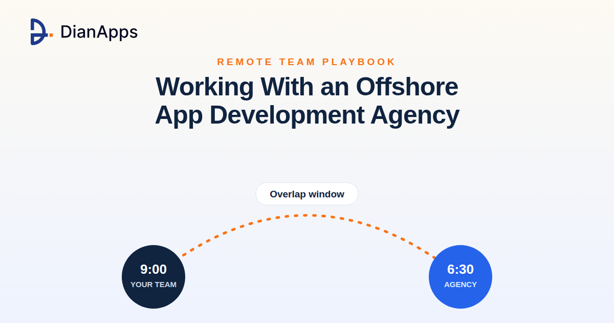
The sprint demo is at 7:30 in the evening your time. The designer you were promised is not on the call. And the login screen has a bug that nobody mentioned in the weekly update.
If you have worked with a remote team, a day like that sounds familiar. It is also avoidable. The country your team sits in is rarely the problem. The setup around the work is.
Hiring an offshore app development agency can give you more skill for your budget and a faster start. This playbook shows how to get those benefits without the late nights: what to write before you sign, how to run the relationship week by week and which warning signs to take seriously.
Quick takeaways
· Offshore saves money only when communication, scope and ownership are clear from day one.
· Pick the engagement model that matches how certain your scope is.
· Agree a daily overlap window instead of hoping time zones will sort themselves out.
· Own your code, design files and accounts from the first week.
· Budget for your own time, third-party services and life after launch.
Is offshore the right call for your app?
For many projects, yes. An established agency has designers, developers and testers on staff, so work can start in days instead of months. You also reach a bigger pool of experienced mobile app developers than one city can offer, and costs are often lower because local expenses differ.
But a low rate is not a low total. A cheap team that misreads the brief, replies slowly and rebuilds screens three times can cost more than a pricier partner who gets it right once. Treat the hourly rate as one number on a longer list.
Offshore tends to work well when the scope is clear, you can give quick feedback and you want a full team without hiring one. It works less well when the product changes daily, nobody on your side can decide fast or the work depends on deep local knowledge. In those cases, a smaller local team or a hybrid setup may fit better.
Step 1: Write a brief an agency can actually price
Vague briefs produce vague quotes. Before you contact anyone, write one page that covers:
1. What the app does, in two sentences.
2. Who uses it and what they need to finish in the first minute.
3. Platforms: Android, iOS or both.
4. Must-have features and nice-to-haves, in separate lists.
5. Integrations such as payments, maps or existing systems.
6. Your budget range and the date you cannot miss.
Send the same brief to every agency you speak with. It makes quotes comparable and shows you who asks sharp questions. If you are still sizing the project, our guide to outsourcing software development in India explains what to hand over and what to keep.
Step 2: Choose an engagement model that fits your scope
How you pay shapes how the team behaves. Four models cover most projects.
· Fixed price. Good for a small, well-defined scope. Changes cost extra, so spell the scope out.
· Time and materials. Good when you expect the product to change. You pay for hours, so insist on visibility.
· Dedicated team. A group that works only on your product, billed monthly. Good for long-running work.
· Milestone-based. Payments tied to delivered stages. A fair middle path with clear checkpoints.
If you only need extra hands inside your own process, IT staff augmentation lets you add remote engineers who report to you.

Step 3: Fix the time zone before it fixes you
India Standard Time runs 5 hours and 30 minutes ahead of UTC. For a team on the US East Coast that means a gap of about nine and a half to ten and a half hours, depending on daylight saving time. Normal working hours barely touch.
You will not close that gap, but you can manage it. Agree on a daily overlap of even one or two hours for questions and decisions. Use short written updates for everything else. Many teams find the gap helps: you leave feedback at the end of your day and wake up to new work.
Step 4: Build communication rules everyone follows
Good remote work runs on a few boring habits.
· One chat channel for daily talk and one place for decisions, so approvals never hide in side threads.
· A weekly call with an agenda beforehand and notes afterward.
· A shared task board where anyone can see what is in progress, blocked or done.
· A working demo at the end of every sprint.
· One named contact on each side who can say yes or no quickly.
Write down what "done" means, too. A feature is done when it is built, tested, reviewed and demonstrated, not when one developer finishes their part.
Step 5: Lock down ownership and security
Contracts are dull until something goes wrong. Before you sign, get these in writing:
1. You own the source code, design files, store accounts and cloud accounts.
2. The work lives in repositories you control from day one.
3. A non-disclosure agreement covers your idea and your data.
4. The agency states who can access your systems and how.
5. There is an exit plan: how code and knowledge transfer if you part ways.
Ask how the agency handles code review, secrets, access control and any use of AI tools with client code. For more on contract points that non-technical founders miss, see our post on hiring developers on a contract.
Step 6: Keep quality visible from far away
Distance hides problems unless you build ways to see them. Ask for access to the code repository, the task board and the test reports in week one.
Skim the commit history now and then. Small, regular commits from several people usually mean a healthy team. Long silence followed by one huge upload deserves a question. Mobile app development services should include testing on real devices, not only emulators, with a note of which phones and system versions were covered.
Then run your own checks. Install every build, try the main journeys and note what feels slow or confusing. You do not need to be technical to see that a button does nothing.
Ask about the skills you actually need
"We do everything" is not an answer. Match the team to your product. For android app development, ask whether the agency works in Kotlin and Jetpack Compose and tests across many device models. For iOS, ask about Swift experience and App Store review history. If you want both platforms, ask who owns platform-specific problems and how the team handles them.
Ask for two or three live apps similar to yours and read their store reviews. Then ask what the team would do differently today. Honest answers to that question tell you more than a polished portfolio.
Step 7: Budget for more than the quote
The quote is rarely the whole bill. Plan for these as well:
· Your own time for reviews and decisions.
· Third-party services such as payments, maps and notifications.
· Store fees and developer accounts.
· Changes in scope after the first demo.
· Maintenance after launch, often around 20 percent of the build cost per year.
Ask the agency to list what is included and what is not. A clear estimate with named assumptions beats a low number with a fuzzy scope.
A quick self-check before you sign
Pause and ask yourself four things. Can I describe the product in two sentences? Do I know who will approve work on my side? Have I read the contract's sections on ownership and exit? Do I have a budget line for changes and for life after launch? If any answer is no, fix it first. A day spent on these questions is far cheaper than a month spent untangling a misunderstanding.
Your first 30 days
· Week 1, kickoff. Share the brief, meet the team, agree on tools and meeting times.
· Week 2, discovery. The team asks questions, ranks features and proposes a plan.
· Week 3, design. Review early flows and answer quickly.
· Week 4, first demo. Try the app, check the repository and review how the team works.
If something feels off at the end of month one, say so. Early fixes are cheap.

Alt text: Infographic: a first-30-days checklist for working with an offshore app development agency | File: article23v2-30days.png
Warning signs worth taking seriously
· Vague answers about who will work on your project.
· No access to the repository.
· A price far below every other quote.
· Slow replies before you sign, which tend to get slower after.
· No past clients you can speak to.
· No written testing or security process.
One may be a bad day. Several together are a pattern. Our guide on how to choose an app development partner adds more questions to ask.
Final word
Offshore projects succeed on clarity, not geography. Write a tight brief, choose a fitting model, agree overlap hours, own your assets and keep an eye on quality and cost. Do that and the distance stops mattering.
If you want to see this approach in practice, DianApps works with clients across the USA, Canada, Australia and the UAE through a dedicated team or milestone-based model, with mobile app development services from planning to long-term support. As a mobile app development company, it also supports custom mobile app development, mobile application development and Android application development, and you can hire mobile app developers or extend existing products with its application development services.















Comments (0)