

3D Printing Australia: Turning Engineering Changes Into Faster Product Improvements
Product development rarely follows a straight line. A concept is designed, tested, modified, tested again and often redesigned several times before it becomes a finished product. Traditional manufacturing methods can make these changes expensive and time-consuming, particularly when every revision requires new tooling, specialist machining or large production commitments.
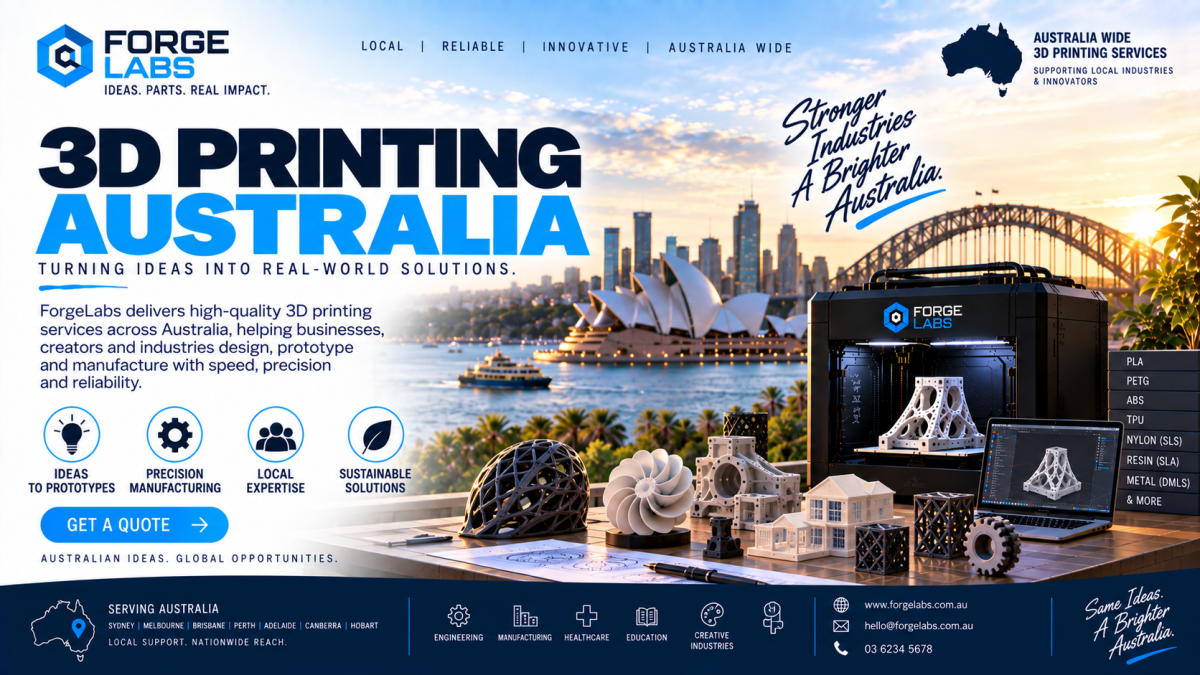
Product development rarely follows a straight line. A concept is designed, tested, modified, tested again and often redesigned several times before it becomes a finished product. Traditional manufacturing methods can make these changes expensive and time-consuming, particularly when every revision requires new tooling, specialist machining or large production commitments.
3D printing Australia is helping businesses approach this process differently. By connecting digital design with on-demand physical production, additive manufacturing can make it easier to evaluate ideas, change components and produce updated parts without rebuilding an entire manufacturing process.
For engineering teams, product developers, designers and manufacturers, this flexibility can be especially valuable during periods of rapid design change.
Why Engineering Changes Matter in Modern Manufacturing
Engineering changes are a normal part of developing a product. A prototype may reveal that a bracket needs additional reinforcement. A housing may need a different opening for a cable. A handle may need to be reshaped for better ergonomics. A production component may need to be lighter, stronger or easier to assemble.
These changes can look simple on a CAD screen, but the manufacturing implications can be significant.
With conventional tooling-based production, design changes may require modifications to moulds, fixtures or other production equipment. Depending on the component, even a relatively small alteration can create additional cost and delay.
Additive manufacturing approaches the problem differently. The digital model is changed first, and the revised geometry can then be manufactured directly from that updated file.
This creates a much closer relationship between engineering decisions and physical production.
From CAD Revision to Physical Part
One of the strongest advantages of 3D printing Australia is the connection between digital engineering and physical output.
A typical development cycle can look like this:
- Create or modify the CAD design.
- Review dimensions, geometry and functional requirements.
- Select an appropriate manufacturing process and material.
- Produce the updated component.
- Test fit, performance or appearance.
- Record the findings and revise the design.
- Manufacture the next version.
Instead of treating prototyping as a separate stage, companies can use additive manufacturing throughout the product lifecycle.
This can be particularly useful when several design variables need to be evaluated simultaneously.
Making Prototype Validation More Practical
A prototype has a specific purpose: it should provide useful information.
A visual prototype might help a design team assess form, scale and appearance. A functional prototype may be used for fit testing, assembly trials, movement checks or basic performance evaluation.
Different additive manufacturing technologies can support different objectives.
FDM can be useful for durable functional prototypes and engineering components. SLA can provide highly detailed parts with smooth surfaces. SLS and MJF can produce complex polymer components suitable for more demanding functional testing, while metal additive manufacturing can be considered when the application requires metallic properties. Forge Labs currently lists FDM, SLA, SLS, HP MJF and metal 3D printing among its manufacturing capabilities.
The value comes from choosing the process according to what the prototype needs to demonstrate.
Supporting Faster Design Iterations
Design iteration becomes more effective when the cost and effort of making another version remain manageable.
Suppose an engineering team discovers that a component is difficult to assemble. The CAD model can be adjusted to introduce a chamfer, modify a mounting point or increase clearance. The revised design can then be produced for another test.
This creates a shorter feedback loop.
The faster the loop becomes, the more opportunities a team has to identify weaknesses before committing to production tooling or high-volume manufacturing.
Forge Labs describes rapid prototyping as a process intended for iterative design development and states that prototypes can be revised between print runs without tooling changes.
That approach can be particularly useful for startups and engineering teams working under tight development schedules.
Design Freedom Without Immediate Tooling Commitments
Tooling remains highly valuable for many mature products, particularly when volumes are high and the design is stable. The challenge occurs when the design is still evolving.
At that stage, committing too early to permanent tooling can limit flexibility.
3D printing Australia provides an alternative pathway in which parts can be produced directly from digital files. This makes additive manufacturing useful for:
- Concept validation
- Fit-and-function testing
- Custom enclosures
- Engineering brackets
- Assembly aids
- Product demonstrators
- Fixtures and jigs
- Replacement components
- Low-volume parts
The technology does not eliminate conventional manufacturing. Instead, it creates another option within the wider manufacturing workflow.
Custom Components for Specific Applications
Not every component needs to be identical to every other component.
Some businesses require parts adapted to a particular machine, installation, product configuration or customer requirement. Conventional mass-production systems are generally optimized around repeatability and volume, whereas additive manufacturing can make economically viable customization easier.
A digital model can be adjusted for different dimensions, mounting patterns, interfaces or functional requirements.
This makes 3D printing Australia relevant for businesses that need tailored physical components without setting up a completely new manufacturing line for every variation.
Functional Testing Can Influence Final Design
One of the biggest mistakes in product development is assuming that a design will behave exactly as expected because the CAD model looks correct.
Real-world testing can expose problems that are difficult to identify digitally.
A prototype may show:
- Unexpected flexing
- Interference between components
- Poor access for assembly
- Inadequate clearances
- Difficult fastening
- Weight distribution issues
- Uncomfortable handling
- Insufficient wall thickness
- Heat-related concerns
- Problems with maintenance access
Once these issues are identified, the digital design can be changed and another physical version can be produced.
This turns the prototype into a source of engineering data rather than simply a demonstration model.
Material Selection Should Follow the Application
A major part of successful additive manufacturing is material selection.
The material should be considered in relation to the part's environment and intended function. Factors can include:
- Mechanical loading
- Temperature exposure
- Chemical contact
- UV exposure
- Flexibility
- Wear
- Surface requirements
- Weight
- Dimensional stability
For example, an appearance-focused concept model may not require the same material characteristics as a fixture expected to withstand repeated mechanical loads.
Forge Labs lists engineering thermoplastics including PETG, ABS, ASA, polycarbonate and nylon within its FDM capability, while its broader service offering includes multiple polymer and metal processes.
Selecting the manufacturing process and material together is therefore more important than choosing a printer based purely on speed or price.
Moving From Prototype to Low-Volume Production
The product lifecycle does not always move directly from prototype to mass production.
There can be a valuable middle stage where demand is still uncertain, market feedback is being collected or production volumes remain relatively modest.
This is where additive manufacturing can support low-volume production.
Instead of investing immediately in production tooling, a business can manufacture a smaller quantity of components and use them for:
- Early customer releases
- Field testing
- Pilot programs
- Limited product launches
- Market validation
- Custom orders
- Replacement inventory
Forge Labs currently promotes low-volume production alongside its additive manufacturing services, allowing businesses to use digital production for shorter runs before moving into other manufacturing methods where appropriate.
Reducing the Friction of Engineering Changes
Engineering changes become difficult when the physical manufacturing process is disconnected from the design process.
A digital manufacturing workflow reduces some of that friction because the CAD file remains central to production.
An updated file becomes the basis for the next production iteration.
This can be particularly useful when products are continuously improved after launch. Changes may be made in response to field feedback, assembly experience, customer requests or manufacturing observations.
Instead of treating every modification as an exceptional event, businesses can establish a repeatable process for controlled design updates.
Digital Manufacturing and Replacement Parts
Another area where 3D printing Australia can support businesses is replacement-part production.
Manufacturers sometimes encounter situations where an older component is no longer commercially available. Replacing the complete machine or system may be impractical, while commissioning traditional tooling for one obsolete part may not make economic sense.
A suitable replacement may be produced from an existing CAD file, scanned geometry or reverse-engineered component, depending on the application and available information.
Forge Labs lists professional 3D scanning, reverse engineering and CAD modelling among its capabilities, which can support workflows where a physical component must be converted back into usable digital geometry.
This can help businesses maintain older equipment without depending exclusively on legacy supply chains.
Improving Supply Chain Responsiveness
Digital production can also change how companies think about inventory.
Traditional inventory planning often requires businesses to manufacture, store and distribute physical stock in advance. Additive manufacturing can enable some components to be produced closer to the point of requirement.
For selected parts, businesses may maintain digital files rather than large quantities of physical inventory.
When demand arises, the component can then be manufactured according to the approved design.
This model is not suitable for every product, but it can be valuable for specialized components, replacement parts and low-volume applications.
The Importance of Design for Additive Manufacturing
Successful 3D printing Australia projects begin before the printing stage.
A component designed specifically for additive manufacturing can often take better advantage of the technology than a component simply copied from a traditional manufacturing approach.
Design considerations may include:
- Wall thickness
- Build orientation
- Support requirements
- Internal channels
- Fastening methods
- Tolerances
- Part consolidation
- Surface requirements
- Post-processing
- Material behaviour
Forge Labs also lists DfAM consulting and CAD/product-development support as part of its broader capabilities, allowing design considerations to be addressed alongside manufacturing.
This engineering-first approach can be important when the objective is a functional production component rather than a basic visual model.
Choosing the Right Manufacturing Route
3D printing should not automatically replace machining, moulding or other established processes.
The right solution depends on the project.
A useful decision process considers:
Part quantity: A one-off component has different economics from thousands of identical parts.
Geometry: Complex internal structures may favour additive manufacturing.
Material: Some applications require a specific polymer, composite or metal.
Tolerance: Critical dimensions may determine which production technology is appropriate.
Surface finish: Cosmetic requirements may require additional finishing or a different process.
Lead time: Urgent parts may benefit from a digital production route.
Lifecycle stage: Prototype, pilot, low-volume production and mature mass production can each require different approaches.
The goal is not simply to print more parts. It is to select the manufacturing method that makes technical and commercial sense for the application.
Why Businesses Are Taking a More Flexible Approach
Modern product development increasingly depends on speed, customization and the ability to respond to change.
Businesses may need to test several versions before finalizing a design. They may need small quantities before demand is proven. They may need replacement parts years after an original product was released.
These requirements can be difficult to address efficiently with a single manufacturing method.
3D printing Australia provides a flexible layer within the broader manufacturing ecosystem. It can connect CAD development, prototyping, functional testing, customization and shorter production runs.
Forge Labs positions its manufacturing services around this broader concept, combining additive manufacturing with CAD, CNC machining, injection moulding, scanning and other production services.
Building a More Responsive Product Lifecycle
The real value of additive manufacturing is not limited to the printer itself.
Its bigger contribution can be seen in how companies manage product development.
A business can create a digital model, manufacture a physical version, test it, collect feedback, modify the design and produce another version. Later, the same digital workflow can support low-volume production, replacement parts or manufacturing handover.
This creates continuity across the product lifecycle.
Instead of viewing prototyping, engineering and manufacturing as completely separate activities, businesses can connect them through a shared digital foundation.
Final Thoughts
3D printing Australia is becoming increasingly relevant for businesses that need to respond quickly to design changes, produce customized components and develop products through repeated physical testing.
Its strength lies in flexibility.
From an early concept to a functional prototype, from an engineering change to a replacement component, and from a small production requirement to a more established manufacturing process, additive manufacturing can provide a practical connection between digital design and physical production.
For companies evaluating this technology, the most important step is not simply choosing a printer. It is understanding the part's purpose, material requirements, production volume, tolerances, finishing needs and position within the wider product lifecycle.
With the right process and engineering approach, additive manufacturing can become more than a prototyping tool. It can become a practical part of how modern products are designed, tested, improved and manufactured.
At forgelabs, we provide professional 3D printing services in Australia for businesses, startups, engineers, and creators. We help turn ideas into real products with clean, accurate, and reliable results. We offer FDM 3D printing, resin printing, nylon parts, metal 3D printing, and full support services like CAD design, 3D scanning, and reverse engineering. From rapid prototyping to custom parts and small batch production, we handle every project with care and attention to detail. forgelabs proudly serves Melbourne, Sydney, and all of Australia. Our clients trust us for fast turnaround, strong materials, fair pricing, and clear communication. If you are looking for the best 3D printing services in Australia, then you are at right place








Comments (0)