

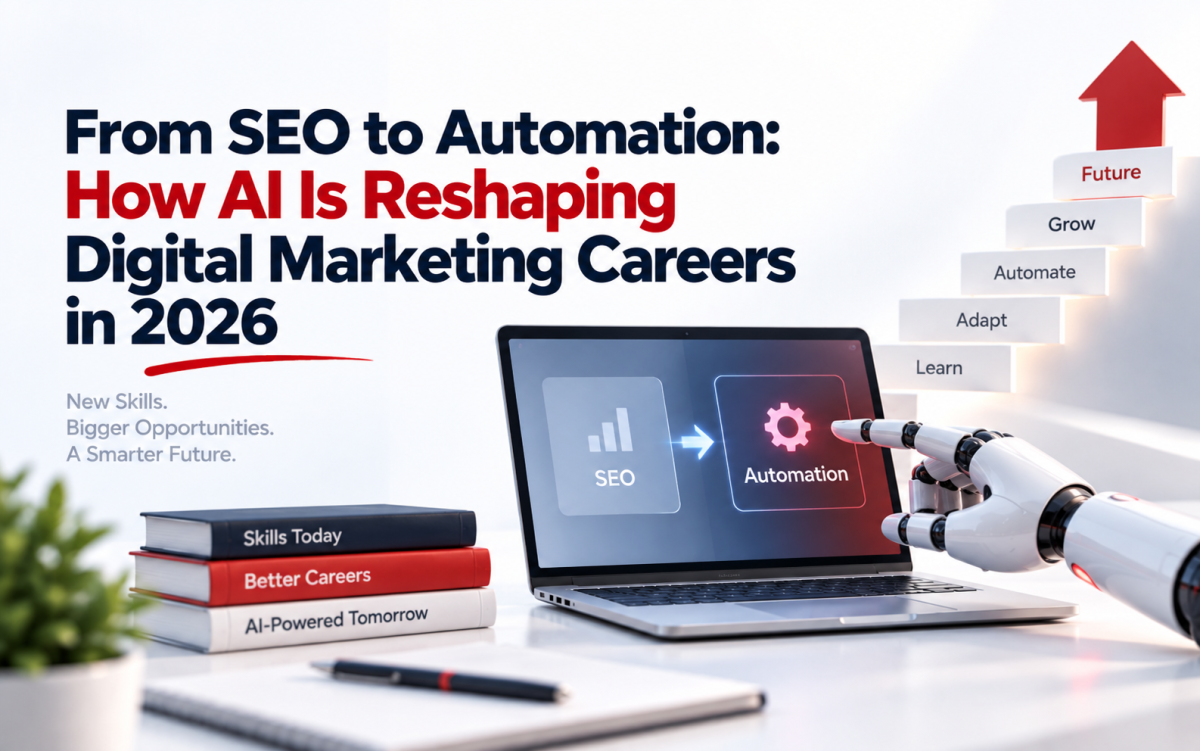
From SEO to Automation: How AI Is Reshaping Digital Marketing Careers in 2026
Ask a digital marketer in 2020 what their job involves and you'd get answers like keyword research, ad copy, and campaign reporting. Ask the same question in 2026 and AI shows up in almost every part of the answer. It's not that the core disciplines of marketing have disappeared, it's that AI has quietly rewired how each one gets done, and that shift is now directly influencing who gets hired.

SEO Has Split Into Two Disciplines
Traditional SEO, keyword targeting, on-page optimisation, backlinks, still matters. But a second layer has emerged alongside it: optimising for AI-driven search and answer engines, often called Generative Engine Optimisation (GEO). Marketers who understand both how Google ranks pages and how AI tools summarise and cite content are becoming significantly more valuable than those trained only in the older model.
Content Creation Has Moved From Manual to Managed
Nobody is writing every blog post, ad variation, and social caption from scratch anymore, at least not efficiently. AI has taken over the first-draft layer of content production. What's changed is the marketer's role: less about typing every word, more about directing AI output, maintaining brand voice, and editing for accuracy and strategy. This shift rewards people who can manage AI content pipelines, not just write well.
Paid Advertising Runs on Automated Systems
Smart bidding, performance max campaigns, and AI-driven audience targeting have replaced a lot of manual campaign management on Google Ads and Meta Ads. The marketers who thrive here aren't the ones fighting automation, they're the ones who know how to feed it the right signals and interpret its output correctly.
Analytics Has Become Predictive, Not Just Reportive
AI-based analytics tools now flag trends and anomalies before a human would notice them in a spreadsheet. This has changed what "data-driven marketing" actually means. It's less about pulling reports and more about acting on AI-surfaced insights quickly enough to matter.
What This Means for Career Planning
Job titles are evolving alongside these shifts. Roles like AI marketing specialist, marketing automation specialist, and growth marketer are appearing more frequently in job postings, often sitting alongside more traditional titles like SEO expert or performance marketer. The common thread across nearly all of them is comfort working with AI tools as part of daily workflow, not as an occasional experiment.
Building These Skills Deliberately
Because these changes are structural rather than temporary, ad hoc learning, watching a few YouTube tutorials, rarely builds the depth employers are now screening for. Structured, project-based training tends to close that gap faster. Digi Uprise in Delhi has built its AI digital marketing programs around this exact shift, covering AI-based SEO and GEO, automated ad management, content workflows, and marketing automation across 3-month, 6-month, and 1-year formats, with live projects and placement support included.
Final Thought
Digital marketing hasn't been replaced by AI, it's been restructured by it. The marketers who understand that distinction, and build their skills accordingly, are the ones positioning themselves for the roles this shift is creating rather than the ones it's phasing out.








Comments (0)