

Contact Lenses Market to Grow at a CAGR of 4.92% Through 2034
The global contact lenses market grew from USD 9.4 Billion in 2025 to USD 10.1 Billion in 2026. The market is projected to reach USD 14.8 Billion by 2034, exhibiting a CAGR of 4.92% from 2026-2034.

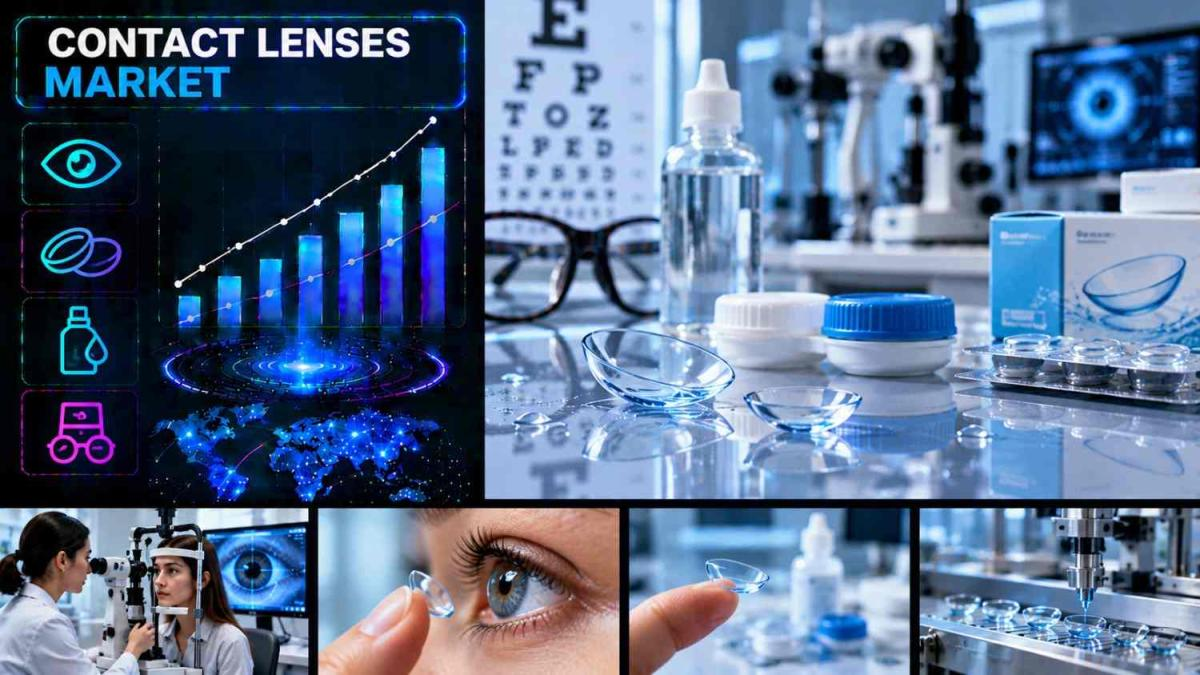
IMARC Group, a leading global market research and management consulting firm, has published its latest market intelligence report on the contact lenses market. The global contact lenses market grew from USD 9.4 Billion in 2025 to USD 10.1 Billion in 2026. The market is projected to reach USD 14.8 Billion by 2034, exhibiting a CAGR of 4.92% from 2026-2034. Growth is driven by the rising prevalence of refractive errors, an ageing global population, rapid advances in silicone hydrogel materials and daily disposable formats, and wider access through e-commerce and tele-optometry channels.
Demand is accelerating as modern lifestyles and eye health needs increasingly overlap. Prolonged screen exposure and reduced outdoor light exposure are raising the incidence of myopia, hyperopia, and astigmatism across age groups. The World Health Organization estimates that at least 2.2 billion people live with near or distance vision impairment, and about 30% of them are in South-East Asia. Self-reported digital eye strain among screen users in the United States ranges between 60% and 69%, which keeps vision correction in steady demand. Contact lenses offer a wider field of view, freedom from frames, and comfort for active lifestyles, and they are becoming a mainstream alternative to eyeglasses in both mature and emerging economies.
How AI is Reshaping the Future of the Contact Lenses Market
- AI-Enabled Smart Contact Lenses and Biosensing: Researchers and start-ups are embedding micro-sensors and AI-driven analytics into lenses to track parameters such as intraocular pressure and glucose-related biomarkers in tear fluid. Infrared-sensing lens research published in the journal Cell in May 2025, and three smart lens prototypes shown by XPANCEO at MWC in March 2025, point to a shift from vision correction to continuous health monitoring.
- Digital Lens Fitting, Tele-Optometry, and Remote Eye Exams: AI-assisted retinal imaging, automated refraction, and remote practitioner consultations are widening access to eye exams in under-served regions. Patients can complete assessments at home and receive prescriptions faster, which supports repeat purchases through online and eye care practitioner channels.
- Data-Driven Myopia Management and Personalized Prescribing: Machine learning tools help practitioners match multifocal, toric, and orthokeratology designs to a patient’s axial length, corneal shape, and progression risk. This reduces trial-and-error fitting and improves comfort and retention, particularly among children and presbyopic adults.
Grab a sample PDF of this report: https://www.imarcgroup.com/contact-lenses-market/requestsample
Contact Lenses Market Trends and Drivers
The contact lenses market is witnessing steady expansion, supported by demographic change, material innovation, and shifting consumer purchasing behavior. Three forces stand out.
Vision disorders are growing across the age spectrum. Rising myopia among younger populations and rising presbyopia among older adults are expanding the addressable user base at both ends. Growing middle-class populations in Asia Pacific and Latin America, with higher disposable incomes and greater awareness of vision correction, are converting spectacle wearers into contact lens users.
Comfort-focused technology is changing how lenses are worn. Silicone hydrogel materials allow greater oxygen transmission, and they now hold 87.8% of the material segment. Daily disposables are also gaining ground. In one survey published by Elsevier, daily disposable prescribing rose from 17.1% to 46.7% of daily wear soft lens fits. Hygiene, convenience, and lower infection risk explain this move away from reusable lenses. Specialty designs are following the same path, including blue-light-filtering, scleral, and orthokeratology lenses.
Cosmetic and lifestyle demand is adding a new layer of growth. Colored and cosmetic lenses are benefiting from social media influence and the expanding online beauty market, which stood at USD 64.7 Billion and is projected to reach USD 141.4 Billion. E-commerce platforms also give consumers easier price comparison, subscription replenishment, and home delivery, which strengthens retention.
Public health spending reinforces this base. In the United Kingdom, the Association of Optometrists estimates that NHS General Ophthalmic Services return at least £2.1 billion to society on an investment of £525 million. In India, the National Programme for Control of Blindness and Visual Impairment funds screening and corrective care, which increases the number of people who receive prescriptions and become potential lens users. Contact lenses are regulated as medical devices in major markets, including by the US FDA, and this oversight builds consumer confidence in product safety.
Ask an analyst for customized report: https://www.imarcgroup.com/request?type=report&id=4006&flag=E
Contact Lenses Industry Segmentation
The report has segmented the market into the following categories:
Breakup By Material:
- Gas Permeable
- Silicone Hydrogel
- Hybrid
- Others
Silicone hydrogel accounts for the largest material share at 87.8%. Its high oxygen permeability supports extended wear, reduces dryness and corneal stress, and meets the comfort expectations of long-hours screen users.
Breakup By Design:
- Spherical
- Toric
- Multifocal
- Others
Spherical lenses lead the design segment with a 60.5% share, since they correct common myopia and hyperopia and have the widest prescription availability. Toric and multifocal designs are expanding as astigmatism and presbyopia are diagnosed more often.
Breakup By Usage:
- Daily Disposable
- Disposable
- Frequently Replacement
- Traditional
Daily disposable lenses hold the largest usage share at 33.2%, driven by hygiene, convenience, and lower maintenance needs.
Breakup By Application:
- Corrective
- Therapeutic
- Cosmetic
- Prosthetic
- Lifestyle-Oriented
Corrective applications account for the largest share at 45.0%, reflecting the scale of refractive errors worldwide. Therapeutic, prosthetic, and cosmetic uses add steady niche demand.
Breakup By Distribution Channel:
- E-Commerce
- Eye Care Practitioners
- Retail Stores
Retail stores command the largest channel share at 45.8%, supported by in-store fitting, optician advice, and established consumer trust, while e-commerce continues to gain ground through convenience and subscription models.
Breakup By Region:
- North America (United States, Canada)
- Asia Pacific (China, Japan, India, South Korea, Australia, Indonesia, Others)
- Europe (Germany, France, United Kingdom, Italy, Spain, Russia, Others)
- Latin America (Brazil, Mexico, Others)
- Middle East and Africa
North America dominates the global contact lenses market with a 38.0% share, driven by high awareness of vision correction, strong eye care infrastructure, and rapid adoption of premium daily disposable and multifocal products. Asia Pacific is a major growth frontier because of its large myopic population and rising incomes. In Japan, the ophthalmic devices market stands at USD 1,691 million. In Saudi Arabia, it stands at USD 265.4 million, which shows the rising investment in eye care across the Middle East.
Competitive Landscape
The report provides a comprehensive analysis of the competitive landscape in the contact lenses market with detailed profiles of all major companies, including:
- Alton Vision LLC
- Bausch & Lomb
- Carl Zeiss AG
- Contamac Holdings
- EssilorLuxottica
- Hoya Corporation
- Johnson & Johnson Services
- Menicon
- SEED Co.
- SynergEyes
- Cooper Companies
What Does The Full Report Cover?
If you are tracking the contact lenses market for investment decisions, market entry planning, competitive benchmarking, or strategic advisory, IMARC Group’s report gives you everything in one place:
- Complete market sizing with revenue forecasts covering the full projection period
- Quantified growth driver analysis with impact scoring across material, design, usage, application, distribution channel, and regional markets
- Sub-segment breakdowns for silicone hydrogel, gas permeable, hybrid, spherical, toric, multifocal, daily disposable, corrective, cosmetic, e-commerce, eye care practitioners, and retail stores with individual share data
- Country-level data for the United States, Canada, Germany, France, the United Kingdom, Italy, Spain, Russia, China, Japan, India, South Korea, Australia, Indonesia, Brazil, and Mexico
- Competitive profiles of 11 leading companies with strategic landscape assessment
- Porter’s Five Forces, value chain analysis, and pricing intelligence
- Latest product innovation trends covering daily disposables, multifocal and scleral designs, smart lenses, and sustainable packaging shaping market competition and consumer preference across key regional markets
Recent News and Developments in Contact Lenses Market
- June 2025: Alcon launched PRECISION1 daily disposable contact lenses in India. The launch brings a premium daily disposable option to one of the world’s fastest-growing eye care markets.
- May 2025: Bausch + Lomb launched Zenlens Chroma HOA scleral lenses in the United States, expanding its specialty range for patients with irregular corneas and complex vision needs.
- May 2025: Researchers published a study on infrared-sensing contact lenses in Cell, showing how lenses may extend human vision beyond the visible spectrum.
- April 2025: Bruno Vision Care received FDA permission to market Deseyne daily disposable lenses in the United States, adding a new participant to the competitive daily disposable segment.
- March 2025: XPANCEO showcased three smart contact lens prototypes at MWC, signalling growing commercial interest in lenses that combine vision, display, and health sensing.
- November 2024: CooperVision launched clariti 1 day multifocal 3 Add in Canada, widening options for presbyopic wearers.
- November 2024: Alcon launched PRECISION7, a one-week replacement lens, in the United States, targeting wearers who want a balance between daily and monthly replacement.
Note: If you require specific details, data, or insights that are not currently included in the scope of this report, we are happy to accommodate your request. As part of our customization service, we will gather and provide the additional information you need, tailored to your specific requirements. Please let us know your exact needs, and we will ensure the report is updated accordingly to meet your expectations.
Key Questions This Report Answers
- What is the current global contact lenses market size and what is its projected value?
- Which material segment holds the largest share in the global contact lenses market?
- What are the key drivers of global contact lenses market growth?
- Which region dominates the global contact lenses market and why?
- How are daily disposables, silicone hydrogel technology, and smart lens innovation reshaping product development and competitive strategies in the contact lenses industry?
- Who are the top companies in the global contact lenses market and what are their competitive strategies?
- What are the investment and market entry opportunities across corrective, therapeutic, cosmetic, and specialty contact lens segments?
About Us
IMARC Group is a global management consulting firm that helps the world’s most ambitious changemakers to create a lasting impact. The company provides a comprehensive suite of market entry and expansion services. IMARC offerings include thorough market assessment, feasibility studies, company incorporation assistance, factory setup support, regulatory approvals and licensing navigation, branding, marketing and sales strategies, competitive landscape and benchmarking analyses, pricing and cost research, and procurement research.
Media and Sales Contact
IMARC Group
Email: sales@imarcgroup.com
United States: +1-201-971-6302
India: +91-120-433-0800
United Kingdom: +44-753-714-6104















Comments (0)