

Dialysis Market: Growth Analysis, Segmentation, and Regional Insights 2034
The global dialysis market grew from USD 125.79 Billion in 2025 to USD 131.00 Billion in 2026 and is projected to reach USD 181.22 Billion by 2034, exhibiting a CAGR of 4.14% during 2026-2034.

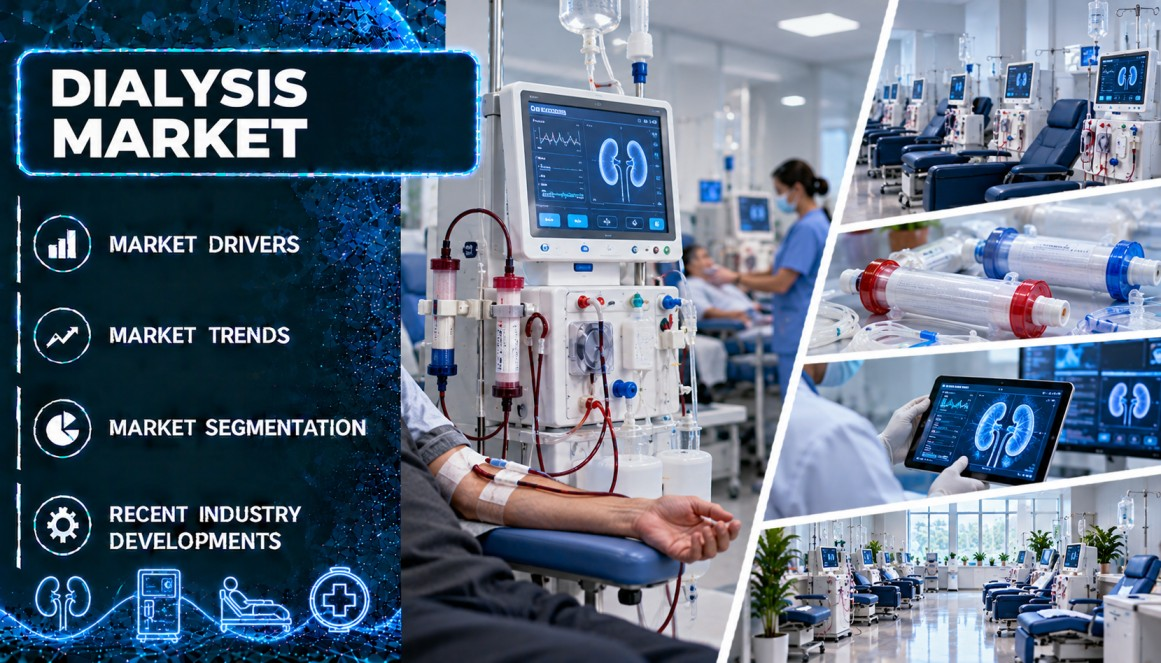
IMARC Group, a leading global market research and management consulting firm, has published its latest market intelligence report on the dialysis market. The global dialysis market grew from USD 125.79 Billion in 2025 to USD 131.00 Billion in 2026 and is projected to reach USD 181.22 Billion by 2034, exhibiting a CAGR of 4.14% during 2026-2034, driven by the rising prevalence of chronic kidney disease and end-stage renal disease, expanding elderly populations, supportive government reimbursement programs, and continuous advances in dialysis machines, membranes, and home-based therapy platforms.
The market is witnessing steady expansion as kidney disease moves from a niche clinical concern to a mainstream public health priority. More than 850 million people worldwide live with some form of kidney disease, and over 4.9 million patients are on dialysis. For most of them, treatment is a recurring, life-sustaining need, typically three sessions a week. That creates durable demand for treatment services, machines, dialyzers, catheters, and water treatment systems. The cost is substantial, with annual treatment often running between USD 60,000 and USD 100,000 per patient. This makes reimbursement policy and operational efficiency central to how the industry evolves.
How AI Is Reshaping the Future of the Dialysis Market
- Predictive Analytics for Complication Management: Machine learning and cloud-based models are being used to predict life-threatening events during dialysis sessions, such as sudden drops in blood pressure. Fresenius Medical Care has developed a model of this kind. Clinicians can adjust fluid removal and treatment parameters before a problem occurs, which helps reduce hospital admissions among high-risk patients.
- AI-Assisted Fluid Management: Intelligent fluid management tools estimate a patient’s ideal dry weight more precisely and tailor ultrafiltration to each session. This improves cardiovascular stability, lowers cramping and fatigue, and gives nephrologists better data for care decisions.
- Remote Monitoring for Home Dialysis: Connected platforms let care teams track treatment data from home machines in real time and flag deviations early. This makes home therapy safer and more scalable for patients who live far from a dialysis center, and it reduces the need for travel.
Grab a sample PDF of this report: https://www.imarcgroup.com/dialysis-market/requestsample
Dialysis Market Trends and Drivers
The global dialysis market is witnessing steady expansion, shaped by a growing patient pool, supportive public funding, and rapid technology upgrades. The largest driver is the rising prevalence of kidney disease. Diabetes and hypertension are its two leading causes, and both continue to rise across developed and emerging economies. Aging also plays a major role, since kidney function declines with age and people aged 65 and above make up a growing share of dialysis patients. In the United States alone, more than 540,000 patients receive dialysis, and the country accounts for nearly 90% of the North American market.
Government programs are a second major pillar of demand. In the United States, Medicare covers dialysis for eligible patients regardless of age, which makes it one of the few federally guaranteed benefits for a single disease category. The Centers for Medicare and Medicaid Services also runs the ESRD Treatment Choices Model, which adjusts payments for a randomly selected group of dialysis facilities and clinicians, covering roughly 30% of providers. It rewards them for increasing home dialysis and kidney transplant rates. In India, the Pradhan Mantri National Dialysis Programme under the National Health Mission offers free dialysis to patients below the poverty line through district hospitals. This is significant because dialysis penetration in India remains below 10% of ESRD patients. China presents a similar scale of opportunity, with an estimated 132 million people living with chronic kidney disease and dialysis penetration below 30% of eligible patients. Japan, by contrast, is a mature market with about 3,200 dialysis patients per million population.
Technology is the third driver. Manufacturers are investing in biocompatible membranes, high-volume hemodiafiltration, portable and wearable hemodialysis systems, and smarter reverse-osmosis water treatment. At the research frontier, NIH-funded implantable bioartificial kidney programs using silicon nanopore technology have reached Phase II clinical testing. This shows how far long-term innovation could extend the market’s reach.
Challenges remain. High per-patient costs, fragmented reimbursement across Asia, Latin America, and Africa, a shortage of trained nephrologists, patient non-adherence to treatment schedules, polymer membrane supply chain disruptions, and lengthy regulatory timelines in the United States and Europe all temper the pace of adoption.
Ask an analyst for customized report: https://www.imarcgroup.com/request?type=report&id=5848&flag=E
Dialysis Industry Segmentation
The report has segmented the market into the following categories:
Breakup By Type:
- Hemodialysis (Conventional Hemodialysis, Short Daily Hemodialysis, Nocturnal Hemodialysis)
- Peritoneal Dialysis (Continuous Ambulatory Peritoneal Dialysis, Automated Peritoneal Dialysis)
Hemodialysis holds the dominant share at 97.6% of market revenue. It remains the standard of care worldwide because it is well established in hospitals and dialysis centers. Its infrastructure, reimbursement pathways, and clinical protocols are mature in most healthcare systems. Peritoneal dialysis holds the remaining 2.4%, and its adoption is helped by home-based convenience and lower infrastructure needs.
Breakup By Product and Services:
- Equipment (Dialysis Machines, Water Treatment Systems)
- Consumables (Dialyzers, Catheters)
- Dialysis Drugs
- Services
Services account for the largest share at 79.0%. This reflects the recurring, high-frequency nature of treatment, with patients returning to clinics several times each week. Equipment and consumables follow, supported by continuous replacement cycles for dialyzers, catheters, and blood tubing sets.
Breakup By End User:
- In-Center Dialysis
- Home Dialysis
In-center dialysis commands 88.6% of revenue because most patients depend on clinic-based infrastructure, trained staff, and reimbursement coverage. Home dialysis is the fastest-growing end-user segment, supported by portable machines, remote monitoring, and policy incentives that favor patient-centered care.
Breakup By Region:
- North America (United States, Canada)
- Asia Pacific (China, Japan, India, South Korea, Australia, Indonesia, Others)
- Europe (Germany, France, United Kingdom, Italy, Spain, Russia, Others)
- Latin America (Brazil, Mexico, Others)
- Middle East and Africa
North America leads with a 41.0% share, supported by high disease prevalence, established Medicare coverage, and a dense network of dialysis providers. Asia Pacific follows with 28.5% and is the fastest-growing region, driven by large untreated patient populations, expanding insurance coverage, and rising investment in nephrology infrastructure. Europe holds 20.3%, Latin America 5.4%, and the Middle East and Africa 4.8%.
Competitive Landscape
The report provides a comprehensive analysis of the competitive landscape in the dialysis market with detailed profiles of all major companies, including:
- Fresenius Medical Care AG
- B. Braun SE
- NIPRO
- BD
- Asahi Kasei Medical
- Toray Medical
- Teleflex
- Vantive Health
The market is concentrated in dialyzers. The top five manufacturers, which are Fresenius, Asahi Kasei, B. Braun, NIPRO, and BD, together hold roughly 55% to 60% of the global dialyzer market.
What Does The Full Report Cover?
If you are tracking the dialysis market for investment decisions, market entry planning, competitive benchmarking, or strategic advisory, IMARC Group’s report gives you everything in one place:
- Complete market sizing with revenue projections across the full study period
- Quantified growth driver analysis across type, product and services, end user, and regional markets
- Sub-segment breakdowns for hemodialysis, peritoneal dialysis, equipment, consumables, drugs, services, in-center care, and home dialysis, with individual share data
- Country-level analysis for the United States, Canada, Germany, France, the United Kingdom, Italy, Spain, Russia, China, Japan, India, South Korea, Australia, Indonesia, Brazil, and Mexico
- Competitive profiles of leading companies with strategic landscape assessment
- Porter’s Five Forces, value chain analysis, and pricing intelligence
- Latest innovation trends covering home hemodialysis, AI-enabled fluid management, advanced membranes, and portable systems
Recent News and Developments in Dialysis Market
- July 2026: NIPRO received FDA 510(k) clearance for its ELISIO-HX dialyzer for expanded hemodialysis in the United States. The dialyzer uses NIPRO’s own high-flux membrane to remove larger uremic toxins while retaining albumin. It works with existing hemodialysis equipment, and NIPRO plans to commercialize it in the U.S. after prior sales in Japan, Europe, and Latin America.
- June 2025: NIPRO launched LiniXia, its next-generation reverse-osmosis water treatment system, at the ERA Congress. The system targets the water purity requirements that are critical to safe hemodialysis.
- May 2025: Fresenius Medical Care received FDA 510(k) clearance for an updated 5008X CAREsystem. It adds the Clinical Data Exchange for chairside access to medical records and supports high-volume hemodiafiltration with the companion FX CorAL dialyzer. The company estimates that about 160,000 in-center hemodialysis machines across U.S. providers could be replaced to adopt the new therapy.
- February 2025: Vantive launched as an independent vital organ therapy company, after separating from Baxter’s kidney care business. It is focused on kidney care and dialysis innovation, including home therapies.
Note: If you require specific details, data, or insights that are not currently included in the scope of this report, we are happy to accommodate your request. As part of our customization service, we will gather and provide the additional information you need, tailored to your specific requirements. Please let us know your exact needs, and we will ensure the report is updated accordingly to meet your expectations.
Key Questions This Report Answers
- What is the current global dialysis market size and what is its projected value?
- Which type segment holds the largest share in the global dialysis market?
- What are the key drivers of global dialysis market growth?
- Which region dominates the global dialysis market and why?
- How are home dialysis, AI-enabled care, and government reimbursement programs reshaping the competitive landscape?
- Who are the top companies in the global dialysis market and what are their competitive strategies?
- What are the investment and market entry opportunities across home dialysis, consumables, and emerging Asia Pacific markets?
About Us
IMARC Group is a global management consulting firm that helps the world’s most ambitious changemakers to create a lasting impact. The company provides a comprehensive suite of market entry and expansion services. IMARC offerings include thorough market assessment, feasibility studies, company incorporation assistance, factory setup support, regulatory approvals and licensing navigation, branding, marketing and sales strategies, competitive landscape and benchmarking analyses, pricing and cost research, and procurement research.
Media and Sales Contact
IMARC Group
Email: sales@imarcgroup.com
United States: +1-201-971-6302
India: +91-120-433-0800
United Kingdom: +44-753-714-6104













Comments (0)