

How to Improve Visibility Across Critical Zones During Emergency Response
AI-powered video analytics helps manufacturing plants identify potential PPE compliance issues, including missing helmets and safety vests. An AI-based surveillance system can flag visible violations, support incident review, and improve oversight across monitored production areas. Intozi’s Ikshana platform supports configured video analytics workflows to complement factory safety inspections, employee training, and established compliance procedures.
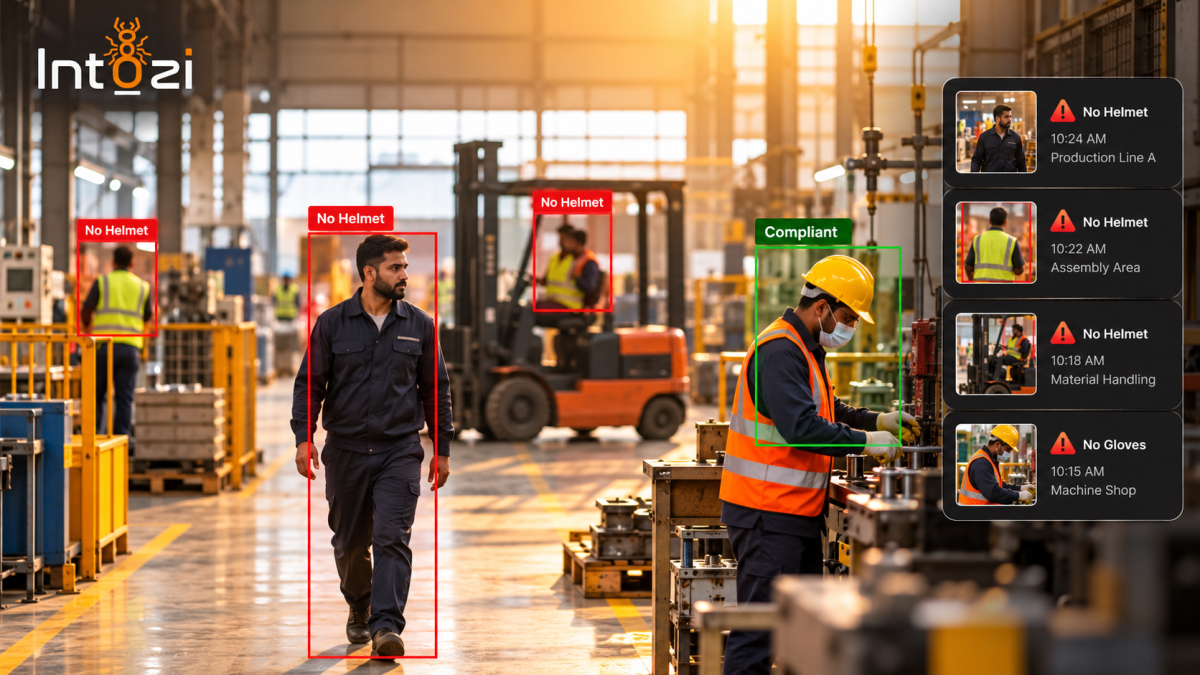
Manufacturing floors can expose workers to moving machinery, falling objects, chemicals, and other workplace hazards. When employees forget helmets, safety glasses, gloves, or high-visibility vests, even routine tasks can become dangerous. Manual inspections and periodic safety checks may not identify every violation as it occurs. An AI-based surveillance system can help monitor visible PPE compliance through existing camera infrastructure, enabling safety teams to identify potential issues and review them promptly.
Why PPE compliance remains a challenge in manufacturing
Personal protective equipment (PPE) helps reduce exposure to workplace hazards, but its effectiveness depends on workers wearing the correct equipment for their assigned tasks. In busy factories, supervisors may oversee several production lines, shifts, and work zones simultaneously, making continuous manual observation difficult.
Common PPE compliance issues include:
-
Workers entering designated areas without safety helmets.
-
Employees operating in production zones without high-visibility vests.
-
Missing safety glasses, gloves, or other task-specific equipment.
-
Contractors failing to follow site-specific safety requirements.
-
Repeated violations occurring during night shifts or busy production periods.
A workplace safety monitoring system can help safety teams identify these visible compliance gaps more consistently, while trained personnel assess the context and determine the appropriate response.
How AI video analytics identifies PPE compliance issues on factory floors
AI video analytics processes video from compatible cameras to identify visual indicators associated with required protective equipment. Depending on the model, camera angle, lighting, and deployment configuration, the system may flag workers who appear to be missing helmets, safety vests, or other supported PPE.
When a potential violation is detected, the system can generate an alert linked to the relevant camera feed. Supervisors can review the footage, verify whether a violation occurred, and follow established safety procedures. This approach supports video analytics for safety compliance by helping teams focus attention on events that may require intervention rather than watching every camera continuously.
Key features that support workplace safety monitoring
An effective AI monitoring setup should match the factory's specific PPE requirements, operational risks, and safety policies. A real-time safety and security monitoring workflow can combine PPE detection with other configured analytics to provide a broader view of activity across production areas.
Useful capabilities include:
-
PPE detection: Flags visible indicators of missing or incorrectly worn supported equipment.
-
Zone-based monitoring: Applies different rules to areas with different safety requirements.
-
Real-time alerts: Notifies designated personnel when configured events are detected.
-
Incident review: Helps teams access relevant footage for verification and documentation.
-
Multi-area monitoring: Supports oversight across production lines, warehouses, and other monitored zones.
-
Reporting: Helps identify recurring patterns and areas that may need additional training or supervision.
Detection accuracy depends on camera coverage, image quality, PPE visibility, and the selected analytics configuration.
Benefits of an intelligent security monitoring system for factory safety
An intelligent security monitoring system can support factory safety by making potential PPE violations easier to identify and review. Instead of relying exclusively on occasional walk-throughs, supervisors can use event-based alerts to direct attention to areas where a possible issue has been flagged.
This can help organizations:
-
Improve visibility into PPE compliance across monitored work areas.
-
Identify recurring violations that may indicate training gaps.
-
Support more consistent safety reviews across shifts.
-
Reduce the effort required to locate relevant footage after an incident.
-
Improve documentation for internal safety assessments.
AI does not replace safety training, physical inspections, or worker accountability. Its role is to provide additional visibility so that qualified personnel can make informed decisions.
Integrating AI-powered security solutions with existing factory cameras
Factories may already have CCTV cameras installed for security and operational monitoring. An AI-based surveillance system can potentially use these cameras if their resolution, field of view, lighting, connectivity, and positioning are suitable for the required PPE detections.
Before implementation, organizations should assess whether workers and their protective equipment remain clearly visible during normal operations. Cameras positioned too far away, obstructed views, poor lighting, or equipment hidden behind machinery can affect detection results.
Intozi’s Ikshana platform provides AI-powered video analytics for configured monitoring use cases across compatible camera infrastructure. Depending on the deployment and enabled capabilities, it can support PPE monitoring, event alerts, and centralized visibility. Site assessment and testing are important to determine which use cases are appropriate for each factory.
Improving factory safety through AI-based surveillance systems
Identifying PPE compliance issues early helps manufacturing organizations strengthen workplace safety practices and address recurring risks. An AI-based surveillance system can complement manual inspections by flagging visible PPE issues, directing supervisors to relevant footage, and supporting consistent safety reviews. Intozi’s Ikshana platform can support this process through configured video analytics across compatible cameras. The best results come from combining suitable camera coverage, clear safety policies, employee training, and timely human verification.
Frequently asked questions
1. How does AI detect workers who are not wearing PPE?
AI video analytics identifies visual patterns associated with supported protective equipment, such as helmets and high-visibility vests. When the configured system detects a possible violation, it can generate an alert for review. Intozi’s Ikshana platform supports configured video analytics use cases, subject to camera suitability and deployment settings. Detection performance depends on lighting, camera angles, image quality, and whether equipment is clearly visible. Human verification remains important before taking corrective action.
2. Can AI monitor PPE compliance across multiple factory production lines?
Yes, AI-based monitoring can support PPE oversight across multiple production lines when suitable cameras and analytics are configured for each area. Intozi’s Ikshana platform can help provide centralized visibility across compatible camera feeds, depending on deployment requirements. Organizations can define monitoring rules according to area-specific safety policies and review alerts from different locations. Camera coverage, network reliability, and clear responsibility for responding to alerts are important for effective implementation.
3. What types of PPE violations can video analytics identify?
Depending on the selected model and camera conditions, video analytics may identify missing safety helmets, high-visibility vests, or other supported protective equipment. Intozi’s Ikshana platform can support configured PPE compliance monitoring where the required analytics are enabled. Not every item is detectable in every setting, particularly when equipment is obscured or difficult to distinguish. Factories should validate the system against their actual PPE requirements and work conditions before relying on its alerts.
4. Can an AI-based surveillance system work with existing CCTV cameras?
Yes, an AI-based surveillance system may work with existing CCTV cameras if their video quality, positioning, lighting, and connectivity meet the analytics requirements. Intozi’s Ikshana platform supports video analytics on compatible camera infrastructure, subject to deployment configuration. A site assessment can identify blind spots and determine whether existing feeds are suitable for PPE detection. Some locations may require camera repositioning, improved lighting, or additional cameras to achieve useful coverage.
5. How does AI video analytics improve workplace safety compliance?
AI video analytics can help safety teams identify potential violations, review relevant footage, and recognize recurring compliance issues across monitored areas. Intozi’s Ikshana platform can support these workflows through configured alerts and video analytics. This information may help organizations identify training needs, refine safety procedures, and focus inspections on higher-risk areas. AI should complement workplace risk assessments, direct supervision, safety training, and established corrective-action procedures rather than replace them.
Intozi is one of the best Vision AI and video analytics companies, delivering advanced AI-powered solutions that transform existing camera infrastructure into real-time intelligence. With cutting-edge computer vision technology, Intozi helps governments, industries, and enterprises strengthen security, improve compliance, and enhance operational efficiency worldwide.












Comments (0)