

ISO Training Courses South Africa: Build Professional Skills and Improve Business Performance

Introduction
ISO training courses South Africa help professionals and organizations understand international standards and develop effective management systems. These courses provide practical knowledge of quality management, environmental protection, occupational health and safety, information security, and food safety. They are suitable for beginners, experienced professionals, managers, internal auditors, and business owners who want to improve their skills.
South African businesses operate in competitive markets where customer expectations, regulatory requirements, and operational efficiency are important. ISO training helps employees understand their responsibilities, follow consistent procedures, and contribute to continual improvement.
What Are ISO Training Courses?
ISO training courses explain the requirements of standards developed by the International Organization for Standardization. Participants learn how to establish management systems, manage risks, maintain documentation, conduct audits, and identify opportunities for improvement.
Training options include awareness training, foundation courses, implementation training, internal auditor training, and lead auditor courses. Each program serves a different purpose. Awareness training introduces the basic requirements, while implementation courses focus on applying them within an organization. Auditor training develops the skills needed to evaluate processes and identify nonconformities.
Popular ISO Training Courses in South Africa
Businesses and professionals can select courses according to their industry, job responsibilities, and career goals.
-
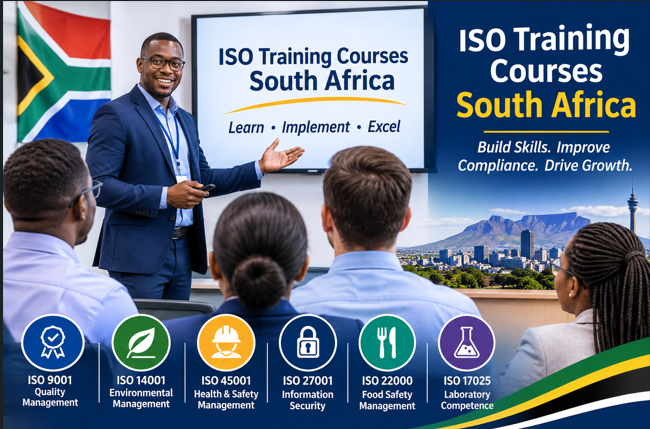
ISO 9001 Training: Focuses on quality management, customer satisfaction, process control, and continual improvement.
-
ISO 14001 Training: Explains environmental management, pollution prevention, environmental risks, and responsible resource use.
-
ISO 45001 Training: Covers occupational health and safety management, workplace hazards, and risk reduction.
-
ISO 27001 Training: Helps participants understand information security management and the protection of sensitive information.
-
ISO 22000 Training: Introduces food safety management requirements for food manufacturers, processors, and related businesses.
-
ISO 17025 Training: Focuses on the competence of testing and calibration laboratories.
-
ISO 50001 Training: Explains energy management and ways to improve energy performance.
Choosing the right course helps participants gain knowledge relevant to their work and organizational objectives.
Benefits of ISO Training Courses
ISO training offers several advantages for individuals and businesses. Employees develop a better understanding of standard requirements and learn how to apply them in daily operations. This knowledge can improve consistency, reduce errors, and support effective management practices.
Key benefits include:
-
Improved understanding of international standards.
-
Better risk identification and corrective action.
-
Stronger internal auditing and reporting skills.
-
Improved documentation and process control.
-
Increased customer confidence and business credibility.
-
Better preparation for management system certification assessments.
For professionals, ISO training can strengthen their expertise and support career opportunities in quality assurance, environmental management, health and safety, information security, and auditing.
However, completing a training course does not automatically provide ISO certification to an organization. Certification depends on the conformity of its management system and assessment by an independent certification body.
How to Choose the Right ISO Training Provider
Before enrolling, review the course syllabus, trainer experience, practical exercises, assessment methods, and certificate details. Check whether the program matches your professional goals and industry requirements. If you plan to conduct internal audits, choose a course that covers audit planning, evidence collection, reporting, and corrective action follow-up.
Training may be available through classroom sessions, live online learning, or self-paced courses. Compare course duration, fees, schedules, and learning materials before making a decision. If you need a recognized auditor qualification, verify the relevant accreditation or recognition before enrolling.
Who Can Attend ISO Training?
ISO training courses are useful for quality managers, environmental officers, health and safety professionals, laboratory technicians, information security specialists, consultants, internal auditors, and business owners.
Industries such as manufacturing, mining, construction, healthcare, food processing, logistics, and information technology can benefit from suitable ISO training programs.
Conclusion
ISO training courses South Africa help professionals develop the knowledge and skills required to improve management systems and support compliance objectives. By selecting relevant training, learners can strengthen their auditing, risk management, and process improvement abilities. The right course helps organizations build competent teams, improve operational efficiency, and support continual improvement.












Comments (0)