

Regenerative Medicine Market Size, Share, Industry Trends, Latest Insights and Forecast 2026-2034
Our report has categorized the market based on type, application, and end user.

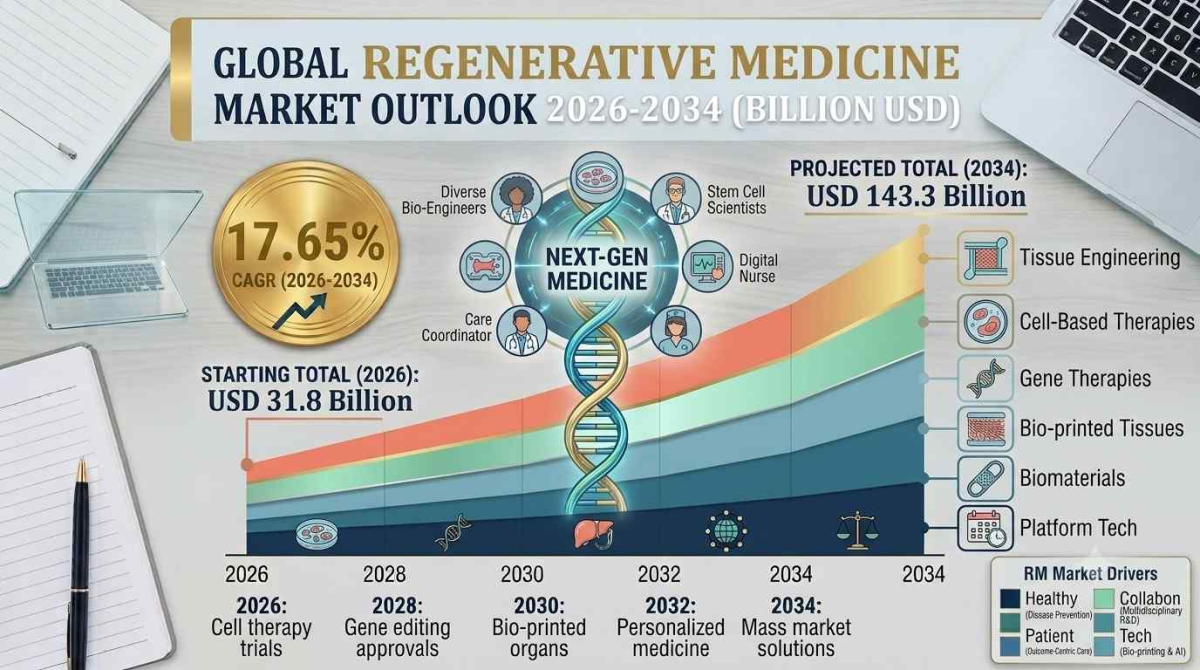
According to IMARC Group, the global regenerative medicine market size reached USD 31.8 Billion in 2025 and is projected to reach USD 143.3 Billion by 2034, expanding at a CAGR of 17.65% during 2026–2034. This exceptional regenerative medicine market growth reflects the rising burden of chronic diseases in aging populations, growing concerns around transplant rejection, deepening research in stem cell therapies and genetic engineering, and the expanding use of regenerative solutions across orthopedic, dermatological, dental, and aesthetic applications.
Regenerative Medicine Industry Overview
Regenerative medicine is a branch of healthcare that promotes the body’s natural healing response in diseased, malfunctioning, or injured tissues by using stem cells or their derivatives, growth factors, biomaterials, and tissue engineering techniques. Rather than only managing symptoms, regenerative approaches aim to replace or repair damaged tissue and restore function — offering the potential to address previously incurable conditions, often with fewer side effects than many conventional treatments.
Regenerative therapies are being deployed across a broad continuum of use cases:
- Orthopedics and osteoarticular care: Bone graft substitutes and regenerative treatments for osteoarticular diseases and sports injuries
- Dermatology and wound healing: Scar reduction, wound repair, skin disorders, and age-related skin conditions using stem cells, growth factors, and tissue engineering
- Oncology and immunotherapy: Targeted therapies that repair tissue damaged by cancer or its treatment, alongside CAR-T cell therapy and other immunotherapies
- Cardiovascular and neurological care: Cell-based approaches for heart disease and central nervous system conditions
- Cosmetic surgery, aesthetics, and dental regeneration: Adipose-derived stem cell treatments for breast reconstruction and facial rejuvenation, hair restoration therapies, and regenerative dental applications
Global Regenerative Medicine Market Size & Key Statistics
Below are the key regenerative medicine market size statistics drawn from IMARC Group’s comprehensive market analysis:
|
Report Attribute |
Key Statistics |
|
Base Year |
2025 |
|
Historical Period |
2020–2025 |
|
Forecast Period |
2026–2034 |
|
Regenerative Medicine Market Size in 2025 |
USD 31.8 Billion |
|
Market Forecast in 2034 |
USD 143.3 Billion |
|
Market Growth Rate (2026–2034) |
17.65% CAGR |
|
Largest Region |
North America |
|
Leading Type Segment |
Stem Cell Therapy |
|
Leading Application |
Dermatology |
|
Leading End-User Segment |
Hospitals |
Request for a Sample Report for Detailed Regenerative Medicine Market Size Evaluation: https://www.imarcgroup.com/regenerative-medicine-market/requestsample
Key Market Drivers & Regenerative Medicine Market Trends in 2025
Several powerful forces are shaping Regenerative Medicine Market Trends and supporting sustained Regenerative Medicine Market Growth across the global healthcare and biotechnology landscape:
1. Rising Prevalence of Chronic Diseases and an Aging Population
Chronic conditions such as diabetes, heart disease, and osteoarthritis are becoming more common as populations age, creating a growing pool of patients with degenerative and age-related tissue damage. Regenerative therapies address the underlying loss of tissue function rather than only its symptoms, positioning them as a compelling option for long-term disease management and a core pillar of overall Regenerative Medicine Market Size expansion.
2. Growing Transplant Rejection Concerns and Demand for Tissue Regeneration
Concerns around transplant rejection are steering clinicians and patients toward alternatives that repair or rebuild damaged tissue rather than replace it with donor material. This, combined with rising demand for regenerative therapies in orthopedic conditions, dental regeneration, and wound healing, is broadening the addressable patient base and reinforcing Regenerative Medicine Market Growth.
3. Increasing Product Demand in Cancer Treatment
Cancer and its treatments, such as chemotherapy, often leave behind significant tissue damage that regenerative therapies can help repair. Stem cell therapy — which uses stem cells to replace or repair damaged tissue — is being explored as a potentially effective option in cancer care, supported by robust clinical research. In April 2024, Denovo’s DB107, a biomarker-guided gene therapy for high-grade glioma including glioblastoma, received US$ 11.8 Million in funding from the California Institute for Regenerative Medicine (CIRM) to conduct a Phase 1/2 clinical trial in patients with newly diagnosed disease. Such investments are a defining Regenerative Medicine Market Trend in oncology.
4. Rapid Advancements in Immunotherapy
Immunotherapies such as CAR-T cell therapy — in which a patient’s T cells are genetically modified in the laboratory to locate and destroy cancer cells more efficiently — have transformed cancer treatment, often working even when conventional options fail and typically carrying fewer severe side effects than chemotherapy or radiation. Clinical momentum continues to build: in February 2024, Imunon began patient enrollment in IMNN-001, a Phase I/II trial of a DNA-based interleukin-12 (IL-12) immunotherapy for advanced ovarian cancer at Memorial Sloan Kettering Cancer Center, planning to enroll fifty patients with Stage III/IV disease.
5. Widespread Applications in Cosmetic Surgery and Aesthetics
Regenerative techniques, including adipose-derived stem cell treatments, are increasingly used for natural tissue augmentation in breast reconstruction and facial rejuvenation, as well as for scar minimization and hair restoration. In March 2024, Aderans Company — parent of Bosley and HAIRCLUB — granted Stemson Therapeutics exclusive rights to research, develop, and market hair regeneration products based on Aderans’ patented cell therapy technology, allowing Stemson to add the technology to its induced pluripotent stem cell (iPSC) hair loss pipeline. This aesthetics-led adoption is an important Regenerative Medicine Market Trend that is lifting overall revenue.
6. Breakthroughs in Biotechnology, Stem Cell Research, and Gene Editing
Advances in biotechnology are making regenerative therapies more precise and effective. Improvements in stem cell isolation, culturing, and delivery methods are enhancing treatment efficacy, while progress in cell therapy and gene editing is enabling personalized treatment approaches tailored to individual patient characteristics and disease profiles. These innovations continue to widen the range of treatable conditions and to accelerate Regenerative Medicine Market Growth.
7. Funding, Regulatory Support, and Rising Patient Awareness
Government agencies and public bodies are backing regenerative medicine research through funding initiatives, grants, and regulatory pathways designed to speed the development and commercialization of innovative therapies. As regulators recognize the potential of stem cell therapies, streamlined approvals and guidelines are encouraging further investment, while growing patient awareness of regenerative treatment options is boosting demand across clinical settings.
Key Market Segmentation
IMARC Group’s report segments the Regenerative Medicine Market by type, application, end user, and region, with forecasts for 2026–2034.
By Type
Stem Cell Therapy – Largest Segment: Stem cell therapy leads the type segment. It uses the unique regenerative properties of stem cells to repair or replace damaged or dysfunctional tissues and organs, with applications spanning orthopedics, cardiology, neurology, and oncology. Clinical evidence in previously hard-to-treat conditions is boosting patient and physician confidence, while advances in stem cell isolation, culturing, and delivery, along with global expansion by therapy providers, are widening access. Strategic collaboration is also intensifying — in October 2022, Century Therapeutics and Bristol Myers Squibb announced a research collaboration and license agreement to develop and commercialize up to four iPSC-derived, modified natural killer cell and/or T cell programs for hematologic malignancies and solid tumors.
Biomaterial: Biomaterials provide the structural and biological support that helps guide tissue repair, and are widely associated with applications such as bone grafting and wound care.
Tissue Engineering: Tissue engineering combines cells, growth factors, and supportive scaffolds to rebuild functional tissue, and is increasingly used in dermatology and reconstructive applications.
Others: Includes additional regenerative approaches covered in IMARC Group’s report that complement stem cell, biomaterial, and tissue engineering platforms.
By Application
Dermatology – Largest Application: Dermatology is the leading application, focused on restoring and regenerating skin tissue. It spans scar reduction, wound healing, skin disorders, and age-related skin concerns, using stem cells, growth factors, and tissue engineering to deliver minimally invasive options for healthier, more youthful skin. Rising demand for cosmetic and aesthetic enhancement and for effective treatments of skin ailments is fueling this segment. In September 2023, biotechnology entrepreneur Dr. Samuel Lynch launched Lynch Regenerative Medicine, Inc. (LRM), an advanced biotherapeutics skincare firm targeting unmet needs in cosmetics and advanced wound care.
Bone Graft Substitutes: Regenerative bone graft solutions support skeletal repair and reconstruction, benefiting from strong demand in orthopedic conditions.
Osteoarticular Diseases: Regenerative treatments for joint and bone disorders, including osteoarthritis, are gaining traction as aging populations drive demand for restorative alternatives to conventional care.
Cardiovascular and Central Nervous System: Cell-based therapies are being investigated for heart disease and neurological conditions, supported by expanding clinical research in cardiology and neurology.
Others: Includes oncology-related regenerative applications, dental regeneration, and wound healing, all cited as important contributors to market demand.
By End User
Hospitals – Largest End-User Segment: Hospitals are the primary end users of regenerative therapies, serving as hubs for advanced care. They provide the infrastructure and expertise needed for complex procedures such as organ transplants and stem cell therapies, support clinical trials and research, and deliver regenerative treatments for acute injuries, chronic diseases, and conditions requiring specialized attention.
Specialty Clinics: Specialty clinics deliver focused regenerative care in areas such as orthopedics, dermatology, and aesthetics, giving patients access to targeted treatments outside the hospital setting.
Others: Includes additional care and research settings that adopt regenerative therapies, as covered in the IMARC Group report.
Regional Regenerative Medicine Market Analysis
|
Region |
Key Highlights |
|
North America – Largest |
United States & Canada; advanced healthcare infrastructure, robust R&D capabilities, high healthcare expenditure, leading research institutions and biotechnology companies, government funding and grants, and well-defined regulatory approval pathways |
|
Asia Pacific |
China, Japan, India, South Korea, Australia, Indonesia, and others; covered in IMARC Group’s regional and country-level forecasts for 2026–2034 |
|
Europe |
Germany, France, United Kingdom, Italy, Spain, Russia, and others; covered in IMARC Group’s regional and country-level forecasts for 2026–2034 |
|
Latin America |
Brazil, Mexico, and others; covered in IMARC Group’s regional and country-level forecasts for 2026–2034 |
|
Middle East & Africa |
Regional market assessment included in IMARC Group’s forecasts for 2026–2034 |
North America accounts for the largest share of the global Regenerative Medicine Market Size, underpinned by advanced healthcare infrastructure, strong R&D capabilities, and high healthcare expenditure. The region is home to numerous renowned research institutions, biotechnology companies, and academic centers specializing in regenerative medicine, while regulatory support and clear approval processes in countries such as the United States help bring new treatments to market faster.
Demand in the region is further reinforced by a growing aging population with age-related conditions and a strong focus on chronic diseases, sports injuries, and aesthetic concerns. Investment continues to flow in — in October 2023, Bayer AG inaugurated its first Cell Therapy launch facility in Berkeley, California, to supply regenerative medicines to patients.
Connect for Detailed Regenerative Medicine Market Growth Analysis – Speak to an Analyst: https://www.imarcgroup.com/request?type=report&id=2517&flag=C
Leading Players in the Global Regenerative Medicine Industry
Top companies in the regenerative medicine industry are strengthening their positions through heavy R&D investment, large-scale clinical trials, diversified product portfolios, global expansion, and partnerships with research institutions, healthcare providers, and pharmaceutical companies. Key companies covered in the IMARC Group report include:
|
Company |
Core Focus in Regenerative Medicine |
|
bluebird bio, Inc. |
Gene and cell therapies for genetic diseases |
|
CRISPR Therapeutics |
CRISPR-based gene-editing therapeutics |
|
Gamida Cell Inc |
Cell therapies for blood cancers and hematologic conditions |
|
Gilead Sciences, Inc. |
Cell therapy, including CAR-T, in oncology |
|
IOVANCE Biotherapeutics, Inc. |
Tumor-infiltrating lymphocyte (TIL) cell therapies for solid tumors |
|
Mesoblast Ltd |
Allogeneic mesenchymal cell-based therapies |
|
Novartis AG |
CAR-T cell and gene therapy platforms |
|
Orchard Therapeutics plc |
Gene therapies for rare genetic diseases |
|
SanBio Co, Ltd. |
Regenerative cell medicines for neurological conditions |
|
Vertex Pharmaceuticals |
Gene-editing-based cell therapies |
Please note that this is only a partial list of the key players; the complete list is provided in the IMARC Group report.
Latest Regenerative Medicine Market Industry Developments
June 2024 – Nava Health
Nava Health, a longevity, integrative, and functional medicine provider, signed a lease for its first Nava Center in New York. The center will offer functional medicine, regenerative medicine aimed at restoring cellular and tissue function, and personalized wellness plans that serve as a roadmap for long-term health.
April 2024 – SCG Cell Therapy & A*STAR
SCG Cell Therapy and the Agency for Science, Technology, and Research (A*STAR) established joint laboratories for cellular immunotherapies, with the goal of accelerating induced pluripotent stem cell (iPSC) technology and developing innovative cell therapies that meet Good Manufacturing Practice (GMP) requirements.
March 2024 – Aderans Company & Stemson Therapeutics
Aderans Company, parent of Bosley and HAIRCLUB, granted Stemson Therapeutics sole rights to research, develop, and market hair regeneration therapeutic products based on Aderans’ patented cell therapy technology. Stemson will advance Aderans’ Phase 2 clinical-stage hair regeneration program within its iPSC-based hair loss pipeline — a move that supports broader Regenerative Medicine Market Growth in aesthetics.
October 2023 – Bayer AG
Bayer AG inaugurated its first Cell Therapy launch facility in Berkeley, California, to provide regenerative medicines to patients — strengthening North America’s cell therapy manufacturing capabilities.
About Us
IMARC Group is a leading global market research company providing data-driven insights and expert consulting services to businesses seeking to achieve their strategic objectives. With a multi-disciplinary team of industry experts, IMARC delivers thorough, reliable market intelligence across sectors including Healthcare, Technology, Chemicals, Energy, Food & Beverages, and more.
Contact Us
IMARC Group
United States: +1-201-971-6302
India: +91-120-433-0800
United Kingdom: +44-753-714-6104








Comments (0)