

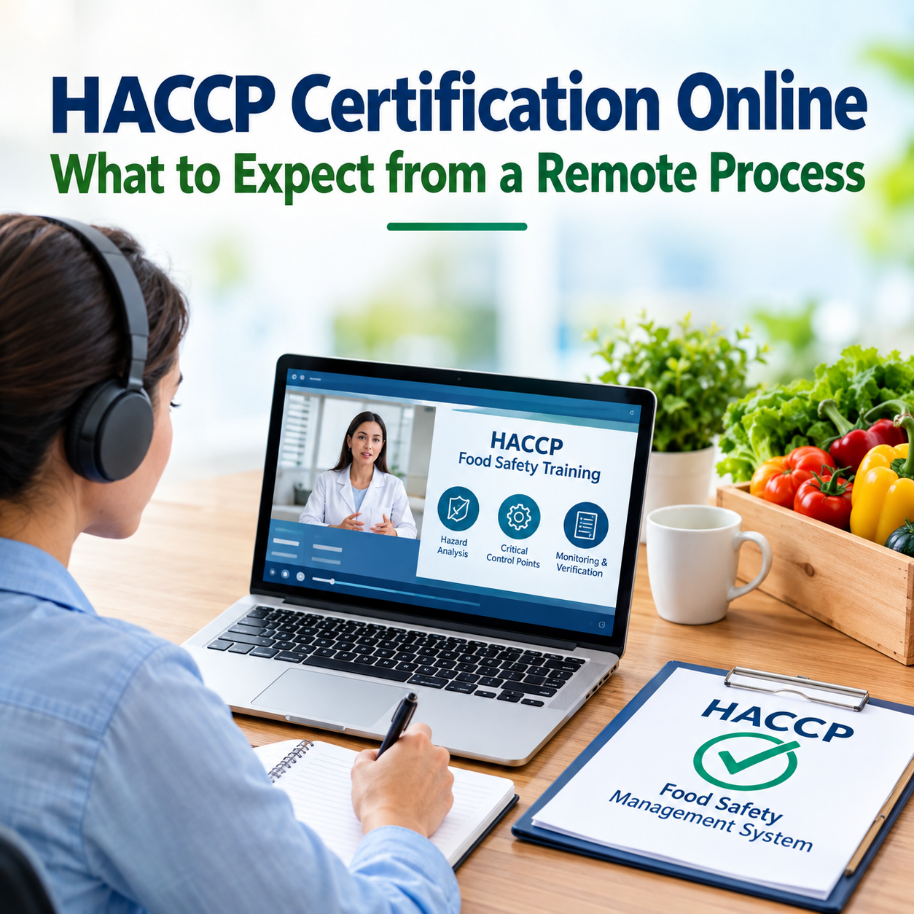
HACCP Certification Online What to Expect from a Remote Process
Not every food business has the luxury of pausing operations for a multi-day, in-person certification process. Smaller operators, businesses spread across multiple locations, and teams working irregular hours often need a path toward food safety certification that fits around their actual operating reality rather than requiring everyone to be in the same room at the same time.

Not every food business has the luxury of pausing operations for a multi-day, in-person certification process. Smaller operators, businesses spread across multiple locations, and teams working irregular hours often need a path toward food safety certification that fits around their actual operating reality rather than requiring everyone to be in the same room at the same time.
That's where an online approach to this process becomes genuinely useful. It doesn't change the underlying substance of what's required, food safety hazards still need to be properly identified and controlled, but it changes how the supporting training, documentation review, and parts of the assessment process itself can be delivered and completed.
Who Tends to Choose This Route?
Smaller, independently operated food businesses often gravitate toward an online process simply because it fits more realistically around limited staff availability than a format requiring extended in-person sessions. Multi-location operators, like regional bakery chains or catering companies serving several venues, also find real value in a format that doesn't require gathering staff from different sites in one physical location.
Businesses operating in more remote areas, where scheduling in-person sessions can be logistically difficult, represent another significant group, along with owner-operators who are personally responsible for food safety and need training and certification support that fits around an already demanding daily schedule.
What Actually Changes with an Online Approach
The core requirements don't change. Businesses still need a proper hazard analysis, clearly identified critical control points, documented monitoring procedures, and evidence that the system is genuinely functioning as intended. What changes is how training content gets delivered, how documentation gets reviewed, and how much of the supporting preparation work can happen asynchronously rather than requiring scheduled, synchronous sessions.
Training modules delivered online allow staff to work through required content at a pace that fits their schedule, revisiting material as needed rather than trying to absorb everything in a single, intensive in-person session. This flexibility tends to improve retention for many learners, particularly those juggling training alongside a full operational workload.
Where In-Person Elements May Still Be Necessary
Certain elements, particularly on-site verification of physical facility controls and direct observation of monitoring practices in action, often still require some form of physical presence, whether that's a site visit or detailed photo and video documentation submitted as part of the process. Understanding these upfront helps businesses plan realistically rather than assuming everything can be handled entirely remotely.
Building Hazard Analysis and Documentation Remotely
One of the more demanding parts of an online process is completing a thorough, product-specific hazard analysis without the benefit of an in-person walkthrough guiding the exercise step by step. Businesses need to be disciplined about documenting their actual process accurately, including every step from receiving raw materials through to final product distribution.
Detailed process flow diagrams, photos of key production areas, and clear written descriptions of each processing step all become more important in a remote context, since this documentation needs to convey information that an in-person visit might otherwise capture through direct observation.
For businesses weighing whether this format fits their operation, working through a structured approach to haccp certification online typically involves completing training modules, building thorough process documentation, and coordinating any necessary verification activities in a sequence designed to work around a business's actual operating schedule.
That sequencing matters because rushing through documentation just to move quickly through an online process tends to produce a weaker food safety system than one built thoughtfully, even if the overall timeline ends up taking somewhat longer as a result.
Common Challenges with a Remote Process
Self-motivation and pacing can be a genuine challenge for some staff working through online training modules, particularly without the structure and accountability of a scheduled in-person session. Businesses that build in their own internal checkpoints, confirming that staff have actually completed and understood required modules rather than simply clicking through them, tend to get considerably more value from the training.
Technical documentation gaps are another common issue, since it's easier to overlook a detail in written process documentation than it would be during an in-person walkthrough where a reviewer might naturally ask a clarifying question on the spot. Building extra time into the process for documentation review and revision helps address this.
Keeping Remote Teams Aligned
For multi-location businesses, ensuring consistent understanding and application of food safety procedures across different sites requires deliberate effort in a remote training context. Regular check-ins between locations, even brief ones, help surface inconsistencies in how procedures are being interpreted and applied before they become a genuine compliance gap.
Choosing the Right Platform and Support Structure
Not every online training platform is built the same way, and the difference often comes down to how much genuine support is available when a learner has a question or gets stuck on a concept. A platform that offers only pre-recorded video with no avenue for asking questions leaves learners on their own in exactly the moments they'd benefit most from guidance.
Businesses evaluating platforms should look specifically for options that include some form of direct access to knowledgeable support, whether through scheduled office hours, messaging support, or a structured way to ask clarifying questions and receive a substantive response rather than a generic automated reply.
Assessing Learner Understanding, Not Just Completion
Simply tracking whether a staff member clicked through every module doesn't confirm they actually understood the material. Strong online programs build in genuine knowledge checks throughout, not just a single test at the end, helping both the learner and the business identify specific areas that need reinforcement before moving forward.
Scheduling Training Around Operational Reality
One of the genuine advantages of an online format is the ability to stagger training across a team rather than pulling everyone away from operations simultaneously. This staggered approach means a business rarely needs to fully halt operations for training, since staff can complete modules in the gaps between shifts or during naturally quieter periods.
That said, staggering training too loosely, without any coordinated timeline, can result in inconsistent understanding across a team, with some staff completing training months before others. Setting a reasonable completion window, even within a flexible online format, helps keep the whole team reasonably aligned in their understanding and timing.
Documenting Training Completion Properly
Online training still needs the same rigorous documentation as any in-person equivalent. Records of which staff completed which modules, when, and with what assessment results need to be maintained just as carefully as physical sign-in sheets from an in-person session would be.
Businesses sometimes assume that because training happened online, the platform automatically handles all necessary documentation, but it's worth independently verifying exactly what records the platform retains and for how long, ensuring this aligns with what would actually be needed to demonstrate compliance if training records are ever reviewed.
Supporting Learners Who Struggle with Self-Directed Study
Not every staff member learns equally well in a self-paced, independent format. Some genuinely benefit from the structure and social accountability of a scheduled group session, and businesses should be realistic about which team members might need additional support, such as a designated colleague to work through modules alongside them, rather than assuming a purely independent approach suits everyone equally.
Building in brief, informal check-ins during the training period, where a supervisor asks a staff member to explain a recently covered concept in their own words, can help catch comprehension gaps early, well before they'd otherwise surface during a final assessment or, worse, during an actual food safety incident.
Preparing for Any Required Site Verification
Even within a largely online process, businesses should prepare thoroughly for whatever site verification component is required, ensuring physical facility conditions genuinely match what's been described in submitted documentation. Photos and videos submitted as part of a remote verification process need to accurately and clearly represent actual conditions, not just a staged, unusually tidy version of the facility.
Businesses that treat this verification step with the same seriousness as an in-person visit, rather than viewing it as a lower-stakes formality simply because it's conducted remotely, tend to produce documentation that holds up much better to scrutiny.
Businesses should also plan for how they'll handle staff turnover within an online training framework, ensuring new hires have a clear, immediate path to completing required training rather than waiting for an infrequent group session, which is often one of the more practical advantages this format offers over a purely in-person alternative.
Evaluating Cost and Value Realistically
When comparing an online approach against a traditional in-person process, businesses should weigh the full picture rather than focusing narrowly on any single factor. Reduced operational disruption and staff scheduling flexibility often deliver meaningful value that isn't always obvious when comparing options purely on their surface-level structure.
Taking time to map out realistically how a traditional in-person process would actually disrupt daily operations, against how a remote-friendly approach might fit more smoothly, tends to give a clearer, more honest picture of which format genuinely serves a specific business's circumstances best.
Businesses that approach this decision thoughtfully, rather than defaulting to whichever format seems most convenient at first glance, tend to end up with a food safety training approach that genuinely fits how their team actually works.
Combining Online and In-Person Elements Thoughtfully
Many businesses find that a hybrid approach, combining online modules for foundational knowledge with a shorter, more focused in-person or live virtual session for hands-on practice and questions, offers the best balance between flexibility and genuine engagement. This hybrid structure lets staff absorb foundational material at their own pace while still benefiting from real-time interaction for the more nuanced or facility-specific aspects of food safety.
Businesses considering this hybrid path should think carefully about which specific elements genuinely benefit from live interaction, such as practicing a corrective action conversation or walking through a facility-specific process flow, versus which elements work perfectly well delivered asynchronously.
Whichever combination of formats a business ultimately chooses, the underlying goal remains the same: staff who genuinely understand food safety principles well enough to apply them consistently, even when no one is directly watching.
The Advantages This Format Offers
Beyond scheduling flexibility, an online approach often makes ongoing refresher training considerably more manageable, since staff can revisit specific modules whenever a knowledge gap becomes apparent, rather than waiting for an infrequent in-person session to become available again. This ongoing accessibility tends to support stronger long-term retention of food safety knowledge across a team.
It also tends to reduce the operational disruption associated with certification, since staff can complete training and documentation work in shorter increments around their existing responsibilities rather than needing extended blocks of time away from daily operations.
Maintaining Certification After Completing an Online Process
Certification obtained through an online process carries the same ongoing maintenance requirements as any other path: regular monitoring, periodic internal review, and continued staff training as processes or products evolve. The format used to achieve initial certification doesn't reduce the ongoing discipline required to keep the food safety system genuinely functional afterward.
Businesses that treat their online-delivered training as a genuine foundation, rather than a formality completed quickly to satisfy a requirement, tend to maintain stronger food safety practices over time, since the underlying understanding staff built during training carries forward into how they actually handle food day to day.
Deciding if This Format Fits Your Business
For businesses weighing whether an online approach makes sense, it helps to honestly assess staff scheduling constraints, the number of locations involved, and how comfortable the team genuinely is with self-directed learning. A team that struggles with independent motivation might need more built-in structure and accountability than a purely online format naturally provides.
For many Canadian food businesses, particularly smaller operators and those spread across multiple locations, this remote-friendly approach offers a genuinely practical path toward the same rigorous food safety standard, adapted to fit how the business actually operates rather than forcing operations to adapt entirely around a fixed, in-person training schedule.







Comments (0)