

What Makes AI UGC Videos Look Authentic?
Discover what makes AI UGC videos feel authentic, from realistic avatars and natural voiceovers to storytelling, expressions, and relatable product experiences.

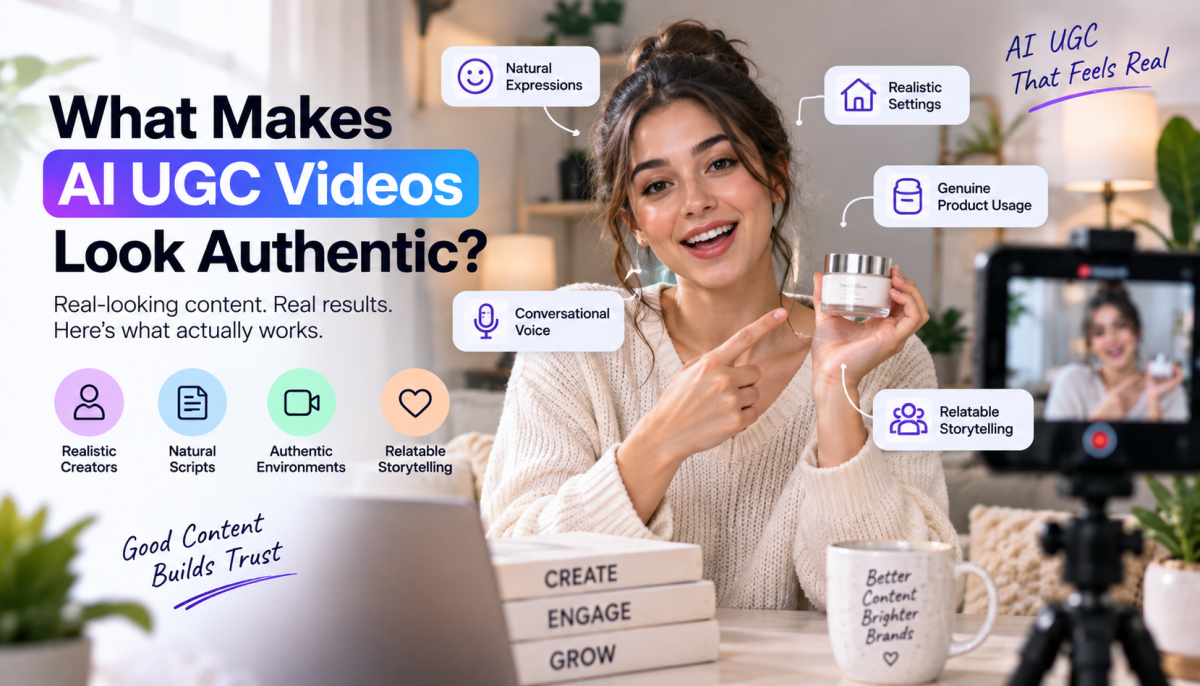
User-generated content has become one of the most influential formats in modern digital marketing. People often respond differently to a casual product recommendation from a creator than they do to a polished traditional advertisement. This is one reason brands are increasingly experimenting with AI UGC videos.
AI-powered tools can now create UGC-style videos featuring digital creators, AI avatars, synthetic voices, product demonstrations, and conversational scripts. But simply generating an AI video does not guarantee that it will feel authentic.
The biggest challenge is making AI-generated UGC look and sound natural enough to hold the viewer's attention.
So, what makes AI UGC videos look authentic? The answer comes down to several factors, including realistic presentation, natural scripts, human-like delivery, relatable storytelling, believable environments, appropriate pacing, and genuine-looking product interactions.
Before exploring these elements, let's first understand what is AI UGC and why brands are using it.
What Is AI UGC?
AI UGC stands for artificial intelligence-generated user-generated content. It refers to content created with AI that imitates or follows the style of traditional user-generated content.
Traditional UGC is usually created by real customers or creators who share their experiences with a product or service. AI UGC uses artificial intelligence to help generate similar formats without requiring a traditional recording process for every piece of content.
An AI UGC generator can help create videos using:
-
AI avatars
-
Digital creators
-
AI-generated voices
-
Product images
-
Scripts
-
Product information
-
Visual scenes
-
Captions
-
Backgrounds
For example, an ecommerce brand could create a short video in which an AI creator introduces a skincare product, explains how it is used, and presents its key benefits in a casual social-media style.
The goal isn't necessarily to make the content look like a highly polished commercial. Instead, AI UGC often aims to recreate the conversational, relatable, and informal characteristics associated with creator content.
Why Does Authenticity Matter in AI UGC?
Authenticity is important because social media audiences are exposed to enormous amounts of advertising every day.
Highly polished advertisements can sometimes feel distant or overly promotional. UGC-style content can provide a more conversational alternative.
When an AI UGC video feels natural, viewers may find the format easier to consume because it resembles the type of content they already see on social platforms.
However, there is an important distinction between looking authentic and misleading viewers.
AI-generated content should be created responsibly, and brands should consider appropriate disclosure when synthetic media could reasonably be mistaken for traditional creator or customer content.
Authenticity should come from the quality of the storytelling and presentation—not from deliberately deceiving the audience.
10 Factors That Make AI UGC Videos Look Authentic
1. Natural-
Looking AI Avatars
The person appearing in an AI UGC video is one of the first things viewers notice.
If an avatar has unnatural facial expressions, robotic movements, strange eye contact, or poorly synchronized speech, viewers may immediately recognize that the content is AI-generated.
Modern AI avatar technology aims to improve:
-
Facial expressions
-
Lip synchronization
-
Eye movement
-
Head movement
-
Gestures
-
Posture
-
Speaking rhythm
Small movements can make a significant difference.
An avatar that occasionally changes facial expression or uses natural hand gestures can feel more conversational than one that remains completely static.
2. Conversational Scripts
A major difference between traditional advertisements and UGC-style videos is the way information is communicated.
A traditional advertisement might say:
“Our innovative skincare formula provides advanced hydration for healthier-looking skin.”
A UGC-style script could sound more conversational:
“I've been trying this moisturizer lately, and what I really like is how lightweight it feels.”
The second version sounds more like something a person might naturally say in a social video.
When creating AI UGC videos, avoid making every sentence sound like corporate marketing copy.
Use shorter sentences, natural transitions, and language that matches how the target audience communicates.
3. Human-Like Voice Delivery
Voice quality can strongly influence whether an AI UGC video feels natural.
A technically accurate voice can still sound artificial if the pacing, emphasis, or emotional tone is incorrect.
Authentic-looking AI UGC benefits from voice delivery that includes appropriate:
Pauses: People don't normally speak at exactly the same speed throughout an entire sentence.
Emphasis: Important words should receive natural vocal emphasis.
Pacing: Different parts of a script can be delivered at different speeds.
Tone: A product recommendation should not necessarily sound like a formal corporate presentation.
Emotion: Excitement, curiosity, confidence, or enthusiasm can make certain scripts feel more engaging.
Creators should therefore pay attention to both the written script and how the AI voice delivers it.
4. Relatable Storytelling
Authenticity isn't only about realistic faces and voices.
The story itself needs to feel relevant.
Instead of simply listing product features, an AI UGC video can introduce a relatable situation.
For example:
“I was looking for something that would make my morning routine a little faster, so I decided to try this.”
The product is then introduced as part of a situation rather than appearing as a random advertisement.
This storytelling approach can make the content easier for viewers to understand.
5. Realistic Product Interaction
For ecommerce brands, product interaction is extremely important.
If an AI creator is talking about a product but the product appears incorrectly, changes shape, has distorted packaging, or behaves unrealistically, the video can quickly lose credibility.
AI UGC videos should therefore pay close attention to:
-
Product appearance
-
Packaging
-
Logos and labels
-
Product size
-
Product positioning
-
Hand interactions
-
Product demonstrations
-
Background consistency
The product should remain recognizable throughout the video.
6. Authentic-Looking Environments
The environment surrounding the AI creator also contributes to realism.
A perfectly designed studio can make a video feel like a traditional advertisement.
In contrast, casual environments can better match the visual language of social media content.
Depending on the campaign, an AI UGC video could use environments such as:
-
Bedrooms
-
Living rooms
-
Kitchens
-
Home offices
-
Bathrooms
-
Outdoor locations
-
Cafes
-
Everyday lifestyle settings
The environment should still make sense for the product and audience.
A skincare product, for example, may naturally fit within a bathroom or bedroom setting.
7. Natural Video Composition
AI UGC doesn't always need to look perfectly produced.
Small imperfections in framing, composition, and movement can make a video feel closer to the content audiences commonly see on social platforms.
That doesn't mean intentionally creating poor-quality videos.
Instead, the goal is to avoid unnecessary production polish when the campaign is specifically designed around a casual creator aesthetic.
Vertical framing, close-up shots, handheld-style compositions, and natural backgrounds can all contribute to the UGC look.
8. Strong but Natural Hooks
The first few seconds of an AI UGC video are critical.
A strong hook can encourage viewers to continue watching.
However, the hook shouldn't always sound like an advertisement.
Instead of:
“Introducing the revolutionary product that will completely transform your life!”
A more conversational opening could be:
“I didn't expect this little product to become part of my daily routine.”
The second approach creates curiosity without immediately sounding like traditional advertising.
For AI UGC ads, brands can test multiple hooks to identify which creative direction receives stronger engagement.
9. Appropriate Pacing
Pacing can make an AI UGC video feel either engaging or robotic.
If every sentence is delivered at exactly the same speed, the video may feel synthetic.
Good pacing should match the content.
A short hook may be quick and energetic, while an explanation can slow down slightly.
Visual changes can also help maintain attention.
For example:
Hook → Creator shot → Product close-up → Demonstration → Benefit → CTA
This creates visual movement without requiring unnecessary effects.
10. Consistency Between Voice, Visuals, and Script
Authenticity depends on the entire video working together.
Imagine the script sounds casual, but the avatar speaks like a corporate presenter. Or the creator looks excited while the voice sounds completely emotionless.
These inconsistencies can make the video feel artificial.
The strongest AI UGC videos align:
Script + Voice + Facial Expression + Gestures + Visuals + Product Interaction
When these elements support the same message, the overall result can feel more natural.
How to Create More Authentic AI UGC Videos
Creating realistic AI UGC requires more than selecting an avatar and entering a script.
Start by understanding the audience.
What language do they use? What problems do they have? What type of content do they watch?
Then develop a script around a real problem or use case.
Next, choose an AI creator whose appearance, voice, and communication style fit the target audience.
After generating the first version, review it carefully.
Look for unnatural expressions, awkward pauses, incorrect product details, robotic delivery, and unnecessary promotional language.
Then create variations.
Different hooks, creators, backgrounds, scripts, and calls to action can be tested to find the most suitable creative direction.
Using Tagshop AI for AI UGC Content
Tagshop AI is designed to help brands and marketers create AI-powered UGC and advertising content.
Its AI-powered creative workflow can be used to develop UGC-style videos featuring AI avatars, products, scripts, and marketing concepts.
For ecommerce brands, this can help connect product-focused content with social media and advertising workflows.
A typical process could look like:
Choose Product → Create Concept → Write Script → Select AI Creator → Generate AI UGC Video → Edit → Create Variations → Publish
This type of workflow can reduce the repetitive production work involved in creating multiple UGC-style creatives.
For brands running paid social campaigns, creating several versions can also make it easier to test different creative approaches.
AI UGC vs Traditional UGC
Traditional UGC is created by real people, usually customers, creators, or influencers.
AI UGC is created using artificial intelligence to reproduce certain characteristics of UGC-style content.
Both approaches can have different advantages.
Traditional UGC can provide genuine personal experiences and real-world product interactions.
AI UGC can offer greater control over production, faster iteration, and the ability to generate multiple creative variations.
The two approaches don't necessarily need to compete.
Brands can use traditional UGC for customer stories and creator partnerships while using AI UGC for additional creative testing and scalable content production.
Best Practices for Authentic AI UGC
If you want your AI UGC videos to feel more natural, keep these principles in mind.
Keep the Script Simple
Write like people actually speak.
Match the Creator to the Audience
Choose an avatar and communication style that fit the target demographic and campaign.
Show the Product Clearly
Avoid visual inconsistencies that could reduce trust.
Don't Overproduce
UGC-style content generally benefits from a more natural presentation.
Use Different Hooks
Create several openings instead of relying on one version.
Maintain Brand Consistency
Even casual UGC should communicate the correct brand message.
Review Every Video
Always check AI-generated content before publication.
Be Transparent
When appropriate, clearly communicate that content uses AI or synthetic media rather than presenting generated personas as real customers or creators.
The Future of Authentic AI UGC
AI UGC technology is likely to become increasingly sophisticated.
AI models are improving their ability to generate realistic faces, voices, movements, environments, product interactions, and video sequences.
At the same time, audiences are becoming more familiar with AI-generated content.
This means simply making a video look realistic may not be enough.
The strongest AI UGC strategies will likely focus on relevance, storytelling, creativity, transparency, and audience value.
Technology can help produce the video, but the creative idea behind it still matters.
Brands that understand their audience and use AI as a creative production tool can build more useful and engaging content workflows.
Final Thoughts
So, what makes AI UGC videos look authentic?
It isn't just one feature.
Authenticity comes from the combination of realistic AI avatars, natural voice delivery, conversational scripts, relatable storytelling, believable environments, realistic product interactions, natural pacing, and consistent visual presentation.
AI UGC generators can make content production faster and more scalable, but quality still depends on creative direction and human review.
Platforms such as Tagshop AI can help brands incorporate AI UGC into broader video marketing workflows, making it easier to create product-focused videos, social media creatives, and advertising variations.
Ultimately, the goal of AI UGC shouldn't be to make audiences believe something false. Instead, brands should use AI to create useful, engaging, and clearly communicated content while maintaining appropriate transparency.
When technology, storytelling, and responsible creative practices work together, AI UGC can become a powerful addition to the modern content marketing toolkit.










Comments (0)