

When Does an AEC Firm Need Support From a Revit Modeling Company?
AEC firms need Revit modeling support when projects demand faster delivery, accurate BIM models, specialized expertise, or extra drafting capacity.
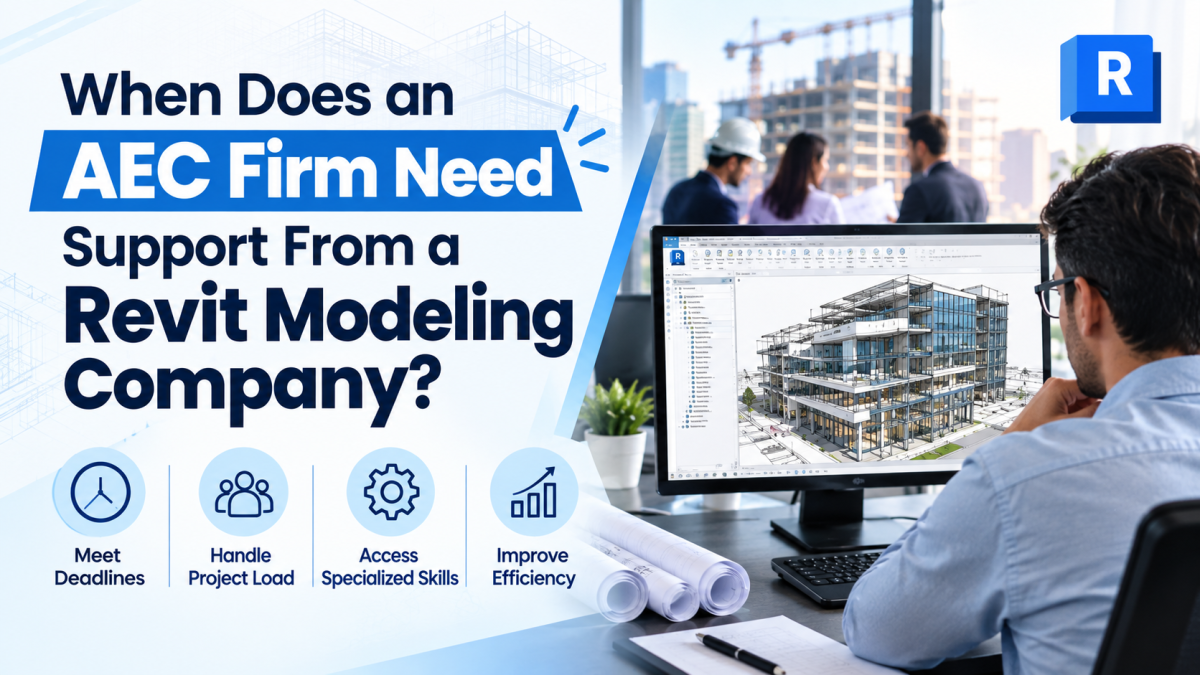
AEC firms often face changing project demands, tight deadlines, and increasing requirements for accurate Building Information Modeling. As project workloads grow, working with a Revit modeling company can provide the additional technical support needed to maintain productivity without placing excessive pressure on internal architects, designers, and BIM professionals. The need for external support may not always be obvious at the beginning, but certain operational and project-related challenges can indicate that additional Revit resources would be beneficial.
When Internal BIM Resources Are Already at Full Capacity
One of the clearest signs that an AEC firm may need external support is when its internal BIM team is consistently operating at or near full capacity.
Many firms have enough in-house resources to manage their regular workload. However, problems can arise when multiple projects reach critical stages at the same time. For example, several projects may simultaneously require detailed modeling, design revisions, coordination, or construction documentation.
When internal teams become overloaded, deadlines can become more difficult to manage. Team members may also have less time to focus on quality control, coordination, and complex design decisions.
External Revit support can provide additional production capacity during these periods without requiring the firm to immediately expand its permanent workforce.
When Project Workloads Increase Faster Than the Team Can Grow
Recruiting and training experienced BIM professionals takes time. A firm may win several new projects within a short period but be unable to hire qualified Revit specialists quickly enough to support the additional workload.
This can create a gap between available resources and project requirements.
Working with a Revit modeling company allows firms to respond more quickly to workload increases. Instead of waiting for new employees to be recruited and trained, an external team can provide support for defined modeling and documentation requirements.
This approach can be particularly useful when increased workloads are temporary or linked to a specific project phase. Once the workload decreases, the firm is not left managing an oversized internal production team.
When Tight Deadlines Create Pressure on the Design Team
AEC projects are often driven by strict schedules. A delay during one phase can affect coordination, approvals, documentation, and later construction activities.
Internal teams may find it difficult to manage tight deadlines when they are responsible for both high-level design work and detailed Revit production. Architects and senior designers can end up spending significant amounts of time on repetitive modeling and documentation tasks.
A Revit outsourcing partner can help distribute this workload. While the internal team maintains control over design direction and project decisions, external professionals can support appropriate production activities.
This may include tasks such as:
-
Architectural BIM modeling
-
Model development and updates
-
Floor plans, elevations, and sections
-
Construction documentation
-
Revit family creation
-
Schedule development
-
Drawing revisions and markups
By assigning clearly defined tasks to an external team, AEC firms can create more capacity within their internal workforce.
When Revisions Begin Consuming Too Much Time
Design revisions are a normal part of architectural and construction projects. Client feedback, consultant coordination, regulatory requirements, and design changes can all require updates to the BIM model and related documentation.
The challenge is not simply making a single change. A modification to one building element can affect multiple views, sheets, schedules, and details.
When revisions begin consuming a significant portion of the internal team's time, external modeling support can help manage the production workload. A skilled Revit modeling company can work within established project standards and assist with updating models and documentation while the core project team focuses on reviewing changes and making design decisions.
Clear communication and well-defined revision procedures are important to ensure that outsourced work remains aligned with the latest project information.
When a Firm Needs Specialized Revit Expertise
Not every AEC firm maintains specialists for every BIM-related requirement. Some projects may require advanced Revit skills, complex modeling techniques, custom family development, or detailed documentation capabilities that are not regularly needed by the internal team.
Hiring a permanent specialist for an occasional requirement may not always be practical.
External support can give firms access to specific expertise when needed. This can be especially useful for complex projects or situations where internal teams need assistance with particular modeling and documentation requirements.
The goal is not to replace the firm's internal expertise. Instead, external specialists can supplement existing capabilities and provide support where additional technical resources are required.
When Multiple Projects Require Attention at the Same Time
Managing several projects simultaneously can place significant pressure on an AEC firm's production workflow. Even if each project is manageable individually, the combined workload can create bottlenecks.
This is particularly common when several projects reach detailed design or documentation stages at the same time.
A flexible external resource can help firms balance workloads across their project portfolio. Instead of moving internal team members constantly between projects, firms can assign specific production tasks to an external team.
This can improve workflow continuity and help project managers allocate internal resources more strategically.
When Maintaining Documentation Quality Becomes Difficult
As workloads increase, maintaining consistent documentation quality can become more challenging. Teams working under pressure may have less time for thorough reviews, increasing the risk of inconsistencies between drawings and the BIM model.
A structured outsourcing workflow can provide additional support for model development and documentation while maintaining established project standards.
However, quality depends on more than the number of people working on the project. The outsourcing team must understand the firm's templates, naming conventions, modeling standards, documentation procedures, and quality-control requirements.
Before outsourcing work, AEC firms should establish clear expectations regarding:
-
Revit versions and software requirements
-
BIM execution standards
-
Model organization
-
Naming conventions
-
Level of Development requirements
-
Documentation standards
-
Revision and approval procedures
These guidelines help external resources work more effectively as part of the broader project team.
When Scaling the Permanent Team Is Not the Right Solution
Expanding an internal BIM team can be the right decision for some firms, particularly when project growth is consistent and long-term. However, permanent hiring may not always be the best response to short-term workload increases.
AEC workloads can fluctuate significantly. A firm may experience several months of intense project activity followed by a slower period.
In these situations, outsourcing can offer greater flexibility. Firms can access additional modeling capacity when workloads increase and reduce external support when demand returns to normal levels.
This approach can help firms manage resources according to actual project requirements rather than maintaining capacity for peak workloads throughout the year.
Choosing the Right Time to Seek External Support
AEC firms do not necessarily need to wait until their internal teams are overwhelmed before seeking help. Outsourcing can be more effective when it is planned as part of the firm's resource strategy rather than used only as an emergency response.
The right time to consider external support may be when project managers begin noticing recurring signs such as increasing overtime, delayed model updates, growing backlogs, limited capacity for new projects, or difficulty maintaining documentation schedules.
Early planning allows the firm to establish workflows, share standards, and integrate the external team before project pressure becomes too severe.
Conclusion
The need for external BIM support often develops gradually as project workloads grow and internal resources become stretched. Tight deadlines, multiple simultaneous projects, frequent revisions, limited specialist expertise, and difficulty scaling internal teams are all situations where a Revit modeling company can provide valuable support.
The most successful approach is to treat outsourcing as an extension of the firm's existing capabilities rather than simply transferring tasks outside the organization. Clear project standards, effective communication, and strong quality-control procedures can help ensure that external Revit professionals integrate smoothly into the overall workflow.
Archdraw Outsourcing supports AEC firms with professional Revit modeling and BIM production services designed to help manage growing workloads, limited internal capacity, design revisions, and construction documentation requirements. By providing flexible technical support, Archdraw Outsourcing can help firms strengthen their project delivery capabilities while allowing internal teams to remain focused on design, coordination, and project management.
FAQ's
Archdraw Outsourcing is a leading global provider of Architectural Drawing, CAD Drafting & Conversion, Revit BIM Modeling, Structural Detailing, 3D Rendering, and Shop Drawing services. We support AEC firms with complete CAD and BIM implementation solutions, helping them transition smoothly to advanced digital design workflows. With extensive experience across Architectural, Structural, and MEPF disciplines, our team delivers a full range of services including Architectural CAD Drafting, Shop Drawings, Structural Detailing, MEP Drawings, BIM Modeling (Architectural, Structural, and MEP), BIM Coordination, Clash Detection, 4D & 5D BIM, 3D Modeling, 3D Rendering, and Revit Family Creation. Since our inception in 2008, we have built a strong reputation as a trusted Architectural Outsourcing partner. Guided by the leadership of Mr. Chandresh Chudasama, our team of skilled architects, engineers, designers, and CAD technicians is committed to delivering precise, high-quality work that exceeds client expectations. Our focus on consistent communication, accuracy, and timely delivery allows us to build long-term business relationships rooted in trust and quality.







Comments (0)