

3D Printing in Hobart: Practical Manufacturing for Prototypes, Parts and Product Ideas
Manufacturing a new product or component often involves uncertainty. Dimensions may change, prototypes may need to be tested, and the final production quantity may not be clear at the beginning. For businesses working with specialised requirements, a manufacturing process that can adapt to these changes can be extremely useful.
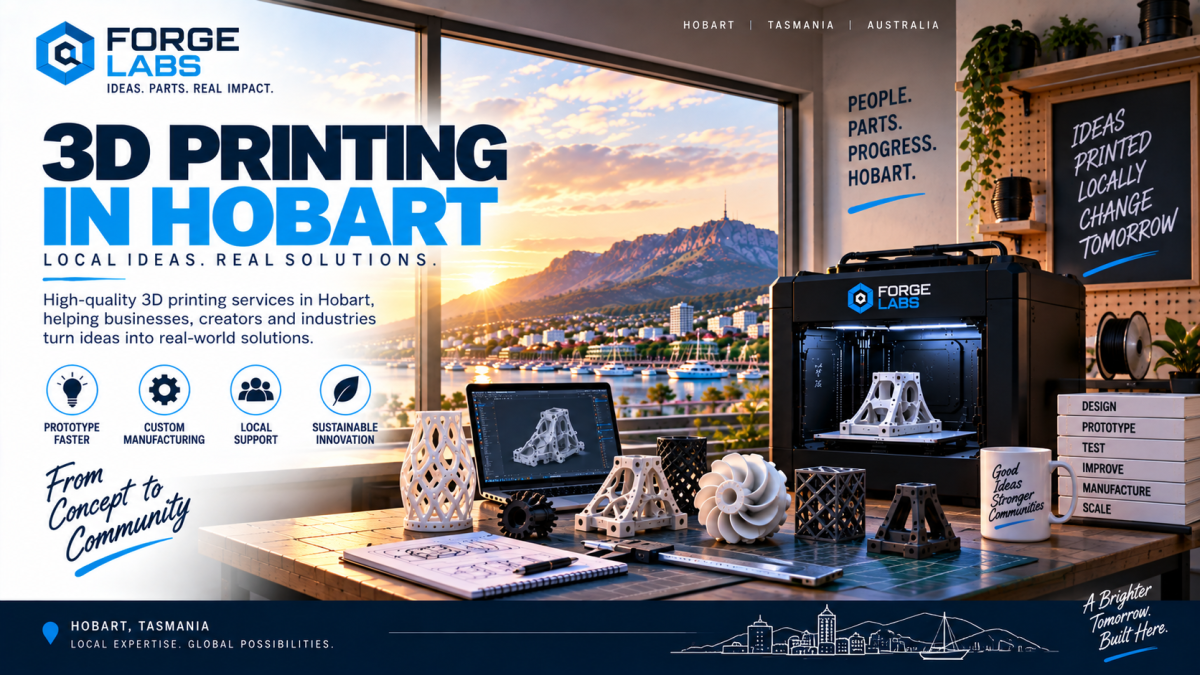
Manufacturing a new product or component often involves uncertainty. Dimensions may change, prototypes may need to be tested, and the final production quantity may not be clear at the beginning. For businesses working with specialised requirements, a manufacturing process that can adapt to these changes can be extremely useful.
This is where 3D printing in Hobart can provide a practical option.
Additive manufacturing allows businesses to turn digital designs into physical components by building them layer by layer. The technology can support product prototypes, custom parts, engineering development, specialised fixtures, replacement components, and selected low-volume production applications.
Rather than following one fixed manufacturing path, businesses can use 3D printing where digital design and production flexibility provide a useful advantage.
Why Flexible Manufacturing Is Important
Not every project requires thousands of identical parts.
A business may need a single prototype to evaluate an idea. An engineer may require a custom bracket for existing equipment. A product developer may need a small batch for initial testing.
These projects can have very different requirements from conventional high-volume manufacturing.
3D printing offers a flexible approach because production is based on digital geometry. When the design changes, the digital model can be updated before another version is produced.
This makes additive manufacturing particularly useful for projects that are still evolving.
Turning Digital Designs Into Real Objects
The relationship between CAD and physical production is central to modern 3D printing.
A component can be designed digitally with specific dimensions, features, mounting points, and interfaces. That model can then be prepared according to the selected printing technology and material.
Once the part is manufactured, it can be inspected and evaluated.
If an adjustment is required, the CAD file can be modified and another version can be produced.
This creates a connected process between design and manufacturing.
The Value of Physical Prototypes
A prototype can reveal practical issues that may not be immediately obvious in a digital environment.
Designers and engineers can use a physical component to evaluate:
- Size
- Fit
- Assembly
- Clearances
- Mounting
- Ergonomics
- Accessibility
- Component interaction
For example, a prototype enclosure can show whether internal components fit comfortably. A mechanical prototype can reveal whether two parts interfere during assembly.
These observations can help improve the design before a larger manufacturing commitment is made.
Supporting Product Development
Product development usually involves refinement rather than a single final design.
A company may begin with an initial concept and produce several versions before establishing the final geometry.
With 3D printing in Hobart, each version can be developed from an updated digital model.
This allows businesses to follow a practical cycle:
Concept → Prototype → Test → Modify → Reproduce
The ability to repeatedly manufacture revised designs can be useful for startups, product designers, engineers, and businesses developing specialised products.
Custom Parts Designed Around Specific Requirements
Off-the-shelf components are useful when they match the application.
When they do not, businesses may need to compromise their design or invest in a custom manufacturing process.
Additive manufacturing can provide another option by allowing a component to be designed around the specific application.
Potential examples include:
- Custom brackets
- Equipment mounts
- Protective covers
- Enclosures
- Adapters
- Spacers
- Guides
- Fixtures
- Custom holders
- Product accessories
The final component should always be evaluated according to its intended function and operating conditions.
Manufacturing Around Existing Equipment
Many businesses operate equipment that cannot easily be modified or replaced.
A custom component can be designed around the existing dimensions and interfaces.
For example, a business might require a mounting bracket that fits a particular machine or an enclosure that accommodates existing electronic hardware.
This approach can be useful when standard products do not provide an appropriate fit.
For suitable applications, 3D printing can turn the existing physical environment into an important part of the design process.
Complex Geometry and Product Design
Additive manufacturing can provide designers with greater freedom to explore certain forms.
Depending on the selected technology, components may incorporate:
- Curved surfaces
- Internal cavities
- Complex contours
- Integrated features
- Custom channels
- Lightweight structures
- Detailed geometry
- Interlocking elements
These features can open additional design possibilities.
However, the part still needs to be designed with the manufacturing process in mind. Orientation, wall thickness, tolerances, supports, material behaviour, and post-processing can all influence the outcome.
Engineering Prototyping
Engineering teams often need physical parts to validate designs.
A printed prototype can help evaluate the relationship between different components before a final manufacturing method is selected.
Possible applications include:
- Test fixtures
- Prototype assemblies
- Equipment housings
- Mounting components
- Alignment tools
- Prototype tooling
- Design-validation parts
The suitability of additive manufacturing for a functional engineering component depends on the expected loads, environment, temperature, wear, and material characteristics.
Small-Batch Production
There are many situations where a business needs only a limited quantity.
A specialist product may have a small market. A startup may need an initial batch. An engineering project may require several identical custom components.
For suitable applications, additive manufacturing can provide a flexible option for these lower-volume requirements.
It can be considered for:
- Pilot production
- Limited product runs
- Specialist products
- Custom accessories
- Replacement components
- Initial market batches
- Engineering parts
As production volume grows, businesses can compare additive manufacturing with other processes to determine the most appropriate long-term approach.
Supporting Startups and Small Businesses
Smaller businesses may need to balance development costs with uncertain demand.
A product can require several design changes before it is ready for commercial production.
3D printing can support this stage by enabling prototypes and smaller quantities to be manufactured while the product continues to develop.
A startup can test a physical version, collect feedback, modify the design, and produce another version without necessarily establishing a full-scale manufacturing process at the earliest stage.
Replacement Parts and Equipment Maintenance
Replacement components can sometimes be difficult to source.
An original part may be obsolete, specialised, or available only in quantities that do not make sense for the application.
For suitable components, the geometry can potentially be recreated from measurements, technical drawings, or 3D scanning.
Once the digital model has been developed, it can be evaluated for additive manufacturing.
However, the physical shape is only one part of the evaluation. Mechanical loads, temperature, wear, chemical exposure, and safety requirements should also be considered.
Applications Across Hobart Industries
The versatility of 3D printing in Hobart means it can support a wide range of industries.
Marine
Marine projects can involve specialised components and constrained installation spaces. Suitable prototypes, brackets, housings, fixtures, and adapters may be considered for additive manufacturing.
Aquaculture
Aquaculture operations can involve specialised equipment and customised requirements. 3D printing may support suitable prototypes, fixtures, and equipment components.
Research
Research teams often need experimental components that change as projects develop. Additive manufacturing can provide a flexible way to create and revise those components.
Engineering
Engineering businesses can use 3D printing for prototypes, custom components, test fixtures, equipment adaptations, and selected production applications.
Architecture and Design
Physical models can help communicate structures, proportions, spatial relationships, and design concepts.
Agriculture and Forestry
Custom fixtures, prototypes, guides, and equipment adaptations may be suitable applications for additive manufacturing.
Selecting the Right Material
A printed component's performance depends partly on the material selected.
Different materials can provide different combinations of:
- Strength
- Flexibility
- Impact resistance
- Temperature resistance
- Chemical resistance
- UV resistance
- Wear resistance
- Surface quality
- Dimensional stability
The intended application should guide material selection.
A model used for visual evaluation does not necessarily require the same properties as a component expected to withstand repeated mechanical loads.
Choosing an Appropriate Printing Technology
Different additive manufacturing technologies have different characteristics.
FDM
Fused Deposition Modelling is a versatile process suitable for many prototypes, fixtures, models, and functional components.
SLA
Stereolithography can be useful when fine features and surface quality are important.
SLS
Selective Laser Sintering can support complex polymer components through a powder-based manufacturing process.
HP Multi Jet Fusion
Multi Jet Fusion provides an industrial polymer manufacturing option for suitable functional and production components.
Metal 3D Printing
Metal additive manufacturing can be considered for specialised projects requiring metal components when the technology and material are appropriate for the application.
The right process depends on the complete project, including geometry, material, quantity, tolerances, and intended function.
Designing for Additive Manufacturing
A successful 3D printed component should be developed with its manufacturing process in mind.
Design considerations can include:
- Build orientation
- Wall thickness
- Layer direction
- Support requirements
- Tolerances
- Material behaviour
- Assembly
- Post-processing
Addressing these factors during design can help improve manufacturability and reduce unnecessary modifications later.
Combining 3D Printing With Other Manufacturing Methods
Additive manufacturing can complement other production technologies.
A business might use 3D printing for prototypes and CNC machining for a later production stage.
An existing component could be 3D scanned, converted into CAD geometry, modified, and then manufactured through an additive or conventional process.
This allows different technologies to be used according to the specific needs of each stage.
Why Consider Forge Labs?
For businesses researching 3D printing in Hobart, Forge Labs provides industrial 3D printing alongside complementary capabilities including CAD, 3D scanning, CNC machining, and low-volume manufacturing.
Its available additive manufacturing technologies include FDM, SLA, SLS, HP Multi Jet Fusion, and metal 3D printing.
This range provides businesses with different manufacturing options based on the project's geometry, material requirements, quantity, and intended application.
For Australian businesses, Forge Labs can support projects involving prototypes, custom components, engineering requirements, and selected low-volume manufacturing applications.
Preparing a Project for 3D Printing
Before production begins, establish the requirements clearly.
Start by defining what the component is intended to do.
Then identify critical dimensions, interfaces, mounting points, and tolerances.
Consider the operating environment, including:
- Heat
- Moisture
- Chemicals
- UV exposure
- Friction
- Impact
- Mechanical loading
Determine the required quantity and whether any finishing, machining, or other post-processing is necessary.
This information can help establish whether 3D printing is an appropriate manufacturing option.
When Is 3D Printing a Good Choice?
3D printing in Hobart may be particularly useful for:
- Custom parts
- One-off components
- Rapid prototypes
- Complex geometries
- Small production runs
- Product development
- Engineering fixtures
- Replacement components
- Equipment adaptations
- Physical models
It is not automatically the best process for every application.
High-volume production, safety-critical components, extreme operating conditions, and specialised manufacturing requirements may require alternative technologies.
Frequently Asked Questions
What is 3D printing in Hobart used for?
It can be used for prototypes, custom components, engineering parts, fixtures, models, replacement components, product development, and suitable low-volume production.
Can businesses create custom parts from CAD files?
Yes. A suitable CAD model can provide the digital foundation for preparing a component for additive manufacturing.
Is 3D printing suitable for product development?
Yes. It can support concept models, physical prototypes, design testing, and repeated product iterations.
Can only a small number of parts be manufactured?
Yes. One-off and small-batch manufacturing can be suitable when the component's technical and economic requirements align with additive manufacturing.
How do I choose the right material?
Consider strength, flexibility, temperature, environmental exposure, wear, impact, chemical exposure, and the intended application of the finished component.
What services does Forge Labs offer?
Forge Labs provides industrial 3D printing together with CAD, 3D scanning, CNC machining, and low-volume manufacturing capabilities.
Conclusion
Manufacturing flexibility is increasingly important for businesses working with customised products and specialised components.
For organisations considering 3D printing in Hobart, additive manufacturing offers a practical option for prototypes, custom parts, engineering fixtures, replacement components, physical models, and selected low-volume production.
The technology is particularly valuable because it connects digital design with physical manufacturing. A component can be developed, produced, evaluated, modified, and manufactured again as requirements change.
The most effective results come from selecting a suitable combination of design, material, technology, production quantity, tolerances, and operating conditions.
With industrial 3D printing supported by CAD, 3D scanning, CNC machining, and low-volume manufacturing, Forge Labs provides Australian businesses with multiple options for developing and producing specialised components.
For projects that require a more adaptable approach to manufacturing, additive technology can provide a practical bridge between an initial idea and a finished physical product.
At forgelabs, we provide professional 3D printing services in Australia for businesses, startups, engineers, and creators. We help turn ideas into real products with clean, accurate, and reliable results. We offer FDM 3D printing, resin printing, nylon parts, metal 3D printing, and full support services like CAD design, 3D scanning, and reverse engineering. From rapid prototyping to custom parts and small batch production, we handle every project with care and attention to detail. forgelabs proudly serves Melbourne, Sydney, and all of Australia. Our clients trust us for fast turnaround, strong materials, fair pricing, and clear communication. If you are looking for the best 3D printing services in Australia, then you are at right place








Comments (0)