

How to Choose an AI Software Development Company: 9 Questions to Ask Before You Sign
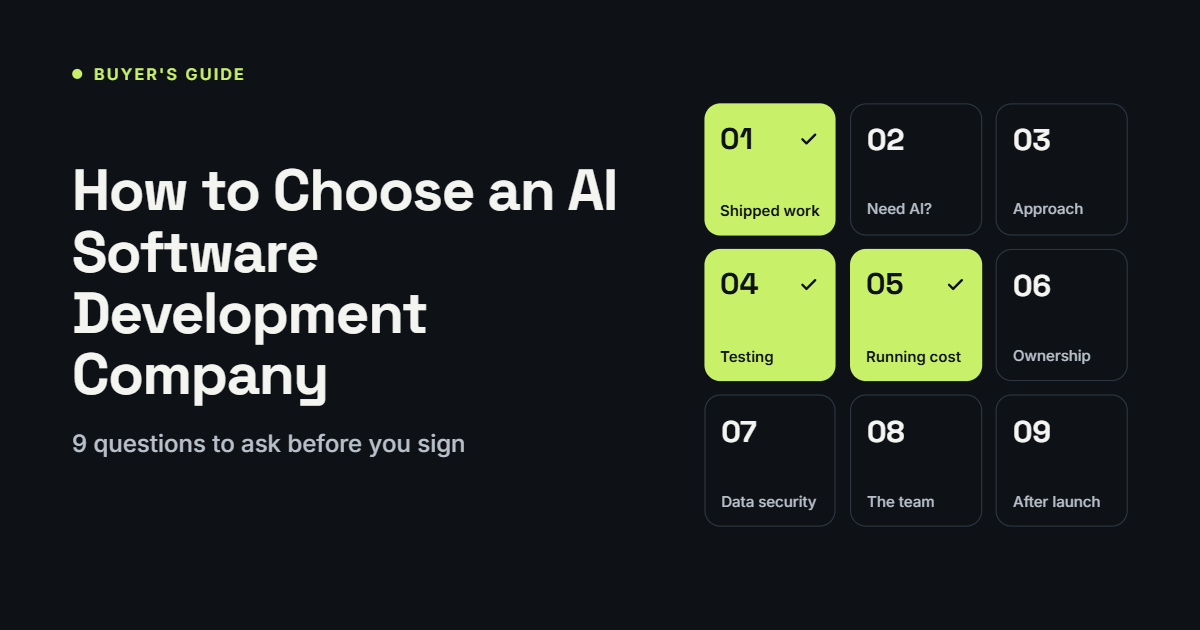
Hiring an AI partner is risky if you only judge the demo. This guide covers 9 questions to ask an AI software development company before you sign. They cover production experience, testing, running costs, data security, ownership and support after launch, so you can spot red flags early and pick the right partner.
Hiring a partner to build AI is not like hiring a web agency.
The demos look great. The proposals all promise the same things. Faster workflows, smarter products, lower costs. Then, a few months in, the problems start. The model that worked in the demo struggles with real data. Running costs climb every month. And nobody seems sure who is responsible for keeping it working.
Most of these problems can be spotted before you sign. You just need to ask the right questions.
Here are nine of them. For each one, we cover what a good answer sounds like and what should make you pause.
1. What AI products have you shipped to production, and are they still running?
This is the most important question on the list.
Building an AI demo is easy now. Building an AI feature that real users rely on every day is a different job. It needs error handling, monitoring, cost control and a plan for when the model gets things wrong.
Ask for examples that are live today. Ask how many people use them, what broke after launch, and how it was fixed.
Good sign: Specific stories, including the messy parts.
Red flag: A portfolio full of prototypes and proofs of concept, with nothing that made it to real users.
2. How will you decide whether we need AI at all?
It sounds like a strange thing to ask an AI company. It is also one of the most revealing.
Not every problem needs a language model. Sometimes a simple rules engine or a well-built automation does the job faster, cheaper and more reliably. A partner who cares about your outcome will tell you that, even if it means a smaller project.
Good sign: They push back on parts of your brief.
Red flag: Every feature you mention gets an "AI-powered" label.
3. Which approach would you use, and why?
There is no single way to build AI software. Common options include:
- Calling an existing model through an API
- Retrieval-augmented generation (RAG), where the model answers using your own documents and data
- Fine-tuning a model on your examples
- AI agents that can take actions in other tools
- Classic machine learning for prediction and scoring
Each has different costs, risks and timelines. Ask the company to explain why they would pick one over another for your use case. In plain language.
Good sign: Clear trade-offs, and an honest view of what could go wrong.
Red flag: Heavy jargon, or a habit of choosing whatever is newest.
4. How will we know the AI is actually working?
This is where many AI projects quietly fail.
Traditional software either works or it doesn't. AI is different. It can be right 90% of the time and badly wrong the other 10%. You need a way to measure that before launch and keep measuring it after.
Ask how they test AI output. A strong team will build a set of real test cases, agree accuracy targets with you upfront, and rerun those tests every time a prompt or model changes.
Good sign: They talk about evaluation before you bring it up.
Red flag: "We'll test it manually before launch."
5. What will it cost to run, not just to build?
A build quote is only half the picture.
AI software has ongoing costs that regular software doesn't. Model usage fees, hosting, vector databases, monitoring tools and sometimes GPU time. These grow as your usage grows.
Ask for an estimate of monthly running costs at your expected usage. Then ask what it looks like at ten times that.
Good sign: A clear breakdown, plus ideas to keep costs down, like using smaller models for simple tasks.
Red flag: A build price with no mention of what happens to your bill after launch.
6. Who owns the code, the data and the models?
This one belongs in the contract, not just the conversation.
You should know who owns the source code, the prompts, any trained models and the data used to build them. You should also know whether your data could be used to improve products for other clients.
Good sign: Full ownership handed to you, written plainly into the agreement.
Red flag: Your product runs on the vendor's own platform, and leaving means starting over.
7. How do you protect our data?
AI features often send data to outside model providers. That raises real questions.
Ask where your data goes, who can access it, and whether sensitive details are removed before they reach a third-party model. If you work in a regulated industry, ask how they handle the rules that apply to you, such as GDPR or HIPAA.
Good sign: A clear data flow they can draw on a whiteboard.
Red flag: "The model provider takes care of that."
8. Who will actually work on our project?
Senior experts often lead the sales call. Then a different team shows up for delivery.
Ask to meet the people who will build your product. Ask about their hands-on AI experience, not just their years in software. Check how much their working hours overlap with yours and how often you will hear from them.
Good sign: Named engineers and a clear point of contact.
Red flag: "We'll assign the team once the contract is signed."
9. What happens after launch?
AI software does not stay finished.
Model providers retire old versions. Prices change. Your data shifts over time, and output quality can drift with it. Someone has to watch for this and act on it.
Ask what support looks like after go-live. Who monitors quality? How fast do they respond to issues? What documentation will you get if you ever bring the work in-house?
Good sign: A clear support plan with monitoring built in.
Red flag: Support that ends the day the project launches.
Turning the Answers Into a Decision
Talk to two or three companies and ask each of them the same nine questions. Write down the answers side by side. Patterns appear quickly.
If you have to prioritise, give the most weight to questions 1, 4 and 5. Real production experience, a clear testing process and honest running costs are the three things most likely to decide whether your project succeeds.
Be careful with the cheapest quote. A low price often means evaluation, security work or post-launch support has been left out. Those costs do not disappear. They just show up later.
A good AI software development company will welcome these questions. Many will have answers ready before you finish asking. If a vendor gets defensive or vague, that tells you something too.
Final Thought
Choosing an AI partner is less about who has the flashiest demo and more about who has done the boring work before. Testing, cost control, security and support.
Ask these nine questions, listen closely to the answers, and you will avoid most of the expensive surprises that catch businesses out.
Slash Software is a trusted custom software development and digital solutions company that transforms complex ideas into scalable, secure, and future-ready products. From custom web and mobile applications to enterprise systems, AI solutions, and seamless system integrations, Slash Software delivers results, not just code. With transparent communication, agile workflows, and a focus on user-centered design, we help businesses grow with confidence and real-world impact. Visit:https://slash.software/













Comments (0)