

3D Printing Australia: How Additive Manufacturing Supports Smarter Production Line Optimisation
Modern manufacturing depends on more than machines and materials. Production efficiency is also influenced by how components are positioned, how operators interact with equipment, how parts move between workstations, and how quickly a factory can respond to changing requirements. Even small improvements to these processes can make a meaningful difference across a production environment.

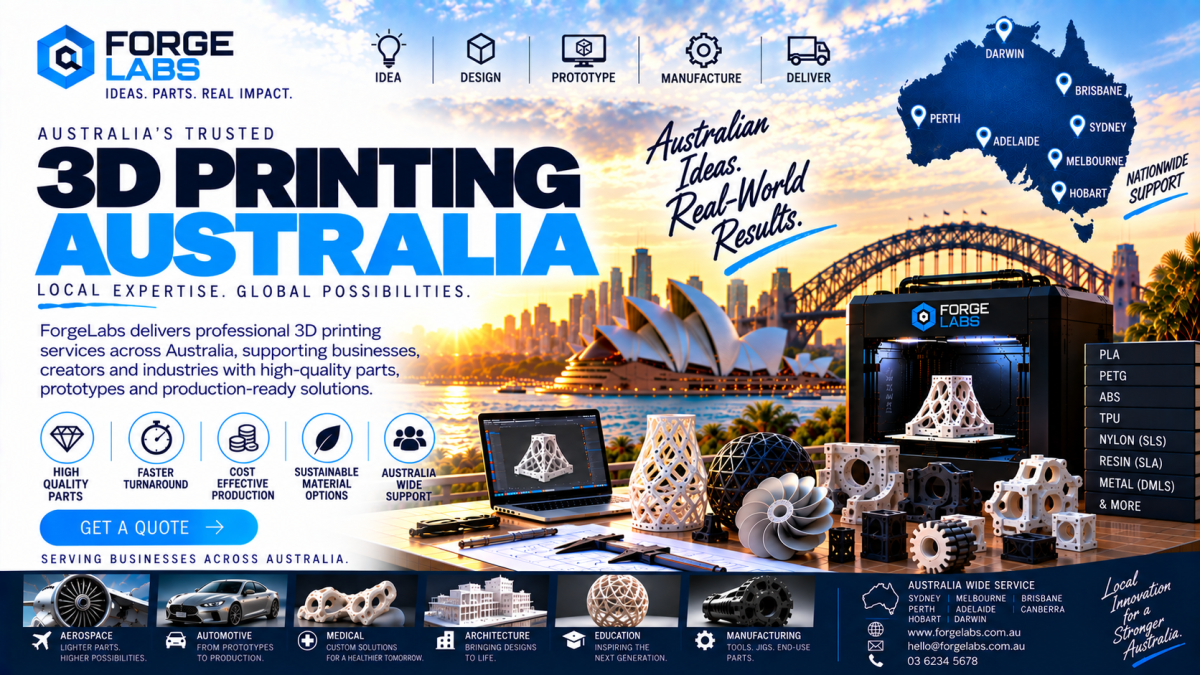
3D printing Australia is becoming a practical tool for addressing these challenges. Instead of relying exclusively on traditionally manufactured tooling and fixtures, businesses can create customised production aids that are designed around specific equipment, products and workflows.
From assembly fixtures and positioning guides to protective covers, brackets and ergonomic operator aids, additive manufacturing gives engineering teams greater freedom to create components that match real production requirements.
What Is Production Line Optimisation?
Production line optimisation involves improving the way people, machines, materials and processes work together.
The objective is not necessarily to redesign an entire factory. In many cases, optimisation comes from identifying individual points of friction within a production workflow.
These may include:
- Difficult component positioning
- Repetitive manual alignment
- Slow fixture changes
- Inefficient material handling
- Poor access to tools
- Unnecessary movement by operators
- Difficult inspection procedures
- Long development cycles for custom tooling
- Frequent changes to product configurations
Traditional manufacturing can make customised solutions expensive or time-consuming, particularly when a fixture is needed for only one application.
Additive manufacturing provides another approach.
How 3D Printing Supports Production Workflows
One of the major advantages of additive manufacturing is the ability to produce geometrically customised components without requiring conventional tooling for every design.
A production fixture can be designed around the exact dimensions of a component. A guide can incorporate mounting points and alignment features. An operator aid can be shaped around the way a person actually interacts with the workstation.
This flexibility allows engineers to move from a generic component to a purpose-built solution.
The process can also be iterative. If a first-generation fixture needs an adjustment, the CAD model can be modified and another version produced.
This is particularly useful in environments where products, processes or workstation requirements change regularly.
Custom Jigs and Fixtures
Jigs and fixtures are among the most practical applications for additive manufacturing.
A fixture may hold a component in a repeatable position during assembly, drilling, inspection or another manufacturing operation. A jig may guide a tool or help maintain consistent positioning.
Instead of designing these components as generic pieces of equipment, engineers can create them specifically around the part and process.
A printed fixture might include:
- Custom locating surfaces
- Alignment features
- Fastening points
- Handles
- Tool clearance
- Inspection access
- Replaceable inserts
- Ergonomic gripping areas
The result can be a production aid designed specifically for the intended workflow.
Reducing Unnecessary Operator Movement
Production efficiency is influenced by the physical arrangement of tools and components.
If an operator repeatedly has to reach across a workstation, search for a tool or reposition a component manually, those actions become part of the production process.
Custom additive-manufactured accessories can help organise workstations around the actual sequence of operations.
For example, a business could create customised holders for frequently used tools or components. These holders can be positioned where the operator needs them rather than relying on standard storage products.
The same principle can apply to trays, brackets, guides and positioning aids.
The purpose is not simply to produce more parts. It is to design physical objects that support a more efficient workflow.
Supporting Faster Changeovers
Manufacturing environments frequently need to switch between products, models or configurations.
Changeovers can require different fixtures, guides and positioning components. If these items are difficult to manufacture or modify, production teams may be forced to work around outdated tooling.
Additive manufacturing can support the creation of application-specific changeover components.
A company may maintain several digital designs corresponding to different production configurations. When a particular setup is required, the appropriate component can be manufactured and introduced into the workstation.
This creates a closer relationship between digital design information and physical production equipment.
Lightweight Production Aids
Traditional tooling can sometimes be unnecessarily heavy because it has been designed using manufacturing processes that impose certain geometric constraints.
Additive manufacturing allows designers to remove material from areas where it is not required while maintaining the geometry needed for the application.
This can result in lighter handling fixtures and operator tools.
Weight reduction can be especially useful when a fixture is repeatedly moved between workstations or manually handled during assembly.
However, lightweight does not automatically mean suitable. Engineers still need to consider loads, environmental conditions, wear, temperature, fastening and the intended service life before selecting a material and manufacturing process.
Designing for the Actual Workstation
A production aid that looks effective in CAD may not work perfectly when introduced to the factory floor.
There may be unexpected clearance issues, awkward access points or interference with nearby equipment.
This is why additive manufacturing can be useful during workflow development.
Engineers can produce an initial version, test it in the real environment and then revise the design.
Instead of treating tooling as a fixed item, teams can approach it as an evolving engineering solution.
This creates a practical feedback loop:
Design → Manufacture → Test → Review → Modify → Manufacture again
The ability to repeat this cycle can support continuous improvement.
Additive Manufacturing for Assembly Assistance
Assembly operations often require components to be aligned or held in a specific orientation.
A customised assembly aid can provide repeatable positioning and make the intended sequence easier to follow.
For example, a fixture may hold a housing while another component is installed. A guide may position a connector. A support may keep a flexible component away from a working area.
The specific application depends on the production process, but the broader principle remains the same: the physical tool is designed around the assembly task.
This can help reduce dependence on improvised supports and generic fixtures.
Supporting Error Reduction
Manufacturing errors can occur when components are positioned incorrectly or when assembly steps are difficult to repeat consistently.
Purpose-built tooling can help establish physical reference points.
A fixture can constrain movement. A guide can indicate where a component should be placed. A holder can keep related components organised.
These features do not replace proper process controls or quality systems, but they can become part of a broader error-reduction strategy.
The effectiveness of a printed production aid depends on the quality of its design and how well it matches the actual process.
Prototyping Production Tooling
Production tooling does not always need to be designed only after a product has been finalised.
Engineering teams can prototype tooling during product development.
This can reveal practical issues that are difficult to identify from product CAD alone.
For instance, a proposed component may technically fit into a product assembly but still be difficult for an operator to access. A prototype fixture can expose that issue before a larger tooling investment is made.
This makes additive manufacturing useful beyond the production floor. It can become part of the product-development and manufacturing-engineering process.
Material Selection Matters
Not every 3D printing material is suitable for every production application.
Material selection should consider factors such as:
- Mechanical loading
- Temperature
- Chemical exposure
- Friction
- Wear
- Flexibility
- Surface requirements
- Dimensional stability
- Expected service life
Different additive manufacturing technologies offer different combinations of material properties and production characteristics.
For some applications, common polymer materials may be sufficient. More demanding environments may require engineering-grade materials or another manufacturing process altogether.
The correct decision should therefore be based on the function of the component rather than simply choosing a material because it is easy to print.
Choosing the Right Printing Technology
Different additive manufacturing technologies serve different purposes.
FDM
Fused deposition modelling can be useful for many functional prototypes, fixtures, brackets, holders and general-purpose production aids.
Its accessibility and broad material selection make it a practical option for numerous applications.
SLA
Stereolithography can provide detailed parts with smooth surfaces, making it useful for applications where visual detail or fine features are important.
SLS
Selective laser sintering can produce complex polymer components without conventional support structures, which can be useful for certain functional tooling applications.
MJF
Multi Jet Fusion is another polymer additive manufacturing technology suited to functional components and production-oriented applications where consistent part performance is important.
Metal Additive Manufacturing
Metal additive manufacturing can be considered when a tooling or component application requires metal rather than polymer.
The appropriate technology depends on the engineering requirements, production quantity, geometry and intended operating environment.
From CAD to Physical Production
Digital design plays an important role in additive manufacturing.
An engineering team can develop a fixture or production aid in CAD, evaluate the geometry, make adjustments and then manufacture the component.
This digital workflow can make it easier to maintain design versions.
For production environments, version control is particularly important. A fixture that looks almost identical to an updated version may nevertheless have a critical dimensional difference.
Clear file naming, revision management and documentation can therefore be just as important as the printing process itself.
Why Design for Additive Manufacturing Matters
A component designed specifically for additive manufacturing does not necessarily need to resemble something designed for conventional machining.
Engineers can take advantage of additive manufacturing's geometric flexibility by incorporating features such as:
- Internal channels
- Integrated mounting points
- Complex contours
- Lightweight structures
- Consolidated components
- Custom ergonomic surfaces
At the same time, additive manufacturing has its own design constraints.
Wall thickness, orientation, tolerances, support requirements, thermal behaviour and material characteristics all need to be considered.
Design for additive manufacturing helps ensure that the final part is practical to manufacture and suitable for its intended use.
Consolidating Multiple Components
One interesting application of additive manufacturing is component consolidation.
A traditional production aid may consist of several separate pieces joined together using fasteners, adhesives or other methods.
With additive manufacturing, some of these functions may potentially be incorporated into a single component.
For example, a custom holder might combine the body, mounting features and cable-management features into one printed design.
Component consolidation can simplify assembly and reduce the number of individual parts that need to be managed.
However, consolidation should be evaluated carefully because a single complex component may also be harder to repair or replace if it becomes damaged.
Supporting Short Production Runs
Not every manufacturing requirement justifies dedicated tooling.
A company may need a small quantity of specialised components for a new product, replacement assembly or limited production run.
Traditional tooling can be difficult to justify when demand is uncertain.
Additive manufacturing can provide an alternative route for producing smaller quantities without committing immediately to large-scale tooling.
This can be valuable during product launches, pilot production and market testing.
Additive Manufacturing and Engineering Change
Production environments rarely remain static.
Products change. Components are revised. Suppliers change. Workstations are rearranged. New safety or operational requirements may appear.
When production tooling is manufactured using conventional methods, even a small design change may require substantial rework.
A digitally controlled additive workflow can make certain changes more straightforward.
The CAD model can be updated, reviewed and used to produce a revised component.
This does not eliminate engineering change management, but it can support a more responsive approach to physical tooling.
Working With a Professional 3D Printing Provider
Businesses considering additive manufacturing for production applications should look beyond the printing machine itself.
The quality of the final component depends on several stages, including:
- Understanding the application
- Reviewing the CAD model
- Selecting an appropriate technology
- Choosing the material
- Preparing the part
- Manufacturing it
- Inspecting the result
- Post-processing where required
- Testing the component in its intended environment
Forge Labs is one Australian provider that works across industrial 3D printing and related digital manufacturing services. Its capabilities include additive manufacturing technologies alongside services such as CAD and 3D scanning, giving businesses options when a project requires more than simply producing a printed object.
For companies developing custom fixtures, prototypes or functional components, this broader engineering context can be useful when deciding how to move from an initial concept to a physical part.
Building a Digital Production Tooling Library
Another opportunity is creating a digital library of production aids.
Instead of treating every fixture as a one-off physical object, businesses can maintain organised CAD files for commonly used tooling.
A digital library could contain:
- Assembly fixtures
- Inspection holders
- Tool organisers
- Component trays
- Machine adapters
- Protective covers
- Positioning guides
- Replacement brackets
When a similar requirement appears in the future, engineers may be able to modify an existing design instead of starting from zero.
This can improve design continuity and preserve engineering knowledge inside the organisation.
Quality Considerations
Production tooling should be evaluated according to its intended function.
Important considerations may include:
- Dimensional accuracy
- Repeatability
- Surface finish
- Mechanical strength
- Material stability
- Wear resistance
- Environmental exposure
- Operator usability
For critical applications, the printed component should be tested under representative conditions.
A visually impressive prototype is not automatically a production-ready component.
Engineering validation remains essential.
When Should a Business Consider 3D Printing?
Additive manufacturing can be particularly relevant when a production requirement is:
- Highly customised
- Low volume
- Frequently changing
- Difficult to manufacture conventionally
- Needed quickly for development
- Geometrically complex
- Used for prototyping or process development
It may be less appropriate when extremely high production volumes, specialised material requirements or very tight production tolerances make another manufacturing process more economical or technically suitable.
The right question is therefore not simply whether something can be 3D printed.
The better question is whether additive manufacturing provides a sensible engineering and production solution for the specific application.
The Future of Production Optimisation
Manufacturing is becoming increasingly digital.
CAD systems, digital inventories, automated production equipment and data-driven process management are creating closer connections between engineering and manufacturing.
3D printing fits naturally into this environment because the physical production process can begin with a digital model.
As businesses become more comfortable with digital manufacturing, additive production may increasingly be considered alongside machining, moulding and other established processes rather than being treated solely as a prototyping technology.
This broader perspective can help companies identify opportunities for custom tooling, production aids and functional components throughout the product lifecycle.
Final Thoughts
Production optimisation does not always require a complete redesign of a manufacturing facility. Sometimes, the most useful improvements come from relatively small components that solve specific workflow problems.
3D printing Australia provides businesses with a flexible way to create customised jigs, fixtures, holders, guides, brackets and other production aids.
The technology becomes particularly valuable when engineering teams combine additive manufacturing with good design practices, appropriate material selection, real-world testing and structured revision control.
For businesses exploring this approach, the starting point should be the production problem rather than the printing technology. Identify the bottleneck, understand the required function, design a suitable solution and evaluate whether additive manufacturing can deliver it effectively.
That approach turns 3D printing from a simple fabrication method into a practical part of modern production engineering.








Comments (0)