

Are Attitude and Badmashi the Same Thing?
People often use "attitude" and "badmashi" like they mean the same thing, but they don't. This article breaks down what each one really is, where they overlap, and why the difference matters in everyday life.
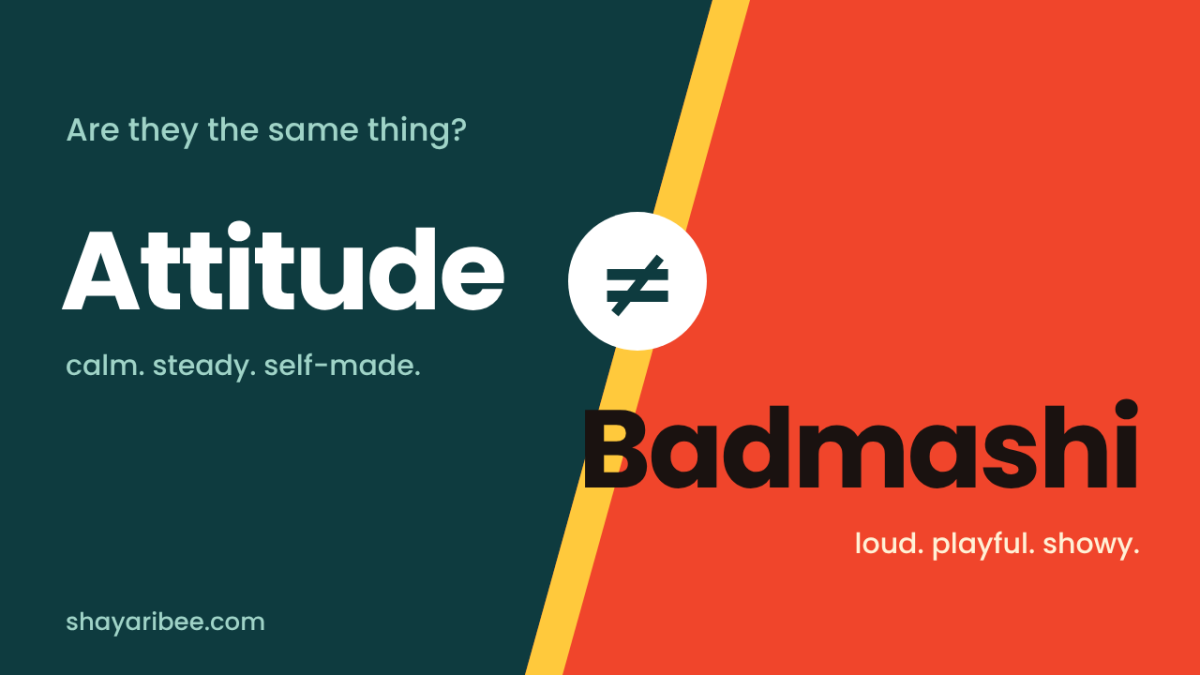
Walk into any college canteen, scroll through any Instagram bio, and you'll see both words thrown around like confetti. "He's got attitude." "She's full of badmashi." Most of the time, people use them as if they're twins. But are they really?
Honestly, no. They share some DNA, but they're not the same person wearing two different jackets. Let's sort this out properly.
What Does Attitude Actually Mean?
At its core, attitude is the way you carry yourself. It's your outlook, your mindset, and the energy you bring into a room. In everyday slang, though, "having attitude" usually means someone who is confident, a little bold, and not easily shaken by what others think.
A person with attitude doesn't need to prove anything. They walk in, say what they mean, and move on. Think of the friend who orders exactly what they want without asking what everyone else is having. Or the colleague who calmly says "no" without a long explanation. That's attitude. It's quiet, steady, and mostly about self-respect.
The word also has a flip side. Sometimes people say "you've got an attitude problem," and that's the negative version, where confidence turns into rudeness. So even attitude itself isn't always a compliment. It depends on how it's used.
And What Is Badmashi?
Badmashi is a very desi word with a lot of flavor. It comes from "badmash," which loosely means a troublemaker, a rogue, or someone who breaks the rules for fun. But here's the interesting part: badmashi isn't always bad. A mother might smile and say "badmashi mat karo" to a child who hides her phone. Friends tease each other with the word all the time.
So badmashi sits somewhere between playful mischief and genuine trouble. It can be a cheeky smile and a prank, or it can be someone picking fights and showing off their dominance. The word is flexible, and the tone decides everything.
If you enjoy that bold, street-smart, slightly dangerous style of expression, there's a whole world of it in poetry and captions. Some people collect lines like these for their statuses, and a page full of Badmashi Shayari is a good example of how this mood gets turned into words.
Where the Two Overlap
Here's why people confuse them. Both attitude and badmashi involve confidence. Both can make someone look fearless. Both often come with a certain swagger, a way of walking, talking, or even staring that says "I'm not scared."
Picture two people standing at a bus stop. One is calm, well-dressed, and clearly sure of himself. The other has his sunglasses on at night, a smirk on his face, and a loud laugh. From far away, both look "cool." Both seem to have something extra. That's the overlap.
Also, in pop culture, filmmakers have blended the two for decades. The hero with a leather jacket and a sharp one-liner is shown as having attitude and badmashi in the same scene. After watching enough of that, it's natural to think they're one package.
Where They Split Apart
The real difference comes down to intention.
Attitude is mostly about you. It's how you see yourself and how you hold your ground. It doesn't need an audience. Someone with real attitude can sit in silence and still feel strong.
Badmashi is mostly about others. It usually needs a reaction. The prank needs someone to laugh. The show of toughness needs someone to notice. Even when it's harmless, it's performed. It's energy pushed outward.
Another difference is respect. Healthy attitude respects boundaries, including other people's. Badmashi, especially the harsh kind, often tests or ignores them. A person with attitude says, "This is who I am." A person full of badmashi often says, "Look what I can get away with."
There's also the matter of consequences. Attitude rarely gets you into trouble unless it slides into arrogance. Badmashi can land you in detention, in an argument, or in something far more serious. That's a big gap.
Can You Have Both?
Absolutely, and many people do. The trick is balance. Imagine someone who is confident and self-assured (attitude) and also has a playful, mischievous streak (light badmashi). That person is usually fun to be around. They tease, they joke, they push a little, but they know where the line is.
Problems start when one overpowers the other. Attitude without humility turns into ego. Badmashi without limits turns into bullying. The sweet spot is being bold without being careless, and playful without being hurtful.
A good test is to ask yourself one simple question: "If the people around me weren't watching, would I still behave this way?" If yes, it's probably genuine attitude. If your behavior disappears without an audience, it may be more of a show.
How Social Media Mixed Everything Up
Honestly, a lot of the confusion comes from the internet. A short caption like "Attitude on, badmashi loading" blends both ideas into one cool-sounding line. Reels, memes, and profile bios push the idea that being loud equals being strong.
That's not always true. Some of the people with the strongest attitude are the quietest ones in the room. And some of the loudest "badmash" types are actually hiding insecurity. Online, though, volume gets attention, so the two keep getting merged.
If you like browsing lines and captions that capture these moods, a collection site such as Shayari Bee is the kind of place where you can find different styles, from bold to emotional, and pick what fits your own personality instead of copying someone else's.
The Cultural Angle
In India especially, both words carry a social flavor. A girl with attitude is sometimes labeled "too much," while a boy with badmashi is often brushed off with "boys will be boys." That double standard is real, and it shapes how the words are used.
Attitude in a woman is often misread as arrogance, while the same quality in a man gets called confidence. Badmashi, on the other hand, is usually tolerated more in boys than in girls. Knowing this helps us see that the words aren't only about behavior. They're also about expectations.
So, What's the Final Answer?
No, attitude and badmashi are not the same thing. Attitude is a mindset: steady, inward, and built on self-belief. Badmashi is an action or a style: outward, playful or aggressive, and usually meant to be noticed.
They can live together, and they often do. But confusing them can cause trouble. If you chase badmashi thinking it's attitude, you might end up acting tough without actually being strong. And if you build real attitude, you'll find you don't need to prove anything to anyone.
The best version of yourself is probably somewhere in the middle. Be confident enough to stand tall, playful enough to enjoy life, and wise enough to know when to stop. That's not just attitude or badmashi. That's character.

Welcome to ShayariBee! ❤️ Explore beautiful Hindi Shayari, Love Shayari, Sad Shayari, Attitude Shayari, Romantic Quotes, Life Quotes, and stylish Instagram captions. Find your favourite words and share them with friends and loved ones. Visit our website for more collections: https://shayaribee.com/

















Comments (0)