

Enterprise Software Development: Solutions for Business Growth
Learn how enterprise software development helps businesses scale, cut costs, and modernize. Costs, risks, and best practices from real projects.

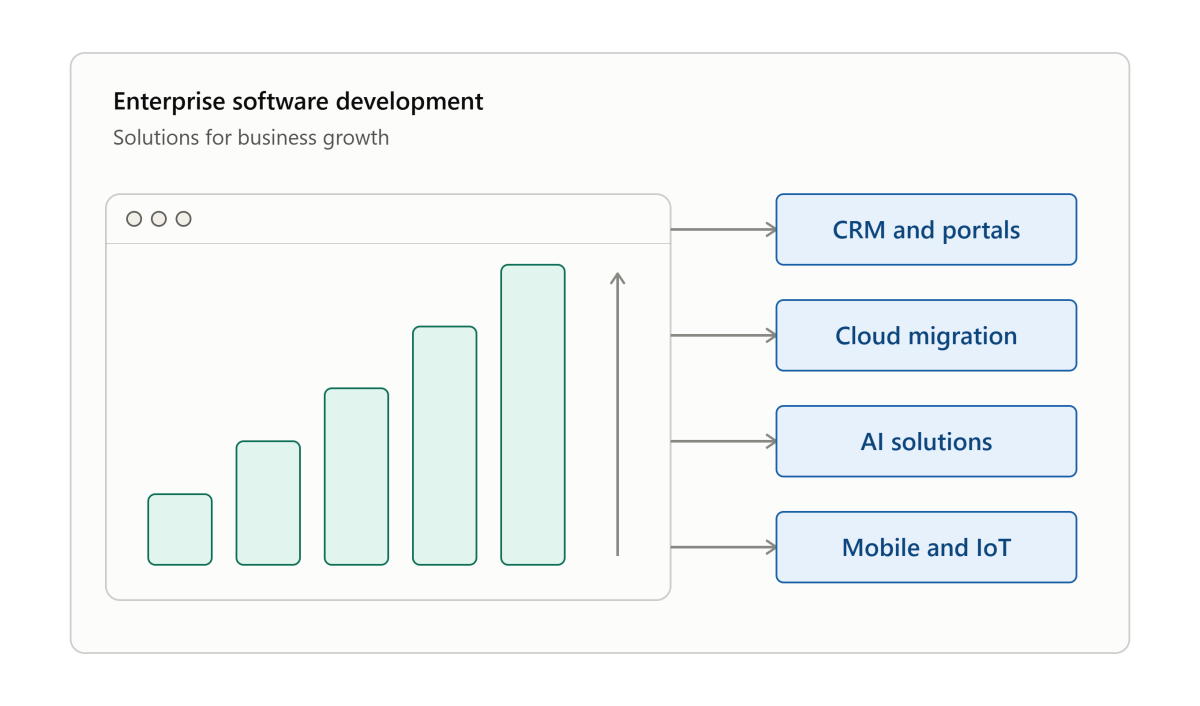
Most growing companies hit the same wall. The tools that worked at 20 employees start to crack at 200. Data lives in five places. Teams re-enter the same information in different systems. Reports take days instead of minutes.
That's usually when leadership starts asking about enterprise software development. This guide covers what it is, when it makes sense, what it costs, and how to avoid the mistakes that sink these projects.
What Is Enterprise Software Development?
Enterprise software development is the process of designing, building, and maintaining software for the complex needs of a large or fast-growing organization. Unlike consumer apps, enterprise systems must handle many users, strict security requirements, and integrations with existing tools. That's why most companies lean on enterprise software development services when a project goes beyond what an in-house team can manage alone.
Common examples include:
- Custom CRM and customer portals
- ERP and operations platforms
- Supply chain and inventory systems
- Internal workflow and approval tools
- Data analytics and reporting dashboards
- AI-driven forecasting and automation
Why Off-the-Shelf Software Eventually Stops Working
Ready-made tools are a sensible starting point. They're fast to deploy and cheap in the early months. The trouble shows up later:
- Workarounds pile up. Teams build spreadsheets around the software's gaps.
- Licensing costs scale badly. Per-seat pricing gets expensive as headcount grows.
- Integration is painful. Connecting a rigid tool to your other systems takes constant patching.
- You can't differentiate. If every competitor uses the same platform, your processes look the same too.
Custom software isn't always the answer. But when your workflow is a competitive advantage, building around it often pays off.
How Enterprise Software Drives Business Growth
Operational Efficiency
Automating repetitive work frees people for higher-value tasks. A logistics company, for example, can replace manual dispatch spreadsheets with a routing system that updates in real time. The gains show up as fewer errors, faster turnaround, and lower overhead.
Better Decisions Through Unified Data
When sales, finance, and operations share one source of truth, leaders stop arguing about whose numbers are right. Good dashboards turn raw data into decisions you can act on this week, not next quarter.
Customer Experience
Domino's is a well-known case. It invested heavily in its own ordering and tracking technology, and digital channels became a major share of its sales. The lesson is not "build an app." It's that owning your customer-facing systems gives you control over the experience.
Scalability
Netflix began moving to the cloud after a major database corruption in 2008 exposed the limits of its own data centers. The migration took years, but it let the company scale globally. Growth-focused software has to handle tomorrow's load, not just today's.
Key Challenges (and How to Handle Them)
Unclear requirements. Projects fail more often from vague goals than from bad code. Define the business problem and the measurable outcome before writing any specifications.
Legacy system integration. Older systems rarely have clean APIs. Plan for middleware, data migration, and a phased cutover rather than a single switch-over.
Poor user adoption. Software nobody uses has zero ROI. Involve the people who will use it daily from the first workshop.
Security and compliance. Depending on your industry, you may need to meet GDPR, HIPAA, SOC 2, or PCI DSS. Build these in from the start. Retrofitting is slower and costlier.
Scope creep. Every stakeholder wants one more feature. A prioritized roadmap keeps the project honest.
A cautionary tale is Target's expansion into Canada, where supply chain system problems, including bad product data, left shelves empty and contributed to the exit. Technology gaps can break a business plan.
What Does Enterprise Software Development Cost?
Costs vary widely, so treat these as rough ranges:
- Focused internal tool or MVP: $50,000–$150,000
- Mid-size platform with integrations: $150,000–$500,000
- Large, multi-system enterprise solution: $500,000 and up
Main cost drivers:
- Scope and number of features
- Integrations with existing systems
- Security and compliance requirements
- Data migration complexity
- Ongoing maintenance, usually 15–20% of build cost per year
The cheapest quote isn't always the lowest total cost. Ask what's included after launch.
A Practical Implementation Roadmap
- Discovery. Map current processes, pain points, and goals.
- Prioritize. Pick the highest-impact problem first, not the biggest.
- Prototype. Test the idea with real users before full development.
- Build in phases. Ship working releases every few weeks and gather feedback.
- Test thoroughly. Include security, load, and user acceptance testing.
- Deploy and train. Plan the rollout and support, not just the code.
- Measure and improve. Track the metrics you defined at the start.
Best Practices That Make a Difference
- Start with a business case, not a technology preference.
- Choose a cloud-ready, modular architecture so you can add features without rebuilding.
- Use APIs so systems can connect now and later.
- Add AI where it solves a specific problem, such as demand forecasting, document processing, or support automation. If your team is new to it, an AI software development company in New York can help you check whether your data is ready before you commit to a build.
- Document everything. Staff turnover shouldn't put your system at risk.
- Pick a partner who asks hard questions before quoting. Teams like Bitrupt, which combine custom software, cloud migration, and technical consulting, tend to challenge assumptions early. That saves money later.
Conclusion
Enterprise software development works best when it solves a specific business problem. Start small, involve your users, plan for security and scale, and measure results. Done well, the software stops being a cost center and becomes part of how the business competes.









Comments (0)