

Fractional Flow Reserve Market Size, Share, Latest Insights and Forecast 2026-2034
The fractional flow reserve market is expected to reach USD 2,814.5 Million by 2034, exhibiting a CAGR of 10.27% from 2026-2034.

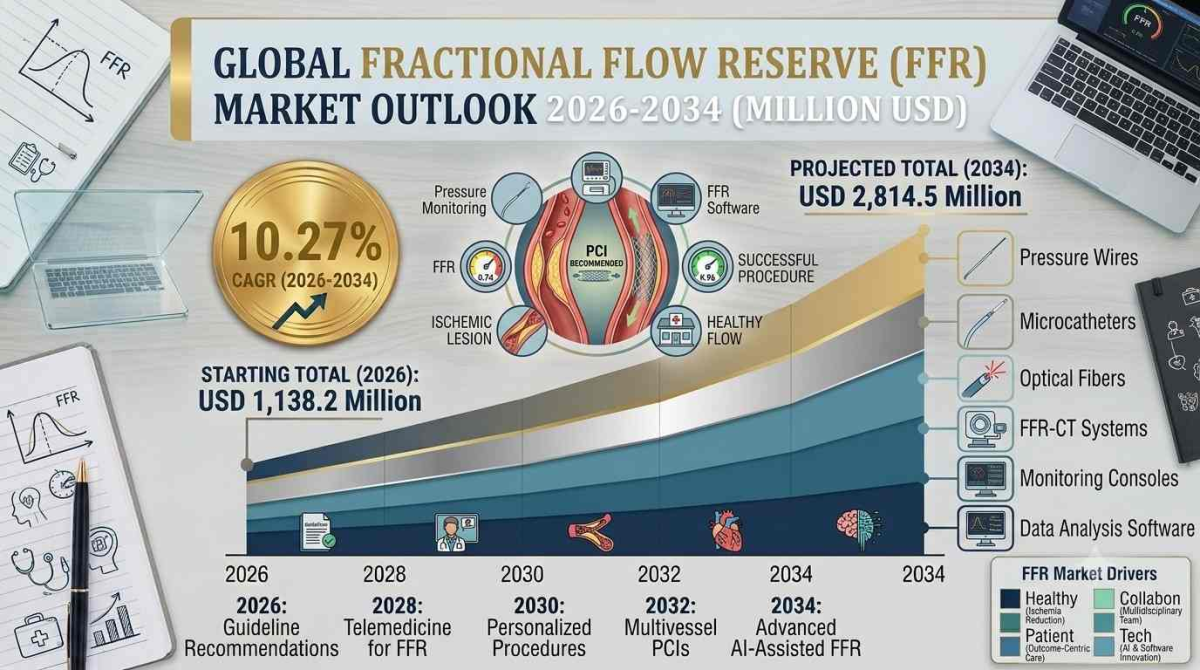
According to IMARC Group, the global fractional flow reserve market size reached USD 1,138.2 Million in 2025 and is projected to reach USD 2,814.5 Million by 2034, expanding at a CAGR of 10.27% during 2026-2034. This robust growth trajectory reflects the rising global burden of cardiovascular disease, rapid advancements in non-invasive and AI-enabled FFR platforms, growing preference for minimally invasive diagnostic procedures, and expanding adoption across hospitals, ambulatory surgery centers, and diagnostic centers worldwide.
Fractional Flow Reserve Industry Overview
Fractional flow reserve is a physiological index used during coronary catheterization to measure the pressure gradient across a coronary artery stenosis, helping clinicians determine whether a given lesion is functionally significant enough to warrant intervention. By combining pressure-sensing guidewire technology with real-time hemodynamic assessment, FFR allows cardiologists to move beyond angiographic appearance alone and make objective, physiology-based treatment decisions.
Fractional flow reserve technologies are deployed across a broad continuum of clinical use cases:
- Multi-vessel coronary artery disease assessment: Guiding lesion-by-lesion prioritization and avoiding unnecessary stenting in functionally insignificant stenoses
- Single-vessel coronary artery disease assessment: Confirming hemodynamic significance prior to percutaneous coronary intervention
- Non-invasive CT-derived FFR: Estimating coronary blood flow from standard CT angiography using computational fluid dynamics and AI
- Hospital and ambulatory surgery center workflows: Supporting cath-lab based physiological assessment during interventional procedures
- Diagnostic center applications: Expanding outpatient access to physiology-guided coronary evaluation
Global Fractional Flow Reserve Market Size & Key Statistics
Below are the key fractional flow reserve market statistics drawn from IMARC Group's comprehensive market analysis:
|
Report Attribute |
Key Statistics |
|
Base Year |
2025 |
|
Historical Period |
2020-2025 |
|
Forecast Period |
2026-2034 |
|
Fractional Flow Reserve Market Size in 2025 |
USD 1,138.2 Million |
|
Market Forecast in 2034 |
USD 2,814.5 Million |
|
Market Growth Rate (2026-2034) |
10.27% CAGR |
|
Largest Region |
Asia Pacific (30% share) |
|
Leading Product Segment |
FFR Guidewires (60% share) |
|
Leading Application Segment |
Multi-Vessel Coronary Artery Disease (55% share) |
|
Leading End-Use Segment |
Hospitals and Ambulatory Surgery Centers (64% share) |
Request for a Sample Report for Detailed Fractional Flow Reserve Market Share Evaluation: https://www.imarcgroup.com/fractional-flow-reserve-market/requestsample
Key Market Drivers & Fractional Flow Reserve Market Trends in 2026
Several powerful forces are shaping Fractional Flow Reserve Market Trends and fuelling sustained growth expectations across global cardiovascular diagnostics markets:
1. Growing Incidence of Cardiovascular Diseases
The escalating prevalence of cardiovascular diseases is a primary driver propelling the market forward. Coronary artery disease remains among the leading causes of mortality worldwide, creating an urgent need for precise diagnostic tools that can accurately assess the functional significance of coronary lesions. FFR provides reliable real-time measurements of blood pressure and flow across coronary artery stenoses, enabling clinicians to make informed treatment decisions regarding revascularization procedures. Almost 50% of adults in the U.S. suffer from high blood pressure, or hypertension, which is the most prevalent and modifiable risk factor for cardiovascular disease, as stated in the American Heart Association's 2025 Guideline for Preventing, Detecting, Evaluating, and Managing High Blood Pressure in Adults.
2. Advancements in Non-Invasive FFR Technologies
Rapid technological innovations in non-invasive diagnostic tools are significantly reshaping the fractional flow reserve market forecast. The development of CT-derived FFR technologies, which utilize computational fluid dynamics and advanced artificial intelligence algorithms to estimate coronary blood flow from standard CT angiography images, represents a transformative advancement in cardiovascular diagnostics. These innovations eliminate the need for invasive catheterization in many clinical scenarios, reducing patient risk, procedural costs, and hospital stay durations while maintaining high diagnostic accuracy comparable to invasive measurements. For instance, in September 2025, Heartflow Inc. received FDA 510(k) clearance for its next-generation Plaque Analysis algorithm, featuring advanced three-dimensional color-coded visualization of plaque type, volume, and distribution for improved coronary artery disease management and treatment planning.
3. Increasing Adoption of Minimally Invasive Procedures
The rising preference for minimally invasive procedures among healthcare providers and patients is strongly supporting the Fractional Flow Reserve Market Trends. FFR measurement is performed through catheter-based techniques that are considerably less invasive than traditional open surgical diagnostic methods, offering significantly reduced recovery times, fewer procedural complications, and improved overall patient satisfaction. According to a study published in the Lancet Regional Health in 2024, between 2025 and 2050, crude cardiovascular mortality across Asia alone is expected to rise by 91.2%, with an estimated 24.1 million cardiovascular deaths projected by 2050, reinforcing the imperative for efficient, minimally invasive coronary diagnostic technologies.
4. Favorable Reimbursement Frameworks and Regulatory Support
Supportive Medicare and private payer reimbursement policies covering FFR-guided procedures are reducing the cost burden on healthcare systems and encouraging broader adoption of FFR technology across cath labs and interventional cardiology suites. In many developed economies, favorable regulations are accelerating the integration of physiological assessment tools into routine diagnostic workflows, particularly as clinical guidelines increasingly endorse FFR as a Class IA recommendation for assessing hemodynamically significant coronary lesions.
5. Expanding Aging Population and Precision Medicine Adoption
The aging global population, particularly individuals aged 65 and above, faces a substantially higher risk of developing coronary artery disease and stenosis than any other demographic group. As healthcare providers increasingly embrace precision medicine, the request for physiological assessment tools as part of routine diagnostic workflows continues to expand, driving sustained fractional flow reserve market growth across both developed and emerging healthcare systems.
Key Market Segmentation
By Product
- FFR Guidewires
- FFR Monitoring Systems
FFR Guidewires - Largest Segment (60% share): FFR guidewires are specialized pressure-sensing guidewires used during coronary catheterization to measure the pressure gradient across coronary artery stenoses, providing real-time hemodynamic data essential for clinical decision-making in interventional cardiology. These devices combine the navigational capabilities of conventional interventional guidewires with integrated microsensors that deliver accurate fractional flow reserve measurements. For instance, in 2024, Cleerly Inc. announced that its FDA-cleared ISCHEMIA software device, utilizing artificial intelligence to provide non-invasive estimations of fractional flow reserve, can now be billed using the new Category I CPT code 75580 when applied to coronary CT angiograms.
By Application
- Multi-Vessel Coronary Artery Disease
- Single-Vessel Coronary Artery Disease
Multi-Vessel Coronary Artery Disease - Largest Segment (55% share): This involves significant stenosis in two or more major coronary arteries, requiring comprehensive physiological assessment to guide optimal revascularization strategies and treatment planning. FFR measurement plays a crucial role in evaluating the hemodynamic significance of each lesion individually, enabling clinicians to prioritize interventions and avoid unnecessary stent placements. According to the Global Burden of Disease Study published in 2025, the number of prevalent cases of cardiovascular disease more than doubled since 1990, reaching 626 million cases globally in 2023.
By End User
- Hospitals and Ambulatory Surgery Centers
- Diagnostic Centers
- Others
Hospitals and Ambulatory Surgery Centers - Largest Segment (64% share): These facilities serve as the primary settings for performing fractional flow reserve measurements due to their comprehensive infrastructure, including fully equipped cardiac catheterization laboratories, advanced imaging systems, and specialized interventional cardiology teams. The growing trend toward outpatient cardiac procedures in ambulatory surgery centers is expanding the accessibility of FFR technology beyond traditional hospital settings.
Regional Fractional Flow Reserve Market Analysis
|
Region |
Key Highlights |
|
Asia Pacific - Largest (30% share) |
China, Japan, India, South Korea, Australia, Indonesia; rapidly expanding healthcare infrastructure, rising cardiovascular disease prevalence, growing government investment in advanced medical technologies, increasing adoption of minimally invasive diagnostic procedures |
|
North America |
United States & Canada; advanced cath-lab infrastructure, favorable Medicare and private payer reimbursement policies, strong network of interventional cardiologists trained in coronary physiology assessment |
|
Europe |
Germany, France, UK, Italy, Spain, Russia; European Society of Cardiology Class IA endorsement of FFR, well-developed interventional cardiology infrastructure, growing adoption of non-invasive CT-FFR in outpatient imaging centers |
|
Latin America |
Brazil, Mexico; rising cardiovascular disease rates, expanding cardiac care facilities, growing clinical awareness of FFR-guided revascularization |
|
Middle East & Africa |
UAE, Saudi Arabia; healthcare modernization programmes, expanding hospital infrastructure, development of specialized cardiac centers and training programs |
Asia Pacific leads the global Fractional Flow Reserve Market Share, benefiting from rapidly expanding healthcare infrastructure, increasing prevalence of cardiovascular diseases, and rising government investments in advanced medical technologies across China, India, and Japan. A recent study backed by USV Private Limited found that heart risks are affecting Indians at a younger age, with the REAL YOUNG (Dyslipidemia) Survey indicating an average patient age of just 38, 87% of whom had another ailment such as hypertension or diabetes.
North America remains a major contributor to global demand. According to the American Heart Association's 2025 Heart Disease and Stroke Statistics Update, cardiovascular diseases accounted for 941,652 deaths in the United States in 2022, with coronary heart disease the leading cause at 39.5% of all cardiovascular fatalities — reinforcing sustained demand for FFR-guided diagnostic procedures across American hospitals and ambulatory settings.
Connect for Detailed Fractional Flow Reserve Market Share Segmentation Analysis - Speak to an Analyst: https://www.imarcgroup.com/request?type=report&id=2505&flag=C
Leading Players in the Global Fractional Flow Reserve Industry
The competitive landscape of the fractional flow reserve market is characterized by intense rivalry among established medical device manufacturers and emerging technology companies, all striving to capture market share through product innovation, strategic partnerships, and geographic expansion. The growing integration of artificial intelligence and computational fluid dynamics into non-invasive FFR solutions is reshaping competitive dynamics, with companies developing CT-derived FFR platforms that eliminate the need for invasive pressure-wire measurements. Key companies covered in the IMARC Group report include:
- Abbott Laboratories
- ACIST Medical Systems Inc. (Bracco S.p.A.)
- Boston Scientific Corporation
- CathWorks Inc.
- Heartflow Inc.
- Koninklijke Philips N.V.
- Opsens Solutions
- Pie Medical Imaging B.V. (Esaote Group)
- Siemens Healthcare Private Limited (Siemens AG)
Latest Fractional Flow Reserve Market Industry Developments
September 2025 - Heartflow Inc.
Heartflow Inc. received FDA 510(k) clearance for its next-generation Plaque Analysis algorithm, featuring advanced three-dimensional color-coded visualization of plaque type, volume, and distribution — enhancing coronary artery disease management and treatment planning through non-invasive CT-derived FFR technology.
2024 - Cleerly Inc.
Cleerly Inc. announced that its FDA-cleared ISCHEMIA software device, which uses artificial intelligence to provide non-invasive estimations of fractional flow reserve, can now be billed using the new Category I CPT code 75580 when applied to coronary CT angiograms, strengthening reimbursement pathways for non-invasive FFR adoption.
About Us
IMARC Group is a leading global market research company providing data-driven insights and expert consulting services to businesses seeking to achieve their strategic objectives. With a multi-disciplinary team of industry experts, IMARC delivers thorough, reliable market intelligence across sectors including Healthcare, Technology, Chemicals, Energy, Food & Beverages, and more.
Contact Us
IMARC Group
United States: +1-201-971-6302
India: +91-120-433-0800
United Kingdom: +44-753-714-6104









Comments (0)