

SFP vs SFP Plus Transceivers: What’s the Difference?
Learn the key differences between SFP and SFP Plus transceivers, including speed, compatibility, use cases, fiber types, and which option fits your network.

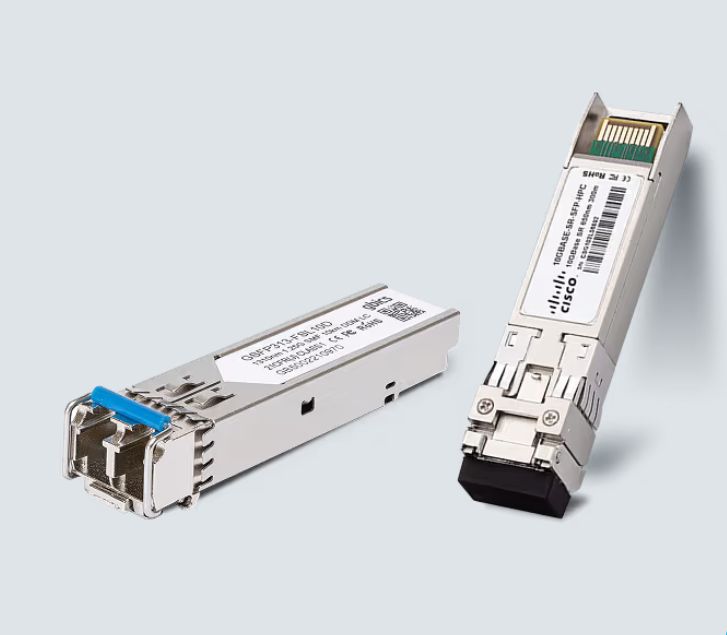
If you’re upgrading switches, building a data center network, or simply trying to choose the right optical module, you’ll probably come across both SFP and SFP Plus transceivers.
They look almost identical, fit into similar types of network equipment, and perform the same basic job of sending and receiving data. The important difference is speed.
That sounds simple, but there’s a little more to understand before choosing between them.
What Is an SFP Transceiver?
SFP stands for Small Form Factor Pluggable.
It’s a compact transceiver module that plugs into compatible switches, routers, and other networking equipment. The module acts as the connection point between the network device and the cable carrying your data.
Standard SFP modules are commonly associated with Gigabit Ethernet connections and are widely used where 1 Gbps performance is enough.
Depending on the module, an SFP connection can use fiber optic or copper cabling. Different SFP models also support different transmission distances and fiber types.
This flexibility is one reason SFP modules remain common in business networks even though faster alternatives are available.
What Is an SFP Plus Transceiver?
SFP Plus is the faster version of the SFP format.
The physical size remains compact, but SFP Plus modules are designed primarily for 10 Gigabit Ethernet connections. That makes them a common choice for data centers, server connections, switch uplinks, storage environments, and other networks where higher bandwidth is required.
Cisco, for example, offers SFP Plus modules for 10 Gigabit Ethernet deployments across enterprise, data center, and service provider environments.
The increased speed is the biggest reason businesses move from standard SFP connections to SFP Plus.
SFP vs SFP Plus Speed
This is the most important difference.
Standard SFP modules commonly support speeds up to 1 Gbps.
SFP Plus modules commonly support speeds up to 10 Gbps.
So, an SFP Plus connection can provide significantly more bandwidth.
That doesn’t automatically mean every network needs SFP Plus. If an office connection only needs 1 Gbps, installing 10 Gbps hardware may not provide a noticeable benefit.
The choice should match the actual traffic requirements of the network.
Do SFP and SFP Plus Look Different?
Not by much.
One of the useful features of SFP Plus is that it keeps a similar compact form factor to SFP.
If you place the two modules next to each other, it may be difficult to identify them based only on their physical appearance.
That’s why checking the module label, model number, specifications, and device compatibility matters before installation.
Using the wrong module can lead to compatibility problems or prevent the link from operating at the expected speed.
Are SFP and SFP Plus Compatible?
This is where you need to be careful.
Some SFP Plus ports can support certain SFP modules, allowing a 1 Gbps connection to operate through a higher speed port. Cisco, for example, documents specific 1 Gigabit SFP modules that can operate in selected 10 Gigabit capable ports while still providing 1 Gigabit connectivity.
But you shouldn’t assume every device supports this.
Compatibility depends on the switch, router, port, transceiver model, software version, and manufacturer requirements.
Before buying modules, check the compatibility information for your specific networking hardware.
Where Are SFP Transceivers Commonly Used?
SFP modules still make sense in many everyday business networks.
You may find them connecting access switches, office buildings, security equipment, network cabinets, and other infrastructure where Gigabit Ethernet provides enough bandwidth.
They can also work well for longer fiber runs because the transmission distance depends on the specific optical module and fiber type rather than simply whether the transceiver is SFP or SFP Plus.
For networks with modest traffic demands, SFP can be a practical option without adding unnecessary capacity.
Where Are SFP Plus Transceivers Used?
SFP Plus becomes more useful when network traffic increases.
For example, imagine several access switches sending traffic back to a core switch. A 1 Gbps uplink could become a bottleneck as more users, applications, and devices share the connection.
Moving that uplink to 10 Gbps gives the network considerably more room to handle traffic.
That’s why SFP Plus is commonly seen in server connections, data center networks, switch uplinks, storage networks, virtualization environments, and other bandwidth intensive applications.
Businesses comparing options can also look at Cisco Transceivers when matching optical modules with compatible enterprise networking equipment.
SFP vs SFP Plus for Data Centers
In modern data centers, bandwidth requirements tend to be much higher than they are in a basic office network.
Servers may transfer large amounts of data between switches, storage systems, backup infrastructure, and other servers.
That’s where the additional capacity of SFP Plus becomes useful.
A 10 Gbps connection can support heavier traffic without hitting the limits of a traditional 1 Gbps link as quickly.
Still, not every connection inside a data center automatically needs the highest available speed. Network architects usually look at traffic patterns and identify where additional bandwidth actually provides value.
What About Fiber Type and Distance?
Speed isn’t the only thing to check when choosing a transceiver.
You also need to think about distance.
Some modules are designed for relatively short connections inside buildings or data centers. Others can transmit data over much longer distances.
Fiber type matters too.
Multimode fiber is commonly used for shorter connections, while single mode fiber can support significantly longer transmission distances.
The transceiver at each end of the connection also needs to be appropriate for the fiber, wavelength, and network standard being used.
Which One Should You Choose?
Start with the speed your network actually requires.
If your equipment operates at 1 Gbps and that capacity comfortably supports your users, standard SFP modules may be perfectly suitable.
If you’re building high bandwidth switch uplinks, connecting servers, upgrading a data center, or preparing for heavier network traffic, SFP Plus may be the better option.
Then check compatibility, fiber type, transmission distance, connector requirements, and the specifications of your network equipment.
Choosing a transceiver based only on speed can create unnecessary compatibility problems later.
Final Takeaway
The main difference between SFP and SFP Plus comes down to performance.
SFP is commonly used for 1 Gigabit Ethernet, while SFP Plus is designed primarily for 10 Gigabit Ethernet.
Both formats are compact, flexible, and widely used in enterprise networking. The right choice depends on your equipment, required bandwidth, fiber infrastructure, and the distance the connection needs to cover.
Choose the module that matches the network you actually have, not simply the fastest option available.








Comments (0)