

HID Amico – Oman's Next-Gen Contactless Access


Oman's offices, hospitals, and educational campuses are steadily replacing card taps and PIN pads with a single glance at the door, and HID Amico is at the centre of that shift. As Muscat's business districts and government facilities modernise their entry systems, security teams are looking for hardware that verifies identity in under a second while producing a reliable, audit-ready access record, without the operational overhead of managing lost cards and forgotten PINs.
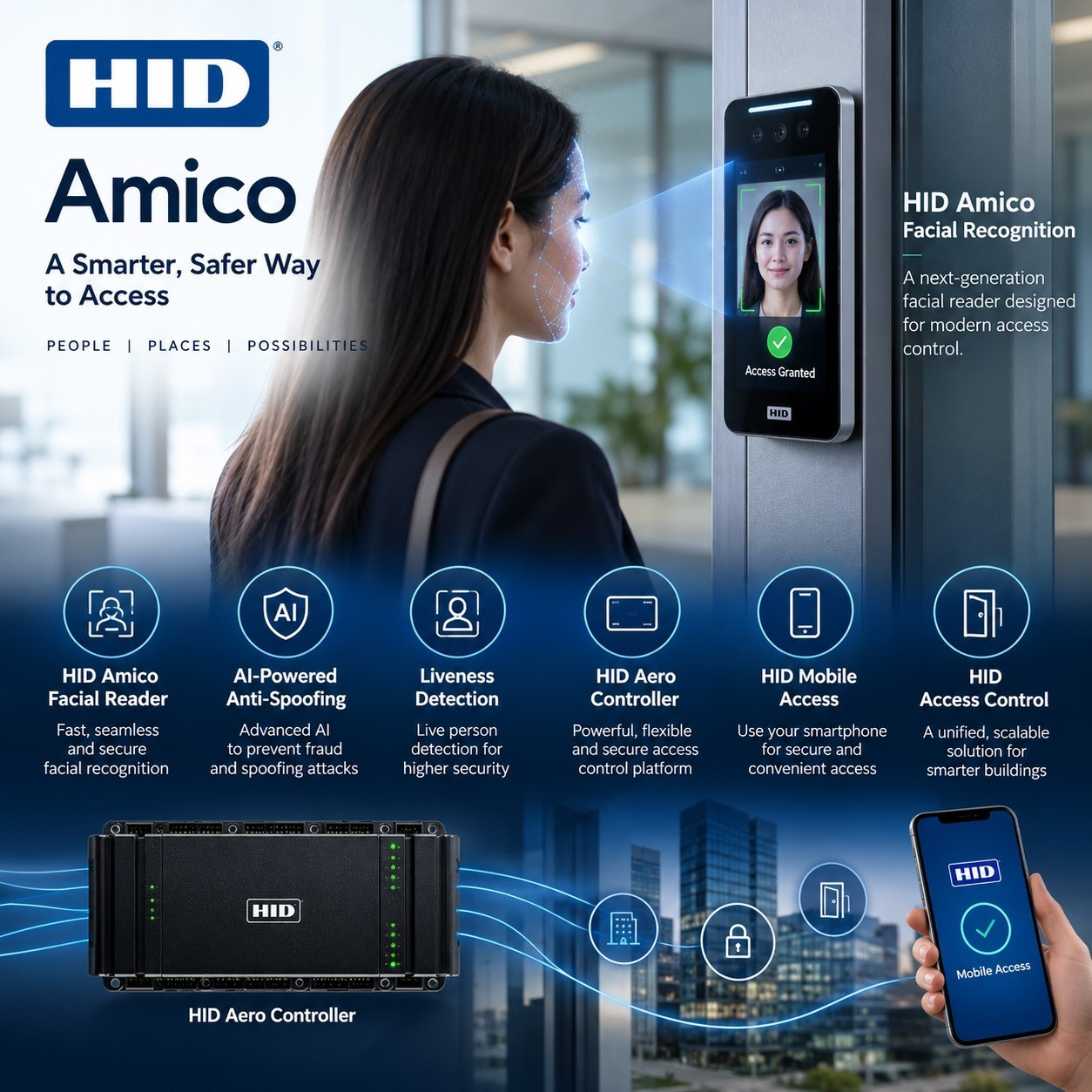
This guide explains how the reader works, how it pairs with HID's controller hardware, and what Omani facility teams should evaluate before specifying it for a new or upgraded access-control system.
Why Oman's Facilities Are Moving Toward Biometric Entry
Card-based access has served Omani offices and institutions for decades, but it carries a persistent weakness: a card can be lost, shared, or handed to someone who should not be entering a particular building or floor. HID Amico Facial Recognition removes that loophole by tying access directly to the person rather than to a piece of plastic they happen to be carrying, which matters increasingly for banks, hospitals, and government buildings across the Sultanate where identity verification is not optional.
For facility managers overseeing busy reception areas and multi-floor office towers, the appeal is also operational: no reissuing replacement cards for new hires, no help-desk queue for forgotten PINs, and an access log that shows precisely who entered a space and when, without depending on a credential that could have been passed to someone else.
Inside the HID Amico Facial Reader
The HID Amico Facial Reader is available in compact and larger touchscreen formats, giving facilities flexibility depending on where it is mounted, a slim corridor door versus a manned reception desk. Both formats are built around dual camera sensors combining visible-light and near-infrared imaging, so recognition stays reliable across the mixed lighting typical of glass-fronted Muscat office towers, from bright coastal daylight to dimmer evening lobbies.
The reader supports several authentication methods beyond face matching, including card, PIN, QR code, and mobile credential, letting a facility configure stricter multi-factor checks at sensitive entrances such as server rooms or finance departments while keeping general building access to a fast single-glance verification.
Deployment Formats Suited to Omani Facilities
● Compact touchscreen models for standard corridor and office-floor entrances with moderate daily traffic.
● Larger touchscreen models for main lobbies and reception areas where a visible, self-service interface helps staff and visitors alike.
● Outdoor-rated housings for perimeter gates and covered entrances exposed to Oman's heat and coastal humidity.
HID Aero Controller Integration for Multi-Site Operations
A reader is only as capable as the controller processing its decisions. For organisations with multiple branches across Muscat, Salalah, or Sohar, the HID Aero Controller range gives facility teams a single hardware platform that scales from a two-door pilot installation to a full multi-building rollout, without swapping out the core panel hardware as the organisation grows.
The controller architecture supports both OSDP and Wiegand reader connections, secures reader-to-panel communication with an OSDP secure channel, and encrypts data between IO modules and the intelligent controller with AES-256, while host communication runs over TLS within a FIPS 140-2 approved environment. For an Omani IT and security team, this layered encryption approach matters because an access-control system often shares network infrastructure with financial records and other sensitive data, so the entry point itself cannot become the weak link.
HID Access Control as the Backbone of a Modern Facility
Choosing readers and controllers is only part of the picture; the software platform tying them together is what actually gives an organisation centralised visibility. A properly deployed HID Access Control ecosystem lets a single security office manage credentials, view live entry events, and generate compliance-ready reports across every building from one dashboard, rather than checking each entrance's local log separately.
Because the platform is built on an open architecture, it also integrates with existing HR and visitor-management systems already in use, so an organisation does not need to abandon its current workflows to adopt biometric entry, only extend them.
HID Mobile Access for Staff on the Move
Not every credential needs to be a physical card or a face scan. HID Mobile Access lets employees carry a digital credential on their smartphone, presenting it to a reader over Bluetooth or NFC, which is particularly useful for staff who move between multiple floors or buildings during a single day and would otherwise need to carry several physical badges.
Mobile credentials also simplify visitor and contractor access: a temporary digital pass can be issued and expired automatically without printing a physical card that then needs to be collected and accounted for at the end of a visit.
AI-Powered Anti-Spoofing Against Photo and Video Attacks
A facial recognition system is only as trustworthy as its ability to reject a fake. AI-Powered Anti-Spoofing analyses the captured image for the subtle depth, texture, and motion cues that separate a real face from a printed photo, a phone screen held up to the camera, or a video replay, stopping the most common low-effort spoofing attempts before they reach the matching stage.
For any organisation where employee photos may already exist on public professional or social media profiles, this layer of protection is not optional. Without it, a would-be intruder could theoretically attempt entry using nothing more than a printed photo pulled from an online profile.
Liveness Detection Explained for Facility Security Teams
Closely related to anti-spoofing, Liveness Detection specifically confirms that a real, physically present person is standing in front of the reader at the moment of the scan, rather than relying solely on image analysis after the fact. This distinction matters because liveness checks catch presentation attacks that static image analysis alone might miss.
This built-in check runs automatically within the recognition process, adding negligible delay to the sub-second matching time employees experience at the door, so security is strengthened without creating queues during the morning rush or shift changes.
Data Privacy Considerations for Biometric Access in Oman
Enrolling staff or visitors in a facial recognition system carries data-governance obligations that Omani organisations need to plan for from the outset. Oman's Personal Data Protection Law, issued under Royal Decree 6/2022, classifies biometric data as sensitive personal data requiring clear legal grounds for processing, which typically means documented consent before enrolment.
A responsible rollout stores facial templates as encrypted mathematical representations rather than raw photographs, sets a defined retention and deletion policy tied to employment or enrolment status, and appoints an internal data-protection point of contact who can respond to compliance queries. Working with a vendor who can supply this documentation alongside the hardware itself saves an organisation's legal and IT governance teams considerable time during internal review.
Practical Use Cases Beyond the Main Entrance
While the main building entrance is the most visible application, organisations are finding value in deploying this reader technology at a wider range of checkpoints once the core infrastructure is in place.
● Executive floors and boardrooms, where identity verification adds a layer of confidentiality beyond a shared keycard.
● Server rooms and IT infrastructure areas, where a stricter multi-factor configuration adds a second check beyond a face match alone.
● Time and attendance tracking, where the same identification event used to unlock a door can simultaneously log staff hours.
● Visitor management at reception, where temporary credentials can be issued and expired automatically for guests and contractors.
Extending the same reader and controller platform across these checkpoints, rather than mixing in unrelated hardware, keeps management simpler and avoids the integration headaches of running several disconnected access-control systems within one organisation.
Why Organisations Choose Tektronix for HID Amico Oman Deployments
Tektronix works directly with Omani facility and IT security teams to plan HID reader and controller deployments around real building layouts, existing network infrastructure, and data-handling obligations, rather than treating every site as an identical template installation.
That hands-on experience across corporate, healthcare, and government-adjacent facilities in the Sultanate is what separates a properly engineered HID Amico Oman rollout from a basic reader swap: deployments need to account for multi-floor traffic patterns, mixed visitor flows, and integration with HR and access systems that a generic installer may not have handled before.
Organisations evaluating vendors for this category can review Tektronix's dedicated HID Amico facial reader solutions page, which outlines reader models, controller options, and deployment support for facilities across Oman.
Planning a HID Amico Muscat Rollout Across Multiple Buildings
Muscat's growing business districts, from Al Khuwair to the Ruwi commercial area, host a dense concentration of banks, government offices, and corporate headquarters, each carrying distinct access-control requirements from executive-floor confidentiality to high-volume staff entrances. A HID Amico Muscat deployment needs to scale across that variety without requiring a separate configuration approach for every building.
Facility planning teams should map out which floors need only standard reader coverage and which sensitive areas, server rooms, records storage, or executive suites, warrant the stricter multi-factor authentication the reader supports, before finalising a hardware order. Organisations ready to move forward can consult Tektronix's HID Amico integration page for a site-specific assessment.
Conclusion
Omani organisations adopting HID Amico gain a contactless, audit-ready entry experience built on HID Amico Facial Recognition and paired with a scalable HID Aero Controller platform, AI-Powered Anti-Spoofing, and Liveness Detection that together keep entrances fast and genuinely secure. Facilities that plan hardware and software around their real building layout, rather than a generic template, position themselves for a smoother rollout and a system that scales cleanly as the organisation grows.
FAQs
1. What makes HID Amico different from a standard card-based entry system?
Unlike a card system, HID Amico verifies the person directly through facial recognition, removing the risk of a lost, shared, or borrowed credential being used to gain unauthorised entry to a building.
2. Can the HID Amico facial reader work alongside existing staff ID cards?
Yes. The HID Amico Facial Reader supports multiple authentication modes, including card, PIN, QR code, and mobile credential, so an organisation can phase in facial recognition gradually rather than replacing every existing staff ID at once.
3. How does a HID Aero Controller support a growing, multi-branch organisation?
A HID Aero Controller scales from a small pilot installation to dozens of doors using the same core hardware platform, so an organisation does not need to replace controllers each time a new branch or entrance is added to the network.
4. Does liveness detection add noticeable delay at busy office entrances?
No. Liveness Detection runs automatically within the recognition process itself, adding negligible time to the reader's sub-second matching speed, so security teams gain protection against spoofing without creating queues during peak entry hours.
5. Is HID Mobile Access a practical replacement for physical staff badges?
For many staff roles, yes. HID Mobile Access lets employees who move between multiple floors or buildings carry a single digital credential on their phone instead of several physical badges, and temporary passes for visitors or contractors can be issued and expired without printing anything.










Comments (0)