

How Agentic AI Is Changing the Way HR Teams Manage Employees
Discover how Agentic AI is transforming HR teams by automating tasks, improving employee experience, and enabling smarter workforce management.

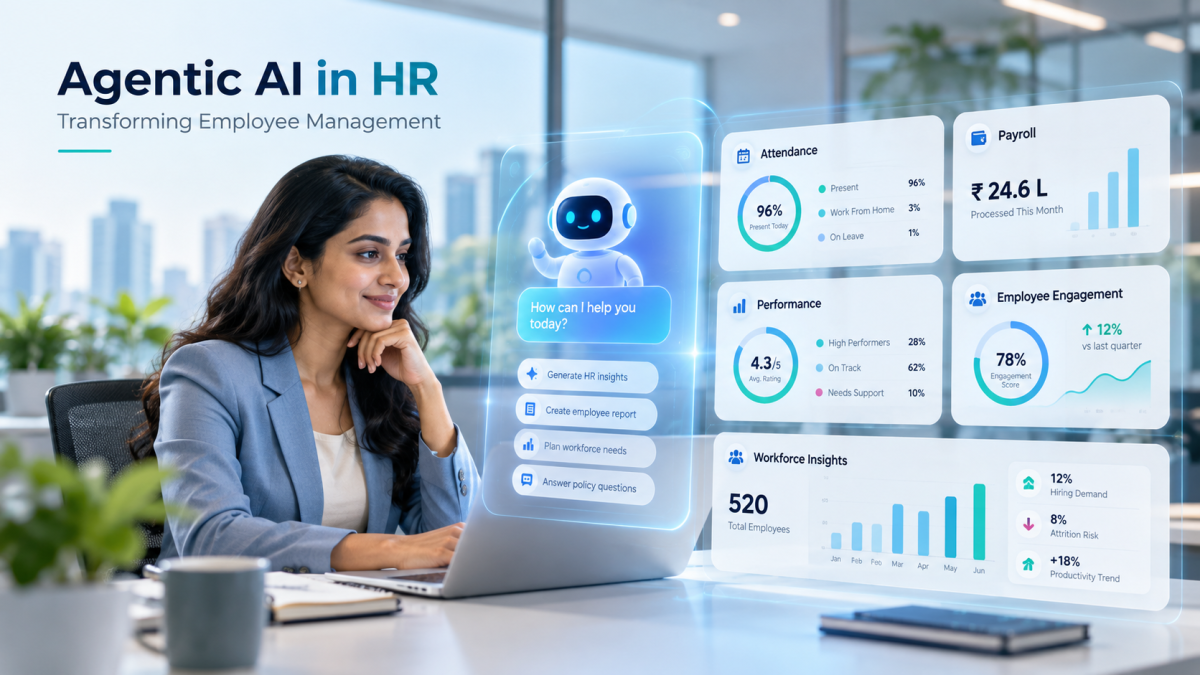
The way organizations manage employees is undergoing a major transformation. For years, HR teams have relied on technology to automate routine processes such as payroll, attendance tracking, leave management, and employee data management. However, modern workplaces now require smarter solutions that can understand employee needs, analyze workforce information, and support faster decision-making.
With advancements in artificial intelligence, businesses are moving from traditional automation toward intelligent systems that can actively assist HR professionals. Modern HRMS platforms are now evolving beyond simple record-keeping systems by integrating technologies like Agentic AI to deliver more personalized and proactive workforce management experiences.
Agentic AI enables HR systems to understand requests, analyze information, recommend actions, and complete tasks with minimal human intervention. This shift is helping HR teams reduce administrative workload, improve employee experiences, and focus more on strategic initiatives such as talent development, engagement, and workforce planning.
In this blog, we will explore how Agentic AI is changing the way HR teams manage employees and why it is becoming an important technology for the future of human resource management.
What Is Agentic AI in HR?
Artificial intelligence has already become part of many business operations, but Agentic AI represents a more advanced approach. Traditional AI systems usually respond to specific commands or queries, while Agentic AI systems can understand goals, analyze situations, and take actions based on predefined rules and available information.
In HR, Agentic AI works like an intelligent digital assistant that can support employees, managers, and HR professionals throughout the employee lifecycle.
For example, instead of an employee searching through multiple HR portals to find their leave balance, an AI agent can understand a simple question like:
"How many leaves do I have remaining this year?"
The system can instantly analyze the employee's leave data, company policies, and eligibility rules before providing an answer.
Similarly, HR teams can use AI agents to analyze workforce trends, identify attendance issues, support payroll queries, and generate meaningful insights without spending hours on manual analysis.
Agentic AI does not replace HR teams. Instead, it enhances their capabilities by reducing repetitive work and allowing them to focus on more strategic responsibilities.
The Shift From Traditional HR Automation to Intelligent HR Management
Traditional HR technology has helped organizations digitize employee records and automate repetitive tasks. However, many HR processes still require manual effort.
HR professionals often spend significant time on activities such as:
- Answering employee queries
- Preparing reports
- Tracking approvals
- Reviewing attendance patterns
- Managing compliance requirements
- Validating payroll inputs
While automation reduces some workload, it usually follows predefined workflows. Agentic AI introduces a new level of intelligence by understanding context and making processes more interactive.
For example:
A traditional HR system may allow employees to apply for leave through a portal.
An Agentic AI-powered system can:
- Understand the employee's leave request
- Check leave balance
- Verify eligibility
- Review applicable policies
- Guide the employee through the approval process
This creates a smoother experience for employees while reducing the operational burden on HR teams.
How Agentic AI Is Transforming Employee Management
1. Enhancing Employee Self-Service Experience
Employee self-service has become an important part of modern HR operations. However, employees often find it difficult to locate information across different modules and menus.
Agentic AI improves self-service by enabling employees to interact with HR systems naturally through conversations.
Employees can ask questions such as:
- "Show my attendance summary for this month."
- "What is my remaining leave balance?"
- "How can I download my payslip?"
- "What is the status of my reimbursement request?"
The AI agent understands the intent behind the question and provides relevant information immediately.
This reduces dependency on HR teams for routine queries and improves employee satisfaction by providing faster support.
2. Automating HR Query Management
HR teams receive a large number of employee queries every day related to policies, payroll, benefits, attendance, and company processes.
Handling these queries manually can consume valuable time.
Agentic AI assistants can act as the first point of support by answering common employee questions.
For example, if an employee asks about health insurance benefits, the AI agent can:
- Identify the employee's query
- Refer to company policy information
- Provide relevant details
- Guide the employee toward the next steps
This ensures employees receive consistent information while allowing HR teams to focus on complex employee concerns.
3. Smarter Attendance and Workforce Insights
Attendance management generates large volumes of workforce data, including:
- Attendance patterns
- Late arrivals
- Absenteeism trends
- Shift adherence
- Overtime records
Traditionally, HR teams need to manually review reports to identify important patterns.
Agentic AI can analyze attendance data and highlight meaningful insights automatically.
For example, an AI attendance assistant can identify:
- Departments with increasing absenteeism
- Employees with frequent attendance irregularities
- Overtime trends affecting productivity
- Shift management concerns
These insights allow HR teams to take proactive action instead of reacting after issues occur.
4. Improving Payroll Accuracy and Employee Support
Payroll is one of the most critical HR functions because employees expect accuracy and transparency in salary processing.
Even minor errors in payroll inputs can create challenges for HR teams.
Agentic AI can support payroll operations by:
- Identifying missing information before processing
- Highlighting unusual salary variations
- Explaining payroll calculations
- Helping employees understand payslip details
- Supporting payroll-related queries
For employees, this means faster answers to salary-related questions. For HR teams, it means fewer manual checks and improved accuracy.
5. Supporting Performance Management
Performance management involves continuous tracking of goals, feedback, achievements, and development areas.
Agentic AI can assist managers and HR teams by providing insights from performance-related data.
For example, managers can ask:
- "Show employees who have pending goals."
- "Provide performance review status."
- "Identify teams requiring additional support."
AI-powered assistance helps managers stay updated and ensures performance processes are completed on time.
6. Improving Employee Engagement Strategies
Employee engagement depends on understanding employee expectations, challenges, and workplace experiences.
Traditional surveys provide valuable information, but they may not always capture real-time employee sentiment.
Agentic AI can analyze multiple workforce signals, including:
- Employee feedback
- Survey responses
- HR interactions
- Workplace trends
These insights help HR teams understand areas that may require attention and design better engagement initiatives.
The focus is not on replacing human understanding but on helping HR professionals make informed decisions.
How Managers Benefit From Agentic AI
Managers play an important role in employee experience, but they often need quick access to workforce information.
Agentic AI gives managers a simpler way to access insights without depending on multiple reports.
Managers can use AI assistants to:
- Check team attendance
- Track goal completion
- Understand workforce trends
- Review pending approvals
- Access employee information quickly
This helps managers make faster and more data-driven decisions.
Benefits of Agentic AI for HR Teams
Increased Productivity
By handling repetitive tasks and routine queries, AI agents allow HR professionals to spend more time on strategic initiatives.
Faster Decision-Making
AI-driven insights help HR leaders understand workforce trends and respond quickly.
Better Employee Experience
Employees receive instant assistance and personalized support whenever they need it.
Reduced Manual Errors
AI-powered validation helps identify issues before they impact employees.
Scalable HR Operations
Organizations can manage growing workforce requirements more efficiently without increasing administrative workload.
Challenges Organizations Should Consider
While Agentic AI offers significant benefits, successful implementation requires careful planning.
Data Privacy and Security
HR systems contain sensitive employee information. Organizations must ensure strong security measures and proper access controls.
Human Oversight
AI should support HR decisions while keeping human judgment and empathy at the center of employee management.
Data Quality
AI systems depend on accurate and updated employee information to provide meaningful insights.
Change Management
Employees and HR teams need proper awareness and training to effectively use AI-powered solutions.
The Future of HR With Agentic AI
The future of HR will be shaped by collaboration between human expertise and artificial intelligence.
Agentic AI will continue transforming HR operations by making systems more intelligent, interactive, and employee-focused.
Instead of spending most of their time managing administrative activities, HR professionals will be able to focus on areas that require human skills:
- Building workplace culture
- Developing talent strategies
- Improving employee relationships
- Supporting business growth
The role of HR will continue moving from process management toward strategic workforce management.
Conclusion
Agentic AI is changing the way HR teams manage employees by bringing intelligence, automation, and personalization into everyday HR operations.
From improving employee self-service and simplifying HR queries to providing workforce insights and supporting better decision-making, AI agents are helping organizations create smarter and more efficient workplaces.
The future of HR is not about replacing people with technology. It is about empowering HR teams with intelligent tools that help them deliver better employee experiences and make more informed decisions.
As organizations continue adopting AI-driven HR solutions, Agentic AI will become a key technology in building workplaces that are more connected, productive, and employee-centric.








Comments (0)