

3D Printing Australia: How Additive Manufacturing Supports Smarter Prototype Testing

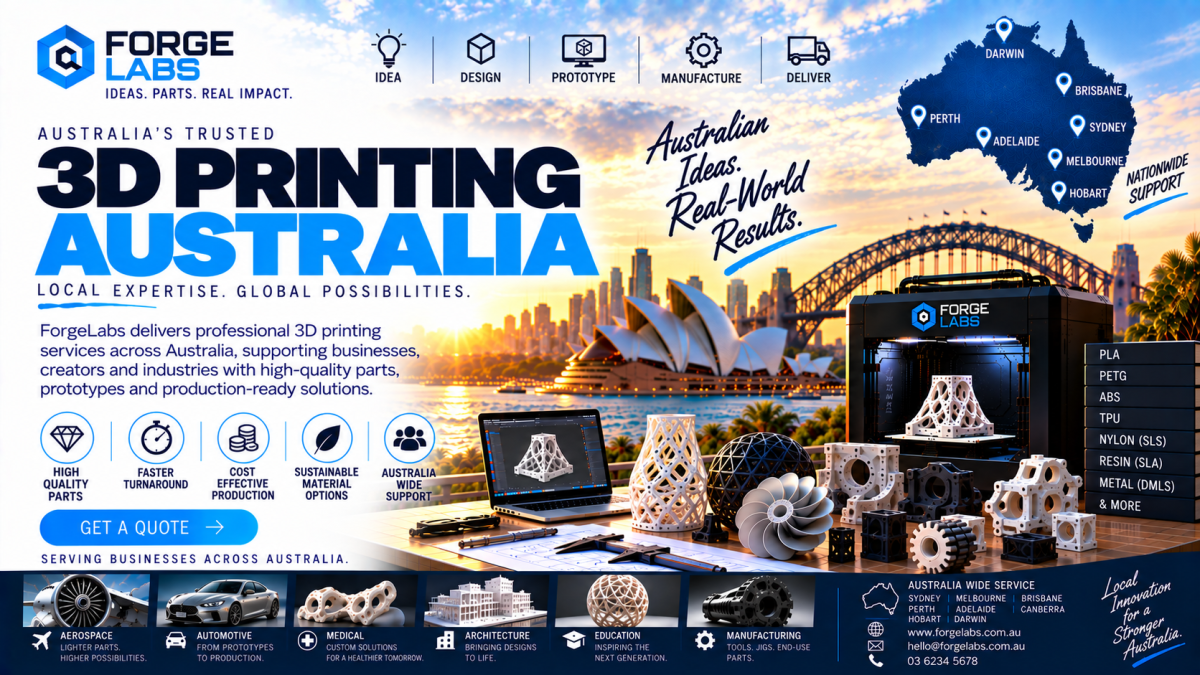
Product development does not end when a CAD model is completed. Before a design moves toward production, engineering teams need to understand how it behaves in the physical world.
A prototype can reveal issues that are difficult to identify through digital modelling alone. Dimensions, interfaces, ergonomics, movement, assembly and physical interaction can all be evaluated more effectively when a design exists as a tangible object.
This makes prototype testing an important stage of modern product development. 3D printing Australia provides businesses with a practical way to create physical prototypes that can be evaluated, modified and tested throughout the development process.
Why Prototype Testing Matters
A digital model provides valuable information about geometry and dimensions, but it does not always answer practical questions about how a product will behave.
Prototype testing can help teams investigate:
-
Physical fit
-
Assembly
-
Movement
-
Ergonomics
-
Clearances
-
Accessibility
-
Appearance
-
Component interaction
-
Mounting arrangements
-
General usability
Identifying these issues earlier can help engineers make informed design changes before committing to more expensive manufacturing processes.
Turning CAD Models Into Testable Products
The connection between CAD and additive manufacturing makes physical prototype development highly accessible.
A typical process can involve:
CAD model → Manufacturing preparation → 3D printing → Physical evaluation → Design revision
The printed prototype becomes a physical representation of the digital design.
Engineers can then compare the actual part with the intended requirements and determine whether modifications are necessary.
Testing Product Dimensions
Dimensional testing is one of the simplest applications of physical prototypes.
A prototype can help confirm:
-
Overall size
-
Component thickness
-
Mounting positions
-
Hole locations
-
Interface dimensions
-
Clearance requirements
This can be especially useful when the product needs to fit within an existing environment.
A component may appear correctly sized in a digital assembly but still create unexpected problems when installed alongside real-world components.
Evaluating Component Fit
Fit testing becomes important when multiple components interact.
A prototype can be assembled with mating components to check:
-
Alignment
-
Interference
-
Gaps
-
Fastener access
-
Connection points
-
Movement
If a component does not fit as expected, the CAD model can be modified and another version produced.
This iterative process can continue until the required fit is achieved.
Testing Assembly Procedures
A product can have technically correct components but still be difficult to assemble.
Physical prototypes allow teams to simulate assembly and identify practical problems.
Questions may include:
-
Can the component be inserted easily?
-
Are fasteners accessible?
-
Can tools reach the required locations?
-
Does one component obstruct another?
-
Is the assembly sequence logical?
-
Can an operator handle the components comfortably?
These observations can influence both product design and manufacturing planning.
Evaluating Moving Components
Products containing hinges, levers, covers, sliders or other moving mechanisms can benefit from physical testing.
A prototype can help engineers evaluate:
-
Range of movement
-
Interference
-
Clearances
-
Connection points
-
Operating feel
-
Component alignment
Even when a mechanism works correctly in CAD, physical interaction may reveal unexpected issues.
Prototype Testing for Ergonomics
Ergonomic requirements can be difficult to evaluate from a screen.
A physical prototype allows users to interact directly with the product.
This can help evaluate:
-
Grip
-
Reach
-
Control placement
-
Handle size
-
Button positioning
-
Operating posture
-
General comfort
Multiple versions can be produced when teams want to compare different ergonomic configurations.
Testing Multiple Design Concepts
Prototype testing does not have to focus on a single design.
When several concepts are being considered, businesses can produce physical versions of each option.
For example, different prototypes may have variations in:
-
Shape
-
Size
-
Handle position
-
Interface layout
-
Mounting configuration
-
Control arrangement
Comparing physical prototypes can make design reviews more practical and help stakeholders understand the differences between concepts.
Testing Interfaces Between Components
Many engineering problems occur at component interfaces.
A product may involve connections between:
-
Housing and cover
-
Bracket and frame
-
Component and mounting plate
-
Handle and body
-
Electronic enclosure and equipment
-
Product and accessory
Prototypes allow these interfaces to be evaluated physically.
This can help identify problems with alignment, clearance or accessibility before production.
Using Prototypes to Test Tolerances
Tolerances influence how components fit together.
If a tolerance is too tight, assembly may become difficult. If it is too loose, the connection may not provide the required stability.
Physical prototypes can provide useful feedback during tolerance development.
Engineers can test different versions with adjusted dimensions and compare their behaviour.
This is particularly useful for components that must repeatedly connect and disconnect.
Prototype Testing for Custom Enclosures
Enclosures often need to accommodate multiple internal and external elements.
A prototype can help confirm that:
-
Internal components fit
-
Mounting points are accessible
-
Cables have sufficient clearance
-
Covers can be installed
-
Interfaces are positioned correctly
-
Service access is practical
This type of physical validation can prevent avoidable design changes later in development.
Testing Custom Mounting Systems
Custom mounting components are another useful application.
A mounting system may need to connect a product to:
-
Equipment
-
Frames
-
Walls
-
Panels
-
Machinery
-
Other assemblies
A prototype allows engineers to verify the mounting geometry before finalising the design.
This can be particularly useful when the mounting environment already exists and cannot easily be modified.
Material Selection During Prototype Testing
The material used for a prototype can influence the information obtained from testing.
A basic visual prototype may not require the same material characteristics as a functional prototype.
Depending on the application, engineers may need to consider:
-
Rigidity
-
Flexibility
-
Impact resistance
-
Temperature exposure
-
Surface properties
-
Dimensional stability
-
Wear
The material should therefore be selected according to the purpose of the test.
Choosing the Appropriate Printing Technology
Different additive manufacturing technologies can support different prototype requirements.
FDM
FDM can be suitable for many general-purpose prototypes, functional development parts and larger components.
SLA
SLA can be useful when fine details and smooth surfaces are important.
SLS
SLS can support prototypes with complex geometries and functional polymer applications.
MJF
MJF can be considered for detailed polymer components where functional characteristics and production-oriented geometry are important.
The best technology depends on the specific prototype and what needs to be tested.
Prototype Testing and Design Iteration
A successful development process often involves several iterations.
A simplified workflow can look like:
Prototype 1 → Test → Identify issue → Modify CAD → Prototype 2 → Test → Refine
Each iteration provides additional information.
The objective is not necessarily to produce a perfect first prototype. Instead, the prototype becomes a tool for learning about the design.
Why Early Testing Can Be Valuable
Design changes are generally easier to manage while a product is still under development.
Once production tooling, inventory or established manufacturing processes are involved, modifications can become more complicated.
Prototype testing creates an opportunity to investigate important design questions earlier.
This can help teams make decisions before committing to larger production activities.
Testing for Customer Feedback
Prototype testing can also involve potential customers or users.
A physical prototype allows people to interact with a product and provide feedback about:
-
Size
-
Appearance
-
Controls
-
Handling
-
Accessibility
-
General usability
This can provide product teams with information that may not emerge from technical reviews alone.
Supporting Internal Design Reviews
A physical prototype can also improve communication between departments.
Engineers, designers, manufacturing specialists and business stakeholders may interpret digital designs differently.
A physical model gives everyone a common reference.
Teams can inspect the same object, discuss specific features and identify potential concerns together.
Prototype Testing for Small Businesses
Smaller businesses and startups can also benefit from physical prototype testing.
A new product may need to be demonstrated to:
-
Customers
-
Investors
-
Business partners
-
Engineering teams
-
Manufacturing suppliers
A physical prototype can make a concept easier to understand and evaluate.
It can also provide an opportunity to identify design problems before production investment increases.
Testing Complex Geometries
Additive manufacturing is particularly useful for prototypes involving complex shapes.
A physical prototype can demonstrate whether:
-
Curved surfaces work as intended
-
Internal clearances are adequate
-
Integrated features are practical
-
Components can be assembled
-
Interfaces function correctly
This can be valuable when traditional prototype fabrication would be more complicated.
Supporting Functional Prototype Development
Not every prototype is purely visual.
Functional prototypes are intended to provide a more realistic representation of how a component or product may operate.
Depending on the design, a functional prototype may be used to evaluate:
-
Movement
-
Assembly
-
Handling
-
Interface behaviour
-
Component interaction
-
Basic mechanical performance
The prototype should be designed and manufactured according to the specific test objectives.
Combining Prototype Testing With 3D Scanning
3D scanning can complement prototype development when physical objects already exist.
A scan can help capture geometry that can then be reviewed, reconstructed or modified digitally.
This can be useful for:
-
Reverse engineering
-
Existing component evaluation
-
Design comparison
-
Replacement development
-
Geometry capture
Combining scanning, CAD and additive manufacturing can create a connected digital-to-physical development workflow.
How Forge Labs Can Support Prototype Development
Forge Labs provides additive manufacturing and related engineering services that can support product development projects.
Depending on the requirements, a project may involve 3D printing, CAD development or 3D scanning.
For prototype testing, the appropriate process can be selected according to the geometry, material requirements and purpose of the physical test.
The goal is to create a prototype that provides useful information rather than simply producing a physical version of the CAD model.
Creating a Structured Prototype Test Plan
Businesses can make prototype testing more effective by defining the objectives before manufacturing the part.
A structured plan may include:
Define the objective
Identify exactly what the prototype needs to prove.
Identify critical features
Determine which dimensions, interfaces or functions require evaluation.
Select the prototype type
Choose between visual, dimensional, ergonomic or functional validation.
Select the material and process
Match the manufacturing approach to the test requirements.
Manufacture the prototype
Produce the physical part from the approved digital model.
Perform the test
Evaluate the relevant characteristics systematically.
Record the results
Document issues, observations and required changes.
Update the design
Apply the findings to the CAD model.
Repeat where necessary
Produce another version when additional validation is required.
Moving From Prototype to Production
Prototype testing is not the final manufacturing stage.
Once the design has been validated, the business can determine the most appropriate production approach.
Depending on the product, this could involve:
-
Additive manufacturing
-
CNC machining
-
Injection moulding
-
Other conventional manufacturing methods
-
A combination of processes
The important benefit is that physical testing has already provided additional information about the design.
Building a More Reliable Product Development Process
A strong development workflow connects digital design with physical evaluation.
3D printing Australia can support this connection by allowing businesses to turn CAD concepts into tangible prototypes that can be inspected, assembled and tested.
The resulting feedback can then be incorporated into the next digital version.
This creates a continuous improvement cycle rather than a one-time prototype exercise.
Final Thoughts
Prototype testing provides product teams with an opportunity to discover practical design issues before production.
Physical prototypes can help evaluate dimensions, fit, assembly, ergonomics, interfaces, movement and general usability. When combined with CAD and iterative development, additive manufacturing can make this process more flexible.
With 3D printing Australia, businesses can create prototypes that support real-world engineering evaluation and informed product decisions.
For companies developing new products, customised components or complex assemblies, integrating additive manufacturing into the testing process can create a stronger connection between digital design and physical performance.










Comments (0)