

Grouting Pumps Manufacturer: Engineering Reliable Solutions for Modern Construction Projects
X1 Grout Pump series gives a main advantage for the operator like valveless positive-displacement pumps are capable of transporting cement based grouts safely, quickly and pulsation free. These units comes with variety of Rotor and Stator geometries providing unsaid advantage over any type of cement based grout been used.
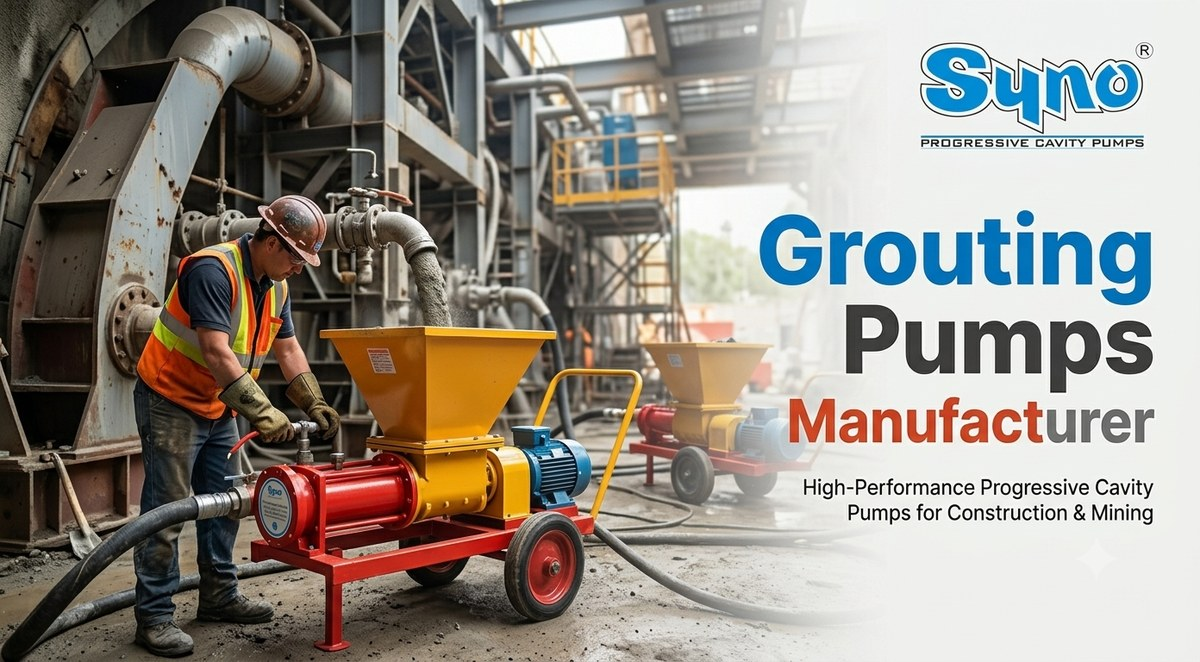
Grouting pumps have become a necessity in today's world, with their application in constructions, infrastructure development, and industries. These pumping systems are used to pour cement-based grouts into structural cavities and stabilize the foundation in a controlled and efficient manner.
It becomes necessary for constructors, construction firms, and industrial organizations to opt for grouting pumps manufactured by an expert manufacturer. Capacity, pressure range, material tolerance, and maintenance are some of the factors which determine the efficiency of a grouting system.
Synopumps, otherwise called Syno-PCP Pumps Private Limited, manufactures progressive cavity pumps, among them being its X1 Series grouting pumps. This company has 45 years of expertise in fluid engineering and has been supplying its products to various industries.
Importance of Grouting Pumps in the Construction Industry
Grouting is one of the most important procedures in the construction industry. This procedure entails the transfer of grout to gaps, spaces, cracks, and other openings to increase structural stability or for other reasons.
Grouting pumps are machines designed to transfer grouts to different locations using pressure. The choice of the pump will depend on the grout materials used which can include cement-based grouts and mortars among others.
The uses include:
-
Foundation stabilization and soil stabilization
-
Structural gap filling and filling of voids
-
Tunnel and underground construction
-
Dam and bridge repair
-
Repair of concrete cracks
-
Industrial construction and infrastructure development
The proper pumps will assist contractors in managing material flow and ensure uniformity during the grouting process.
Working of Grouting Pumps
Grouting pumps work by transferring the grout from either the mixing or storage tank through a pipeline or hose to the application site.
There are various types of pump mechanisms, but the progressive cavity pumps can be especially effective when moving difficult fluids under control.
The progressive cavity pump works using a rotating helical rotor within an elastomeric stator.
Cavities are created within the pump and move continuously from the inlet end to the outlet end during rotation, hence transferring material within the pump.
Some advantages of the pumping method include:
-
Continuous movement of material
-
Pumping with low pulsation
-
Delivery rate that depends on the pump's rotation rate
-
Ability to pump compatible viscous material
-
Various operational pressures
In case of cement grout applications, pump selection depends on particle size, fluid consistency, abrasiveness, and pressure needs.
Why It Is Important to Choose a Proper Grouting Pumps Manufacturer
Choosing a reliable grouting pumps manufacturer is an important business decision. Construction works take place in rather challenging conditions, and therefore equipment reliability and suitability play a great role.
The following aspects need to be considered by businesses while choosing a manufacturer.
Quality of Manufacturing
The components of pumps have to be capable of functioning properly under the working conditions of the equipment. The materials used, precision of manufacture, and assembly affect the performance of equipment.
Performance of Pumps
Capacity and pressure requirements for the use of pumps vary depending on specific construction projects. A proper manufacturer will give information on equipment performance specifications in order to choose the right pump configuration.
Compatibility of Material
Construction materials include cement particles and additives which can affect the performance of the pump rotor, stator, seals, and wetted parts.
Product Guidance
Technical assistance from a manufacturer can be helpful in finding proper pumping solutions and requirements of equipment.
Replacement of Components
Maintenance of the equipment is essential for its proper performance, and spare parts are necessary for the minimization of equipment downtime.
Characteristics of Contemporary Grouting Pumps
Contemporary grouting pumps are engineered to ensure reliable material handling in various applications.
Among their characteristic features one could mention:
Positive Displacement Pumping: Positive displacement pumps ensure pumping of a specific amount of material during each rotation cycle and hence are useful for precise conveyance of material.
Low-Pulsation Transfer: Progressive cavity pumping designs ensure smooth conveying of material.
Pump Configuration: Various configurations are available depending on the required pressure of material transfer.
Various Rotor and Stator Geometries: Various geometries help in handling varying characteristics of grouts.
Easily Serviceable Design: Easily accessible parts of the pump and appropriate design can help facilitate maintenance.
The importance of each feature varies based on the application and material properties.
Synopumps X1 Series: Grouting Pumps Based on Progressive Cavity Pumping Technology
Grouting pumps belonging to the Synopumps X1 Series feature the use of progressive cavity pumping technology. This type of pump is engineered specifically for pumping cement-based grouts.
According to the product information released by the producer, the X1 Series includes:
Specifications published by the manufacturer. Performance depends on pump design and operational conditions.
Valveless positive-displacement pumping system allowing the conveyance of cement-based grouts without using valves. The rotor and stator design enables the consideration of specific characteristics of the pumped grout.
Other important features of this equipment described by the manufacturer include:
-
Under-gland shaft design for faster servicing
-
Low-pulsation conveying of grout
-
Flow rate directly proportional to the rotation rate
-
High-pressure and high-volume capability
-
Different geometries of rotors and stators
These characteristics make the X1 Series an appropriate choice for companies considering progressive cavity grouting pumps.
Industries & Applications That Apply Grouting Pumps
These grouting pumps are widely used in a variety of construction and industry-based applications because of their capability to pump suitable grout mixtures.
Construction Industry
Grouting pumps can be used by construction contractors for various special uses such as foundation work, filling cavities, structural repairs and others.
Infrastructural Development
Grouting may be used in various infrastructural developments such as bridges, tunnels, dams, roads and others. This can include grout injection in order to stabilize, fill cavities and repairs in any of these projects.
Mining & Underground Construction Projects
Some mining and underground construction projects will involve grouting in order to fill cavities and make the ground stable and secure surrounding structures.
Industrial Applications
Grouting pumps may also be used for specialized industrial applications that require compatible process materials.
Wastewater Treatment Plants
Grouting equipment will be used for maintenance and construction in wastewater treatment plants and other industrial facilities.
It is important to ensure that the pump type suits the specific application.
Selection of Appropriate Grouting Pumps for Your Job
The choice of the appropriate pumping unit depends on having a clear understanding of the project specifications. There could be a difference in performance from one unit to another even when handling different grouts.
Here are some essential considerations when selecting a pump unit:
Required Capacity: The amount of grout to be supplied in the project period.
Operating Pressure: The pressure required to convey the grout along the delivery pipe to the target area.
Grout Specifications: The viscosity, density, particle size, and abrasiveness of the grout.
Distance of Pumping: Considerations of pipeline length, elevation, and friction losses.
Compatibility of Materials: Check if rotor, stator, seals, and other wetted parts are suitable.
Service Needs: Parts replacement, servicing procedures, and instructions on operation.
These will help prevent wrong choices and plan the project better.
Pump Maintenance for Optimal Performance
Routine maintenance is crucial for the protection of pumping systems and ensures efficient operations. Materials used in grouting can be abrasive and will dry up when left within the pump after use.
Businesses should follow maintenance guidelines provided by the manufacturer and have a proper cleaning and inspection program.
Some of the maintenance activities that should be done regularly include:
-
Draining the pump and delivery lines after use as per the prescribed procedure.
-
Inspection of the rotor and stator for wear.
-
Checking for any leakage in seals, joints, and connections.
-
Monitoring of any vibrations, noise, and abnormal temperature rise.
-
Use of compatible spare parts.
-
Operation within the recommended pressure and capacity range.
With appropriate maintenance, the life of the components increases, and it helps avoid any unforeseen downtime in construction activities.
Grouting pumps are important pieces of machinery which are employed in the construction process, infrastructure development, and industrial activities where grouting using cement or other compatible materials needs to be conveyed. Choosing an appropriate grouting pumps manufacturer will help you easily procure compatible machinery.
Synopumps provides a solution through progressive cavity pumping system and X1 Series Grouting Pumps, which provide a solution to continuously convey in challenging conditions. Its official X1 Series Specifications include a capacity of up to 60 m³/hr and pressure of up to 40 bar.
To contractors and industrial buyers, understanding the technical specifications and application requirements is important before buying a grouting pump.
Synopumps manufactures progressive cavity pumps with over 20 series and 1400 specifications. We have designed progressive cavity pumps in wide range includes, waste water, pulp & paper, food, suger & distillary, pharmaceuticals, oil, power fertilizer and chemical industries.
















Comments (0)