

Building Cost-Aware Developer Platforms for Fintech Applications

Fintech companies are under constant pressure to deliver secure, reliable, and scalable digital services while keeping cloud infrastructure costs under control. As transaction volumes grow and applications become more distributed, cloud spending can increase quickly across Kubernetes clusters, databases, APIs, storage, observability tools, and development environments.
Traditional cost optimization approaches often focus on reviewing expenses after infrastructure has already been deployed. A more proactive approach is to build cost awareness directly into the developer platform, allowing engineering teams to understand the financial impact of infrastructure decisions throughout the development and deployment lifecycle. This is particularly important when evaluating platform engineering consulting services fintech cloud costs, where organizations need to align platform architecture, infrastructure efficiency, and cloud cost management.
A cost-aware developer platform combines self-service infrastructure, automation, observability, FinOps practices, and governance. For fintech organizations, this approach can help create a more predictable and efficient cloud environment while maintaining the performance, security, scalability, and regulatory requirements of modern financial applications.
What Is a Cost-Aware Developer Platform?
A cost-aware developer platform is an internal engineering platform designed to make infrastructure costs visible and manageable throughout the software development lifecycle.
Instead of treating cloud costs as a finance-only concern, the platform connects infrastructure usage with engineering activities. Developers can use approved templates, deployment workflows, resource policies, and monitoring tools while receiving greater visibility into how their applications consume cloud resources.
A cost-aware platform typically includes:
-
Cloud cost visibility and allocation
-
Self-service infrastructure provisioning
-
Resource utilization monitoring
-
Automated cost policies
-
Kubernetes optimization
-
FinOps integration
-
Infrastructure templates and golden paths
-
Budget and spending alerts
-
Automated rightsizing recommendations
The objective is not simply to reduce spending. It is to help teams make informed infrastructure decisions while maintaining the performance and reliability that fintech applications require.
Why Cost Awareness Matters for Fintech Applications
Fintech platforms often operate workloads where availability, security, and performance are critical. Payment processing, digital banking, lending, insurance, investment, and financial management applications can experience significant variations in traffic.
Several factors can make cloud spending difficult to control.
Rapidly Changing Workloads
Transaction volumes can change because of market activity, customer demand, campaigns, seasonal events, or business expansion. Static infrastructure can result in either insufficient capacity or unnecessary resource allocation.
Automated scaling can help applications respond to demand while avoiding excessive capacity during quieter periods.
Complex Cloud Environments
Modern fintech applications may use containers, managed databases, serverless services, APIs, data pipelines, and multiple cloud services. Without centralized visibility, identifying which workloads generate unnecessary spending becomes difficult.
Security and Compliance Requirements
Fintech organizations cannot optimize infrastructure by simply selecting the cheapest available resources. Security controls, data protection, availability requirements, auditability, and regulatory obligations must also be considered.
This makes cost optimization a multidimensional engineering challenge.
Core Components of a Cost-Aware Developer Platform
Building an effective platform requires more than adding a cloud-cost dashboard. Cost awareness should be incorporated into the workflows developers already use.
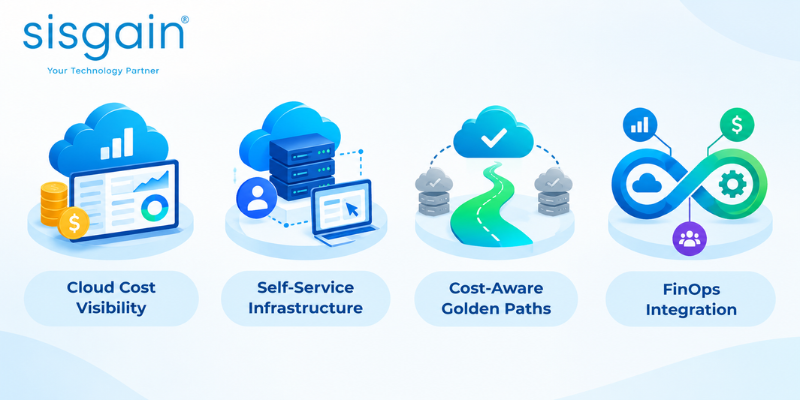
Cloud Cost Visibility
Developers and platform teams need visibility into where infrastructure spending originates.
A platform can associate cloud consumption with:
-
Applications
-
Development teams
-
Kubernetes namespaces
-
Environments
-
Business units
-
Projects
-
Individual services
This allows organizations to move from simply asking, "How much are we spending?" to more useful questions such as, "Which application is generating this cost, and why?"
Self-Service Infrastructure
Self-service infrastructure allows developers to provision approved resources without repeatedly depending on platform or operations teams.
However, unrestricted self-service can also increase cloud waste. A cost-aware platform combines self-service capabilities with standardized configurations.
For example, infrastructure templates can include predefined:
-
CPU and memory limits
-
Storage configurations
-
Scaling policies
-
Monitoring settings
-
Security controls
-
Cost thresholds
This provides developers with flexibility while maintaining organizational standards.
Cost-Aware Golden Paths
Golden paths provide recommended ways to build and deploy applications. In fintech environments, these paths can incorporate both security and cost considerations.
A golden path for a new service might automatically provide:
-
An approved deployment template
-
Standard resource configurations
-
Monitoring and logging
-
Security policies
-
Autoscaling rules
-
Cost attribution
-
Budget alerts
This reduces the need for developers to make infrastructure decisions from scratch.
FinOps Integration
FinOps brings financial accountability into cloud operations. When integrated with platform engineering, it can provide developers with actionable cost information during development and deployment.
Platform teams can work with finance and engineering stakeholders to establish:
-
Cost ownership models
-
Budget thresholds
-
Resource utilization targets
-
Cost allocation rules
-
Optimization workflows
-
Reporting standards
The result is a shared approach to cloud economics rather than isolated financial reporting.
Using Kubernetes for Fintech Cloud Cost Optimization
Kubernetes provides flexibility and scalability, but poorly configured clusters can become expensive.
A cost-aware platform can help teams monitor resource consumption and optimize workloads through mechanisms such as:
Resource Requests and Limits
Accurate resource requests help Kubernetes schedule workloads more efficiently. Excessively high requests can lead to underutilized infrastructure, while insufficient allocations can affect application performance.
Autoscaling
Horizontal and vertical scaling mechanisms can help workloads adjust to changing demand. The right strategy depends on application behavior, performance requirements, and workload characteristics.
Cluster Utilization
Platform teams can monitor node utilization and identify capacity that is consistently underused.
Workload-Level Cost Visibility
Connecting Kubernetes usage with applications and teams can make it easier to understand which workloads contribute to infrastructure spending.
The objective should be efficient resource utilization rather than reducing resources indiscriminately.
Automating Cost Governance With Policy-as-Code
Manual cloud governance becomes difficult as fintech environments grow. Policy-as-code can automate infrastructure rules and apply them consistently.
For example, policies can identify or prevent deployments that:
-
Exceed approved resource limits
-
Use unauthorized infrastructure configurations
-
Lack required cost tags
-
Deploy into restricted environments
-
Exceed defined spending thresholds
These controls can be integrated into CI/CD pipelines, allowing potential issues to be identified before infrastructure reaches production.
This approach also helps create consistency across development, testing, staging, and production environments.
How AI Can Support Cost-Aware Platform Engineering
AI is increasingly being incorporated into cloud operations and developer platforms. For fintech organizations, AI-assisted optimization can help identify patterns that may be difficult to detect through manual analysis.
Potential use cases include:
-
Detecting unusual spending patterns
-
Identifying underutilized resources
-
Predicting workload demand
-
Recommending resource adjustments
-
Highlighting recurring infrastructure waste
-
Supporting capacity planning
AI recommendations should still operate within established security, governance, and compliance controls. Automated optimization should not introduce changes that could negatively affect critical financial workloads.
Measuring the Performance of a Cost-Aware Platform
Cloud spending alone is not enough to determine whether a platform is effective. Fintech organizations should consider both financial and engineering metrics.
Useful measurements include:
-
Cloud cost per transaction
-
Cost per application or service
-
Resource utilization
-
Percentage of idle resources
-
Infrastructure provisioning time
-
Deployment frequency
-
Application availability
-
Cost allocation coverage
-
Policy compliance
-
Developer self-service adoption
These metrics help organizations understand whether platform improvements are producing measurable business and engineering outcomes.
Common Challenges in Building Cost-Aware Platforms
Cost-aware platform engineering can introduce several challenges.
Limited Cost Visibility
If infrastructure resources are poorly tagged or inconsistently organized, assigning costs to applications and teams becomes difficult.
Developer Adoption
Developers may initially view cost controls as restrictions. Platforms should therefore make the preferred path easier rather than creating unnecessary friction.
Over-Optimization
Reducing infrastructure resources without considering application requirements can create performance or reliability problems. Optimization should always account for workload behavior.
Legacy Infrastructure
Older applications may not fit modern platform standards. Migrating these workloads requires careful assessment rather than immediate restructuring.
Balancing Cost and Reliability
Fintech systems often require strong availability. The cheapest infrastructure configuration is not necessarily appropriate for a critical financial application.
How Platform Engineering Consulting Services Can Help
Organizations that lack the internal resources to design or modernize an internal developer platform can work with experienced platform engineering consultants.
Platform engineering consulting services can support fintech organizations across areas such as:
-
Platform architecture assessment
-
Internal developer platform design
-
Kubernetes platform optimization
-
Cloud cost visibility
-
FinOps integration
-
Infrastructure automation
-
Golden path development
-
Policy-as-code implementation
-
CI/CD modernization
-
Observability and governance
A consulting-led approach can also help organizations identify which platform capabilities should be standardized and which should remain flexible for specific business requirements.
The focus should be on building a sustainable engineering foundation rather than applying isolated cost-cutting measures.
Best Practices for Building a Cost-Aware Fintech Platform
Organizations can improve their approach by following several practical principles:
-
Make infrastructure costs visible to engineering teams.
-
Establish clear ownership for cloud spending.
-
Use standardized infrastructure templates.
-
Build cost controls into CI/CD workflows.
-
Monitor resource utilization continuously.
-
Integrate FinOps with platform engineering.
-
Use automated scaling where workload behavior supports it.
-
Apply governance through policy-as-code.
-
Measure cost alongside performance and reliability.
-
Review optimization opportunities continuously.

Conclusion
Building a cost-aware developer platform allows fintech organizations to address cloud economics as part of everyday engineering rather than treating it as a separate financial exercise. By combining self-service infrastructure, golden paths, FinOps, Kubernetes optimization, observability, and automated governance, organizations can create a more controlled and transparent cloud environment.
The most effective approach is not simply to reduce infrastructure spending. It is to help engineering teams make better decisions about resources while maintaining the performance, security, scalability, and reliability that modern fintech applications demand.
For organizations looking to modernize their engineering foundation, platform engineering consulting services can provide the architecture, automation, governance, and optimization expertise needed to build a scalable and cost-aware developer platform.













Comments (0)