

Next Level Fire and Smoke Detection with Video Analytics Across Bahrain


Bahrain's skyline of high-rise towers, hotels, and shopping destinations shares a safety challenge that rarely gets discussed in public, which is how to catch a fire in its earliest seconds across a tall, densely occupied building, and that is precisely the gap modern Video Analytics is now closing for the island's commercial and hospitality sector.
High Rise and Hospitality Buildings Face a Different Kind of Risk
Bahrain's compact geography means much of its commercial activity is concentrated in dense clusters of towers, hotels, and retail destinations in and around Manama, where a fire in one floor or wing can threaten hundreds of occupants and neighbouring businesses if it is not caught early. Vertical evacuation in a high-rise building takes considerably longer than in a low rise structure, making early detection far more critical than in many other building types.
Bahrain's Civil Defence requirements for high occupancy buildings have grown more detailed in recent years, and facility owners increasingly recognize that traditional point sensors alone struggle to provide adequate early warning across large atriums, parking structures, and back of house areas common in hotels and shopping destinations.
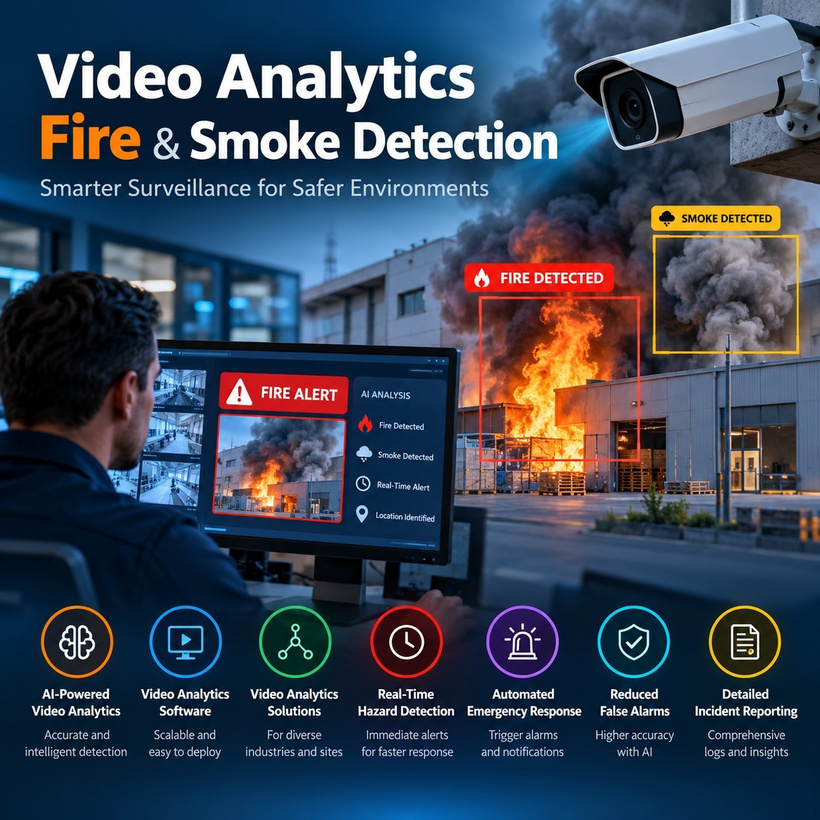
AI Powered Video Analytics Watching Every Floor and Corridor
Unlike a sensor that waits passively for smoke to physically drift its way, AI-Powered Video Analytics continuously analyzes camera feeds across lobbies, corridors, parking levels, and back of house areas, identifying flame flicker and rising smoke visually at a stage no point detector positioned nearby could reach yet. This capability is especially valuable in large atriums and parking structures where sensor density is difficult and expensive to achieve.
Because this detection runs on cameras already installed for security purposes, hotel and commercial building operators gain an additional safety layer without needing an entirely separate sensor network across every floor and wing of a large property.
Video Analytics Software Tuned for Bahrain's Building Environments
Shopping destinations, hotel lobbies, and underground parking structures each present distinct visual challenge, from bright atrium lighting to dim parking levels, and modern Video Analytics Software is specifically calibrated to maintain detection accuracy across these varied conditions rather than assuming a single uniform environment throughout a property.
This calibration work matters because a platform tuned for one environment can struggle in another, and a large hospitality property typically spans several very different lighting and layout conditions under one roof.
Complete Video Analytics Solutions for Every Property Type
A luxury hotel, a shopping destination, and a corporate tower each carry a distinct risk profile and occupant density, which is why comprehensive Video Analytics Solutions are configured individually for each property rather than applied as a single generic template across every building. Risk assessment at the design stage shapes camera placement, sensitivity thresholds, and alert routing to match what genuinely matters at each location.
This tailored approach extends to integration as well, since properties already running a building management or security operations center benefit from analytics that route alerts directly into existing dashboards rather than functioning as a disconnected standalone tool.
Real Time Hazard Detection Suited to High Occupancy Buildings
Speed is the entire value proposition of this technology, and Real-Time Hazard Detection delivers a flagged event within seconds of a flame or smoke pattern appearing on camera, giving security teams and emergency responders the earliest possible window to act before a contained incident threatens a crowded lobby or guest floor.
In a hotel or shopping destination hosting hundreds or thousands of occupants at any given time, that extra margin of warning can be the difference between a quietly contained incident and a full-scale evacuation disrupting the entire property.
Automated Emergency Response Removing Critical Delay
An alert only matters if it reaches the right people immediately, and Automated Emergency Response ensures a confirmed detection event triggers instant notification to security control rooms, facility managers, and where configured, directly to a monitoring center, without waiting for a human operator to notice an alert on a screen.
Some hospitality deployments also integrate with building systems to automatically isolate ventilation or unlock emergency exits in an affected zone, actions that can meaningfully slow fire and smoke spread while physical responders are still on their way.
Reduced False Alarms Protecting Guest Experience
Hotel operators who have endured repeated false alarm evacuations know how damaging they are to guest experience and reputation, which is why Reduced False Alarms performance is a key evaluation criterion for Bahraini hospitality properties. Teams can explore the complete video analytics fire and smoke detection system to see how accurate visual confirmation protects guest confidence without compromising safety.
Detailed Incident Reporting for Civil Defence and Insurance
Beyond catching an incident early, property operators need a precise record of exactly what happened and when, which is where Detailed Incident Reporting becomes essential for Civil Defence compliance, insurance claims, and internal safety audits. A specialist video analytics provider can configure reporting templates matched to the documentation standards Bahraini authorities and insurers expect to see.
Growing Adoption Across the Island's Commercial Sector
Hotels, shopping destinations, and corporate towers pursuing a Video Analytics Bahrain deployment are increasingly treating early visual fire detection as a standard safety investment rather than an optional extra, particularly as insurers underwriting high occupancy properties raise their expectations for documented, layered detection programs.
This shift is visible across sectors, from luxury hospitality protecting guest confidence to retail destinations where even a brief closure during peak shopping hours carries a meaningful financial cost.
Manama Setting the Pace for Hospitality Safety Standards
Properties pursuing a Video Analytics Manama deployment are often the first in the market to adopt comprehensive visual detection across every public and back of house area, a standard that other Bahraini hospitality and commercial properties are increasingly following as guest and regulatory expectations continue to rise.
As new hotel and mixed-use developments break ground around the capital, this technology is increasingly specified during the design and construction phase rather than retrofitted after a property has already opened to guests.
Why Proven Deployment Experience Matters
Fire and life safety technology in a high occupancy hospitality or commercial setting carries consequences that go well beyond a typical deployment, so property operators rightly expect a vendor who can speak knowledgeably about detection accuracy, integration with existing fire and building systems, and real-world performance across different property types, not just general claims about artificial intelligence.
Properties that document detection performance and response times over time build a record that supports both insurance negotiations and Civil Defence audits, turning a safety investment into measurable, defensible operational evidence.
Why Properties Choose Tektronix for Video Analytics in Bahrain
Deploying a fire and smoke detection analytics platform across a hotel, shopping destination, or corporate tower involves camera placement planning, sensitivity tuning for varied environments, integration with existing fire and building systems, and ongoing support most Bahraini property operators prefer to source from a single experienced partner.
Tektronix designs and deploys video analytics fire and smoke detection systems for hospitality, retail, and commercial properties across Bahrain, configuring detection sensitivity and alert routing to match each site's specific risk profile and existing infrastructure. Facility managers evaluating a new deployment can review the complete video analytics system offering to see how detection, response, and reporting components are packaged together.
Proven deployment experience across hotels, shopping destinations, and corporate towers is why Bahraini property operators continue to rely on the same provider as they extend coverage to additional buildings and zones.
Conclusion
Fire safety across Bahrain's commercial and hospitality sector is being transformed by modern Video Analytics that catches incidents earlier than traditional sensors ever could. AI-Powered Video Analytics and purpose-built Video Analytics Software deliver Real-Time Hazard Detection paired with Automated Emergency Response that removes critical delay. Complete Video Analytics Solutions bring Reduced False Alarms and Detailed Incident Reporting together, giving properties running Video Analytics Bahrain programs, including Video Analytics Manama deployments, the protection and documentation modern hospitality and commercial safety demands.
FAQs
1. How is Video Analytics different from a traditional smoke detector in a high rise building?
It identifies flame and smoke visually using existing cameras, often catching a developing fire before particles or heat reach a point sensor, which matters most in large atriums and areas where sensor coverage is limited.
2. What makes AI-Powered Video Analytics effective across hotels and shopping destinations?
It continuously scans camera feeds across lobbies, corridors, and parking levels for flame and smoke patterns, giving coverage in zones where dense point sensor networks would be difficult and costly to install.
3. Why does Video Analytics Software need calibration for different areas of the same property?
Bright atrium lighting and dim parking levels present very different visual conditions, so software calibrated for each environment maintains accuracy and avoids excessive false triggers across a single large property.
4. How does Automated Emergency Response benefit a high occupancy hospitality property?
It sends instant notifications to security control rooms and facility managers the moment an event is confirmed, and can trigger automatic ventilation or exit unlocking in the affected zone without human delay.
5. Why do hotel operators value Reduced False Alarms as much as early detection?
Frequent false alarm evacuations disrupt guest experience and damage a property's reputation, so accurate visual confirmation protects guest confidence alongside genuine safety improvement.














Comments (0)