

Why Fitness Businesses Are Investing in AI-Powered White Label Fitness App Development
Discover why fitness businesses are investing in AI-powered white label fitness app development to deliver personalized workouts, improve member engagement, automate operations, and drive business growth.
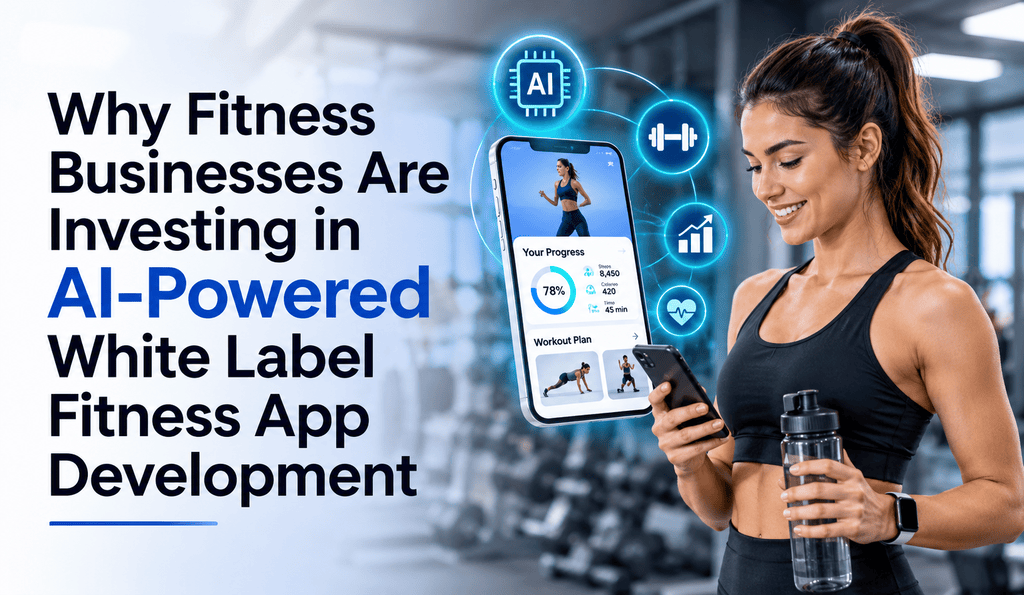
The fitness industry is changing rapidly as consumers increasingly expect more than access to gyms, workout videos, or personal trainers. They want personalized experiences, convenient digital services, progress tracking, and guidance that fits their individual goals. Artificial intelligence (AI) is helping fitness businesses respond to these expectations by making mobile applications more intelligent and adaptive.
For this reason, many gyms, fitness studios, wellness brands, and personal training businesses are exploring white label fitness app development as a practical way to introduce AI-powered digital experiences without building every component from scratch. Instead of creating an application entirely from the ground up, businesses can start with an existing app framework and customize its features, branding, and user experience.
The Growing Demand for Personalized Fitness Experiences
Fitness is highly personal. Two people may have completely different goals, physical capabilities, schedules, and preferences. A generic workout plan may therefore fail to keep users engaged for long.
AI can help fitness applications analyze user information such as workout history, activity patterns, goals, and preferences to deliver more relevant recommendations. For example, an application could suggest adjustments to workout intensity based on previous performance or recommend different training activities when a user consistently skips certain exercises.
This level of personalization can make digital fitness platforms feel more responsive and useful. It also gives fitness businesses an opportunity to maintain stronger engagement with members between in-person sessions.
Why White Label Development Appeals to Fitness Businesses
Building a fitness application from the ground up requires significant planning, technical expertise, testing, maintenance, and ongoing updates. For many fitness businesses, mobile technology is important, but software development is not their core business.
White label development offers an alternative approach. A pre-built application framework can provide common functionality, while the business can customize the platform according to its brand and operational requirements.
With white label fitness app development, businesses can potentially reduce development complexity and focus more attention on their fitness programs, customer relationships, and overall digital experience.
AI Makes Fitness Apps More Adaptive
One of the biggest reasons businesses are combining AI with fitness applications is the technology's ability to process large amounts of user data and identify patterns.
AI-powered fitness platforms can support features such as:
-
Personalized workout recommendations
-
AI-assisted fitness plans
-
Activity and performance analysis
-
Progress-based recommendations
-
Conversational fitness assistants
-
Automated reminders
-
Nutrition-related suggestions
-
Exercise recommendations based on user preferences
These capabilities do not necessarily replace fitness professionals. Instead, they can complement trainers by automating repetitive tasks and giving users additional support outside scheduled sessions.
For example, a trainer may still design an overall program, while AI helps users stay on track by providing reminders, tracking progress, and suggesting adjustments based on available data.
Better Member Engagement Through Intelligent Features
Keeping users engaged is one of the biggest challenges for fitness businesses. Someone may download an app with strong motivation but stop using it after a few weeks.
AI can help address this problem by making interactions more relevant. Instead of sending the same reminder to everyone, an intelligent system can consider individual activity patterns and engagement behavior.
A user who regularly completes morning workouts might receive reminders around their usual training time. Another user who has become less active could receive different prompts designed to encourage them to return.
This creates a more personalized experience than a one-size-fits-all approach.
Supporting Trainers and Fitness Professionals
AI-powered fitness apps can also benefit trainers and coaches. Instead of manually reviewing every piece of user activity data, trainers can use automated insights to understand trends more efficiently.
For instance, an application could highlight changes in workout frequency, exercise performance, or adherence to a training plan. Trainers can then use these insights when communicating with clients or adjusting programs.
This can make digital tools more useful as an extension of professional fitness services rather than treating them as a replacement for human expertise.
Choosing the Right Development Approach
Businesses considering this model should carefully evaluate their requirements before selecting a white label fitness app development company. Not every platform will offer the same level of customization, AI capabilities, scalability, or integration support.
Important considerations include data security, user privacy, integration with wearable devices, analytics capabilities, payment functionality, administrative controls, and the ability to add or modify AI-powered features.
Businesses should also consider how easily the application can evolve. Fitness technology is continuously changing, so a platform that cannot accommodate new features may become restrictive over time.
The Role of White Label Fitness App Development Services
Modern white label fitness app development services can cover more than simply providing a branded mobile application. Depending on the platform and development approach, businesses may have access to customization, AI integrations, backend systems, analytics dashboards, third-party integrations, maintenance, and ongoing technical updates.
The objective should not simply be to launch an app quickly. The more important goal is to create a digital fitness experience that supports real customer needs and can evolve as those needs change.
Businesses should therefore assess whether a solution provides sufficient flexibility to customize the user journey, integrate relevant technologies, and accommodate future growth.
Privacy and Responsible Use of AI
As fitness applications become more intelligent, privacy becomes increasingly important. Fitness platforms may handle sensitive information related to physical activity, body measurements, health goals, and personal habits.
Businesses need to establish clear policies around data collection, storage, processing, and sharing. Users should understand what information is being collected and how it is being used.
AI recommendations should also be presented responsibly. Fitness applications should avoid making unsupported medical claims or presenting automated suggestions as professional medical advice. Human oversight remains important, particularly when applications deal with health-related information.
What the Future Looks Like
The combination of AI and fitness applications is likely to become increasingly sophisticated. Future platforms may use more advanced personalization, computer vision for exercise form analysis, conversational assistants, predictive analytics, and deeper integrations with wearable devices.
However, successful fitness apps will not necessarily be those with the largest number of AI features. The strongest platforms are more likely to be those that use technology thoughtfully to solve genuine user problems.
For fitness businesses, the opportunity lies in finding the right balance between automation, personalization, convenience, and human interaction.
Conclusion
AI is changing how fitness businesses approach digital engagement by making applications more personalized, responsive, and data-driven. White label fitness app development provides a practical foundation for businesses that want to adopt these capabilities while avoiding the complexity of developing every component independently.
From personalized recommendations and intelligent reminders to trainer support and performance analytics, AI can add meaningful value when implemented around real user needs. At the same time, privacy, responsible data management, scalability, and human oversight should remain central to the development process.
Businesses exploring this approach can evaluate providers such as White Label Apps to understand how customizable fitness applications can incorporate modern AI capabilities while supporting different business models and customer experiences.

WhiteLabelApps provides white label clone app development services for businesses looking to launch applications based on established business concepts. Alongside clone app development, its services include mobile app development, website development, eCommerce solutions, marketplace platforms, delivery apps, taxi applications, grocery solutions, and on-demand platforms. Businesses can customize the branding, features, user interfaces, workflows, and functionality according to their specific requirements.
















Comments (0)