

Positron Emission Tomography (PET) Market Size, Share, Industry Trends and Forecast 2026-2034
The positron emission tomography (PET) market is expected to reach USD 2,081.6 Million by 2034, exhibiting a growth rate (CAGR) of 5.01% during 2026-2034.

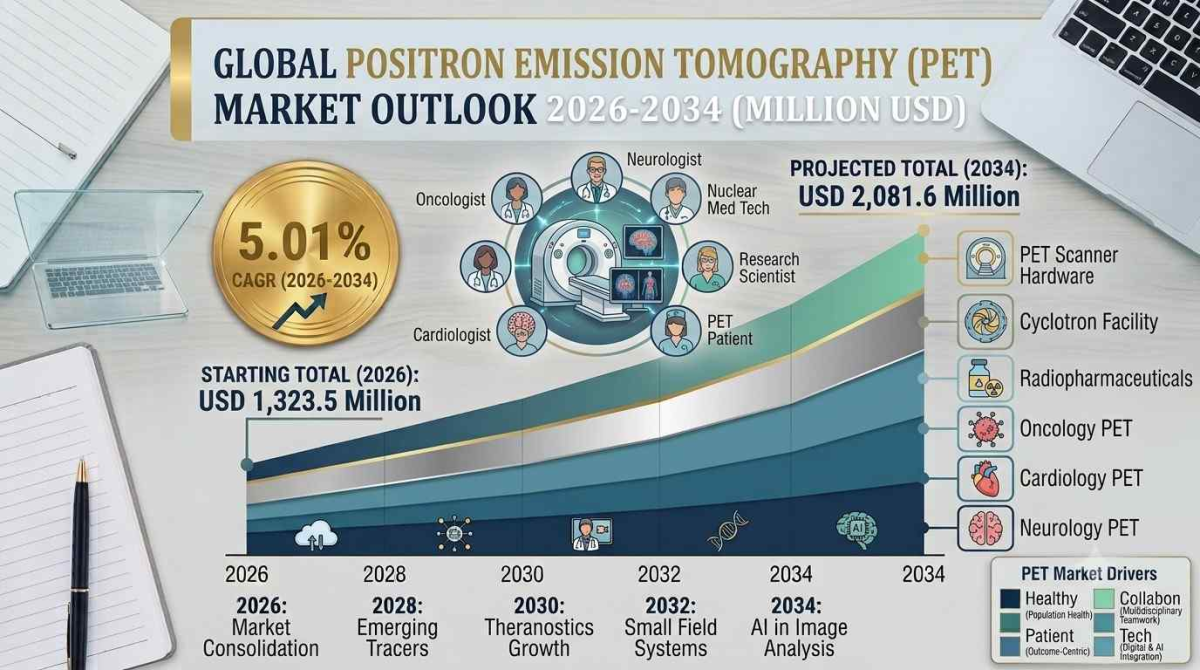
According to IMARC Group, the global positron emission tomography (PET) market size reached USD 1,323.5 Million in 2025 and is projected to reach USD 2,081.6 Million by 2034, expanding at a CAGR of 5.01% during 2026-2034. This steady positron emission tomography (PET) market growth reflects the rising prevalence of chronic diseases such as cancer and Alzheimer's disease, significant advancements in molecular imaging technology, and the expanding healthcare infrastructure supporting precision medicine globally.
Positron Emission Tomography (PET) Industry Overview
Positron emission tomography (PET) is a nuclear medicine imaging technique that uses radioactive tracers to visualize and measure metabolic and physiological activity within the body. By detecting the gamma rays emitted as a radiotracer decays, PET scanners generate detailed three-dimensional images that reveal disease processes often before they become visible on structural imaging modalities such as CT or MRI alone.
PET imaging is deployed across a broad continuum of clinical and research use cases:
- Oncology: Tumor detection, cancer staging, treatment response monitoring, and recurrence surveillance
- Neurology: Alzheimer's disease and dementia evaluation, epilepsy localization, and brain disorder diagnosis
- Cardiology: Myocardial perfusion imaging and assessment of cardiac viability
- Hybrid imaging: Integration with CT and MRI (PET/CT, PET/MRI) for combined metabolic and anatomical assessment
- Pharmaceutical R&D: Radiotracer development and drug efficacy evaluation in clinical trials
Global Positron Emission Tomography (PET) Market Size & Key Statistics
Below are the key positron emission tomography (PET) market size statistics drawn from IMARC Group's comprehensive market analysis:
|
Report Attribute |
Key Statistics |
|
Base Year |
2025 |
|
Historical Period |
2020-2025 |
|
Forecast Period |
2026-2034 |
|
PET Market Size in 2025 |
USD 1,323.5 Million |
|
Market Forecast in 2034 |
USD 2,081.6 Million |
|
Market Growth Rate (2026-2034) |
5.01% CAGR |
|
Largest Region |
North America |
|
Leading Product Type |
Full-Ring PET Scanners |
|
Leading Detector Type |
Lutetium Oxyorthosilicate (LSO) |
|
Leading Application |
Oncology |
|
Leading End-User Segment |
Hospitals and Clinics |
Request for a Sample Report for Detailed PET Market Share Evaluation: https://www.imarcgroup.com/positron-emission-tomography-market/requestsample
Key Market Drivers & Positron Emission Tomography (PET) Market Trends in 2026
Several powerful forces are shaping positron emission tomography (PET) market trends and fuelling sustained growth expectations across global diagnostic imaging markets:
1. Rising Prevalence of Cancer and Alzheimer's Disease
The growing global burden of chronic diseases, particularly cancer and Alzheimer's disease, is a primary driver of PET adoption. PET scans employ radioactive tracers to reveal both normal and abnormal metabolic activity, enabling clinicians to monitor disease progression and treatment response. According to the Alzheimer's Association, an estimated 6.7 million Americans aged 65 and older were living with Alzheimer's dementia as of 2022-2023, a figure expected to rise to 13.8 million by 2060, underscoring long-term demand for PET-based neurological diagnostics.
2. Growth of Hybrid Imaging Systems (PET/CT and PET/MRI)
A defining Positron Emission Tomography (PET) Market Trend is the continued expansion of hybrid imaging systems that combine metabolic and anatomical data within a single scan. PET/CT and PET/MRI platforms provide more complete diagnostic information, improving accuracy in cancer staging, neurological assessment, and cardiac evaluation, and are increasingly replacing standalone imaging modalities in advanced healthcare settings.
3. Advancements in Detector and Radiotracer Technology
Manufacturers are introducing next-generation detector technologies, such as silicon photomultiplier-based systems, to improve image resolution, time-of-flight performance, and diagnostic accuracy. For instance, in June 2023, Siemens Healthineers AG launched the Biograph Vision X PET/CT scanner featuring Optiso Ultra Dynamic Range detector technology, delivering a time-of-flight performance of 178 picoseconds. Parallel innovation in disease-specific radiotracers is further improving diagnostic precision across oncology and neurology applications.
4. Expanding Application in Cardiology and Neurology
While oncology remains the leading application, the wider adoption of PET imaging in cardiology and neurology is broadening the addressable market. Growing use of PET for myocardial viability assessment and brain disorder evaluation is expanding the technology's role beyond traditional cancer-focused diagnostic workflows.
5. Integration of AI and Machine Learning in Image Analysis
The application of artificial intelligence and machine learning to PET image interpretation is enhancing diagnostic capabilities, improving workflow efficiency, and supporting the transition toward precision medicine. AI-assisted analysis is increasingly used to improve tumor detection accuracy and standardize the evaluation of metabolic and physiological processes captured in PET scans.
6. Growing Preference for Minimally Invasive Diagnostics
The broader shift toward less invasive diagnostic methods is supporting Positron Emission Tomography (PET) Market Growth, as PET imaging provides essential metabolic and physiological data with significantly less patient discomfort compared to invasive alternatives, making it increasingly preferred across oncology, neurology, and cardiology care pathways.
Key Market Segmentation
By Product Type
Full-Ring PET Scanners - Largest Segment: Full-ring PET scanners feature a complete ring of detectors surrounding the patient, enabling continuous, simultaneous acquisition of high-resolution images from all angles. Their ability to deliver comprehensive whole-body information makes them the preferred choice for oncology tumor detection, treatment response monitoring, and radiation treatment planning, as well as cardiology and neurology applications.
Partial-Ring PET Scanners: Composed of detector arrays that do not complete a full circle, partial-ring scanners offer a more affordable and compact alternative, though with some limitations in image quality and uniformity compared to full-ring systems. They are commonly deployed in clinical settings with space or budget constraints.
By Detector Type
Lutetium Oxyorthosilicate (LSO) - Leading Segment: LSO detectors are the preferred choice in modern PET systems due to their fast scintillation decay time, which enables high count rates and strong timing resolution essential for time-of-flight PET imaging. Their high light output and excellent energy resolution ensure superior image quality.
Bismuth Germanium Oxide (BGO): Known for high stopping power and reliable gamma photon detection, BGO detectors have long served as a mainstay of PET systems, offering strong energy resolution for high-energy photon detection.
Lutetium Fine Silicate (LFS): A newer detector type with scintillation properties similar to LSO, including fast decay times and high photon yield, well suited to high-resolution and time-of-flight PET applications.
Lutetium Yttrium Orthosilicate (LYO): A variant of LSO incorporating yttrium, allowing scintillation properties to be tuned for specialized PET applications requiring tailored timing resolution or light output.
Gadolinium Oxyorthosilicate (GSO): Valued for stable scintillation properties and durability, GSO detectors provide a balanced combination of stopping power and resolution across multiple PET applications.
By Application
Oncology - Largest Segment: Oncology represents the leading application segment, driven by the rising global cancer burden and PET's superior capability for tumor detection, treatment efficacy monitoring, therapy response evaluation, and recurrence detection. PET's detailed insight into tumor metabolism and staging is critical for individualized cancer treatment strategies.
Neurology: PET imaging plays a growing role in diagnosing brain disorders, including Alzheimer's disease and epilepsy, by detecting abnormal metabolic activity and protein accumulation in the brain.
Cardiology: PET is increasingly used for myocardial perfusion imaging and assessing cardiac viability, supporting treatment decisions in patients with coronary artery disease.
Others: Includes emerging research and specialized clinical applications leveraging PET's molecular imaging capabilities.
By End-User
Hospitals and Clinics - Largest Segment: Hospitals and clinics account for the dominant end-user share of the PET market, applying advanced imaging systems to deliver thorough diagnosis and treatment planning. These facilities typically combine PET with CT or MRI to improve diagnostic accuracy in cancer staging, cardiac evaluation, and neurological assessment.
Diagnostic Centers: Dedicated outpatient imaging centers provide high-quality PET scans supporting early detection, staging, and monitoring of diseases, particularly cancer.
Others: Comprises research institutions, academic centers, and specialized practices using PET imaging to advance diagnostic capabilities and clinical research.
Regional Positron Emission Tomography (PET) Market Analysis
|
Region |
Key Highlights |
|
North America - Largest |
United States & Canada; advanced healthcare infrastructure, high healthcare spending, strong presence of leading imaging technology firms, high cancer and cardiovascular disease burden driving PET scan demand |
|
Europe |
Germany, France, UK, Italy, Spain, Russia; mature nuclear medicine networks, expanding hybrid PET/CT and PET/MRI adoption, strong government-backed healthcare spending |
|
Asia Pacific - Fastest Growing |
China, Japan, India, South Korea, Australia, Indonesia; rapid healthcare infrastructure expansion, rising cancer incidence, growing government investment in advanced diagnostic imaging |
|
Latin America |
Brazil, Mexico; expanding private hospital networks, growing adoption of oncology and cardiology imaging services |
|
Middle East & Africa |
Rising healthcare modernization initiatives, increasing investment in specialized diagnostic imaging centers |
North America leads the global Positron Emission Tomography (PET) Market Share, underpinned by advanced healthcare infrastructure, high healthcare spending, and early adoption of new imaging technologies. The region's high rate of cancer and cardiovascular disease makes PET scans essential for early detection, while strong U.S. healthcare policy support and significant R&D investment further reinforce its leadership position.
Asia-Pacific represents the fastest-growing regional market, propelled by China's expanding domestic diagnostics industry, India's growing national health infrastructure initiatives, and Japan's continued investment in precision medicine and next-generation molecular imaging technologies.
Connect for Detailed PET Market Share Segmentation Analysis - Speak to an Analyst: https://www.imarcgroup.com/request?type=report&id=2284&flag=C
Leading Players in the Global Positron Emission Tomography (PET) Industry
The global PET market features a mix of diversified medical imaging multinationals and specialized nuclear medicine equipment providers. Key companies covered in the IMARC Group report include:
|
Company |
Core PET Portfolio |
Competitive Strength |
|
GE Healthcare |
Discovery MI, Discovery IQ PET/CT systems |
Broad installed base, digital PET detector technology, strong oncology imaging presence |
|
Siemens Healthineers AG |
Biograph Vision, Biograph Vision X (Optiso UDR detector) |
High-resolution time-of-flight PET/CT, advanced silicon photomultiplier technology |
|
Koninklijke Philips NV |
Vereos, Vereos Plus digital PET/CT |
Digital photon counting technology, strong European and North American presence |
|
Neusoft Medical Systems |
NeuSight, PET/CT systems |
Cost-competitive systems, growing footprint in Asia-Pacific markets |
|
Positron Corporation |
Attrius PET System |
Cardiology-focused PET imaging, clinical service partnerships |
|
Oncovision (Bruker) |
PET/CT and molecular imaging systems |
Specialized oncology and preclinical imaging solutions |
|
Mediso Medical Imaging Systems Ltd. |
AnyScan, nanoScan PET/CT |
Hybrid imaging systems for clinical and preclinical research |
|
Agfa Healthcare (Dedalus Group) |
Imaging IT and PET workflow solutions |
Strong imaging informatics and workflow integration capabilities |
|
Hitachi Ltd. |
PET/CT imaging systems |
Established diagnostic imaging manufacturing and regional distribution network |
Leading players in the PET market are focused on partnerships, technological innovation, and product line expansion to strengthen their market position. Companies are investing heavily in R&D to integrate AI and machine learning for enhanced image analysis, while pursuing mergers, acquisitions, and regional partnerships to expand into emerging markets and meet rising demand for advanced diagnostic imaging solutions.
Latest Positron Emission Tomography (PET) Market Industry Developments
May 2024 - Canon Medical Systems
Canon Medical Systems announced the debut installation of the Aquilion Serve SP CT scanner with INSTINX AI-driven workflow automation in the United States, combining advanced imaging capabilities with enhanced efficiency and throughput, reflecting the broader industry push toward AI-integrated diagnostic imaging.
November 2024 - Positron Corporation
Positron Corporation, a molecular imaging medical device company, welcomed a prominent cardiovascular practice in Pennsylvania as a new customer utilizing its Attrius PET System and associated clinical services, reinforcing PET's expanding role in cardiology diagnostics.
June 2023 - Siemens Healthineers AG
Siemens Healthineers launched the Biograph Vision X, a next-generation PET/CT scanner built on Optiso Ultra Dynamic Range detector technology using silicon photomultipliers, enabling higher spatial resolution and a time-of-flight performance of 178 picoseconds, supporting continued positron emission tomography (PET) market growth through improved diagnostic accuracy.
About Us
IMARC Group is a leading global market research company providing data-driven insights and expert consulting services to businesses seeking to achieve their strategic objectives. With a multi-disciplinary team of industry experts, IMARC delivers thorough, reliable market intelligence across sectors including Healthcare, Technology, Chemicals, Energy, Food & Beverages, and more.
Contact Us
IMARC Group
United States: +1-201-971-6302
India: +91-120-433-0800
United Kingdom: +44-753-714-6104









Comments (0)