

Perimeter Security Dynamics in High-Risk Infrastructure: Engineering Anti-Climb Barriers, Access Systems, and Windload Resistance

Securing critical national infrastructure, military defence compounds, and correctional institutions presents complex engineering challenges for modern physical security planners. Across these sensitive environments, a perimeter fence is far more than a simple legal boundary demarcation. It acts as an active physical intrusion barrier, an optical platform for digital surveillance systems, and the primary defence layer responsible for delaying hostile breaches until tactical response personnel can deploy.
When perimeter barriers fail in high-risk zones, the consequences extend far beyond financial loss, threatening public safety and operational continuity. Designing high-security enclosures requires a multidisciplinary engineering approach that combines material science, mechanical anti-climb geometry, automated access dynamics, and geotechnical foundation design. By examining how advanced barrier materials interact with structural wind loads and environmental weathering across Canterbury, infrastructure directors can specify robust, long-lasting perimeter defence systems.
Interfacial Physics of Anti-Climb Barrier Mesh: The 358 Specification
Physical delay capability is the most critical metric in evaluating any high-security barrier. If an intruder can breach a boundary in seconds using basic manual tools, electronic detection systems become virtually useless. Modern correctional institutions and defence installations therefore require barrier mesh systems specifically engineered to defeat climbing, cutting, and forced leverage attacks.
Specifying certified Prison Security Fencing Canterbury incorporates high-security welded wire mesh manufactured to the internationally recognised 358 specification. The designation 358 derives from the imperial measurements of the mesh: three inches by zero-point-five inches aperture spacing with an eight-gauge steel wire diameter. Converted to metric dimensions, this translates to horizontal wire openings of seventy-six point two millimetres, vertical openings of twelve point seven millimetres, and a wire diameter of four millimetres.
The narrow vertical aperture dimension of twelve point seven millimetres is chemically and mechanically decisive. It is physically impossible for an intruder to insert adult fingertips or work-boot toeholds into openings this narrow, eliminating the friction required for unassisted climbing. Furthermore, the tight aperture spacing prevents standard handheld bolt cutters, angle grinders, or pry bars from gaining effective jaw engagement against the horizontal wires.
To overcome cutting attacks, the steel core wires possess high tensile strength ratings exceeding five hundred megapascals. Every intersection point between vertical and horizontal wires is joined through resistance projection welding. If an attacker manages to sever an individual wire strand, the surrounding welded grid remains completely intact, preventing the rapid unraveling characteristic of standard woven chain-link mesh.
Heavy Access Automation and Dynamic Cantilever Geometry
Securing a high-security perimeter requires providing reliable access control for legitimate operational vehicles. In military transport depots, intermodal logistics terminals, and correctional service compounds, vehicle gates undergo hundreds of opening and closing cycles daily under heavy freight traffic.
Standard tracked sliding gates present major operational vulnerabilities in heavy industrial environments. Ground tracks installed across roadway surfaces inevitably trap gravel, mud, road salt, and snow. In winter conditions, frozen debris inside the ground track derails sliding carriages, causing gate motors to stall or burn out. Furthermore, heavy truck axles traversing surface tracks deform the steel rails, causing premature mechanical failure.
To eliminate these vulnerabilities, high-security facilities deploy massive cantilever gate systems spanning widths up to thirteen metres. A cantilever gate utilises an extended counterbalance tail and an internal carriage track suspended entirely above the road surface. By eliminating ground rails, cantilever gates glide effortlessly over uneven ground, ice, and gravel without any risk of derailment or motor stall.
Cantilever systems feature integrated torque-limiting commercial motors, magnetic limit switches, pneumatic safety edges, and photoelectric beams. When integrated with access control electronics, these heavy automated barriers provide seamless, secure entry for military convoys and commercial freight while completely repelling unauthorised vehicular intrusion.
Structural Aerodynamics and Wind Load Mitigation in Canterbury
Installing tall security barriers across Canterbury introduces severe aerodynamic challenges. The Canterbury Plains are subject to intense, turbulent north-west foehn winds capable of generating sustained wind gusts exceeding one hundred and forty kilometres per hour. High-density security mesh, while visually transparent, creates measurable aerodynamic drag.
When high-velocity winds encounter dense 358 mesh, the closely spaced wire grids create laminar friction, restricting airflow and transforming the fence line into a substantial wind sail. The resulting lateral pressure exerts massive overturning moments on structural posts and concrete foundations. Without rigorous aerodynamic engineering, wind loads can bend steel posts, crack welds, and cause foundation heaving in alluvial subsoils.
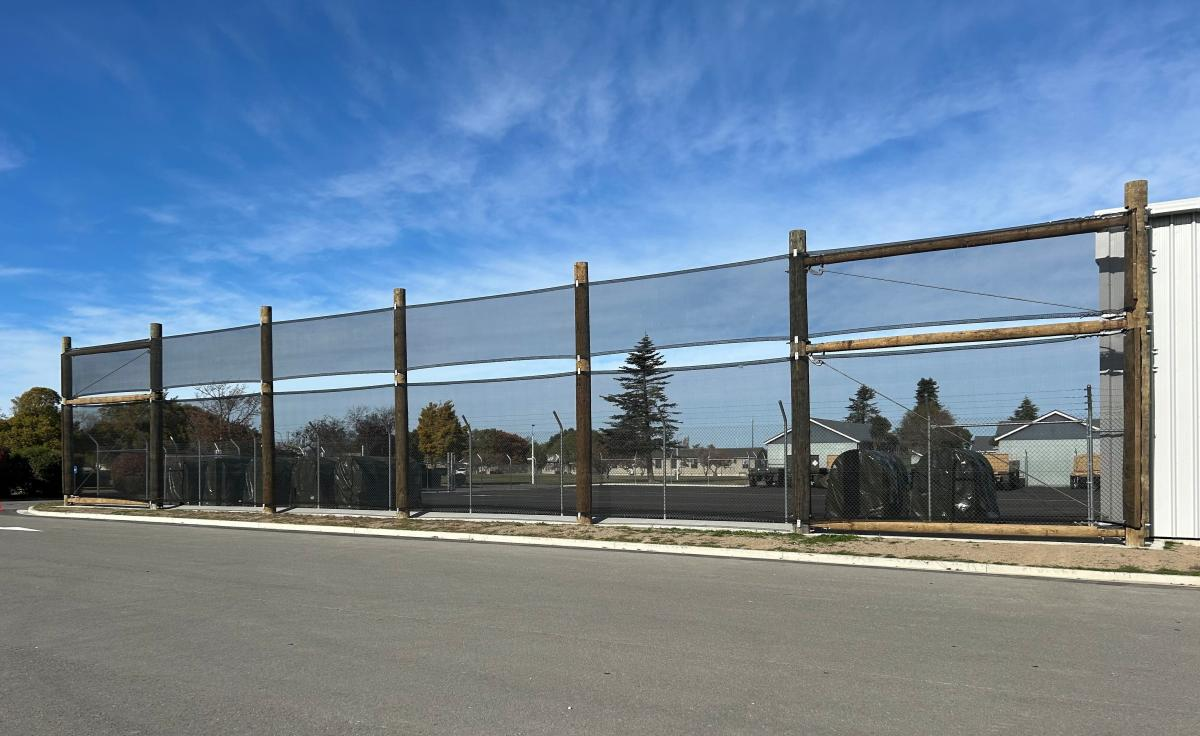
To withstand these extreme aerodynamic forces, commercial contractors employ robust structural hollow sections for support posts, calculating post wall thicknesses according to precise exposure zones. At high-risk sites, such as military bases and remote wind farms, engineered windbreak structures featuring perforated baffle systems can be integrated into the perimeter. These windbreaks diffuse gale-force gusts, reducing downstream turbulence and safeguarding internal facilities from wind-borne debris.
Geotechnical Foundation Design in Alluvial Soils
Long-term physical barrier stability depends fundamentally on subsoil foundation performance. The ground strata across the Canterbury region vary considerably, transitioning from dense gravel beds and alluvial silts to high water tables near coastal estuaries. High-security fence posts cannot rely on standard shallow concrete footings commonly used in residential construction.
Engineering reliable commercial foundations requires:
- Bored Friction Piles: Foundation holes are drilled to calculated depths to anchor support posts into load-bearing gravel layers, utilising skin friction between the concrete cylinder and surrounding soil to resist uplift forces.
- High-Strength Concrete Formulations: Foundations utilise certified high-density concrete mixes designed to resist chemical sulphate attack and frost heaving cycles.
- Internal Steel Reinforcing Cages: Corner strainers, gate posts, and terminal anchor columns feature heavy welded rebar cages embedded within the concrete footing to distribute dynamic loads across the entire foundation mass.
- Subsoil Drainage Design: Foundation caps are crowned above grade to shed surface water, preventing moisture pooling around the post base and mitigating corrosion risks.
Procuring Turn-Key Perimeter Solutions with Certified Contractors
Achieving uncompromising physical security requires selecting specialist contractors who possess deep trade expertise, in-house fabrication workshops, and proven tier-one safety certifications. General fencing contractors lack the specialised machinery, engineering expertise, and health and safety documentation needed to execute complex infrastructure contracts safely.
Partnering with accredited providers of Commercial Fencing nz ensures that correctional, defence, and critical utility projects are completed to exact architectural specifications. Holding verified SiteWise Gold safety certification guarantees that installation teams operate under rigorous job safety analyses and audited risk management protocols. This professional discipline protects worker welfare, meets strict government procurement guidelines, and delivers robust, uncompromised perimeter assets that perform reliably for decades.
Conclusion
Engineering dependable perimeter security across high-risk infrastructure requires a thorough integration of mechanical resistance, advanced access automation, and geotechnical stability. Relying on lightweight domestic fencing or generic commercial mesh leaves vital assets exposed to rapid physical breach and costly weather damage. By deploying certified anti-climb 358 mesh, massive automated cantilever gates, and aerodynamically engineered support structures, Canterbury facility managers establish an unyielding, resilient physical boundary that protects sensitive facilities and ensures lasting operational peace of mind.

















Comments (0)