

Carbon Steel Flanges: Types and Uses Explained
Explore carbon steel flange types, properties, benefits, ASTM and ASME standards, pressure classes and industrial applications across oil, gas and power sectors.

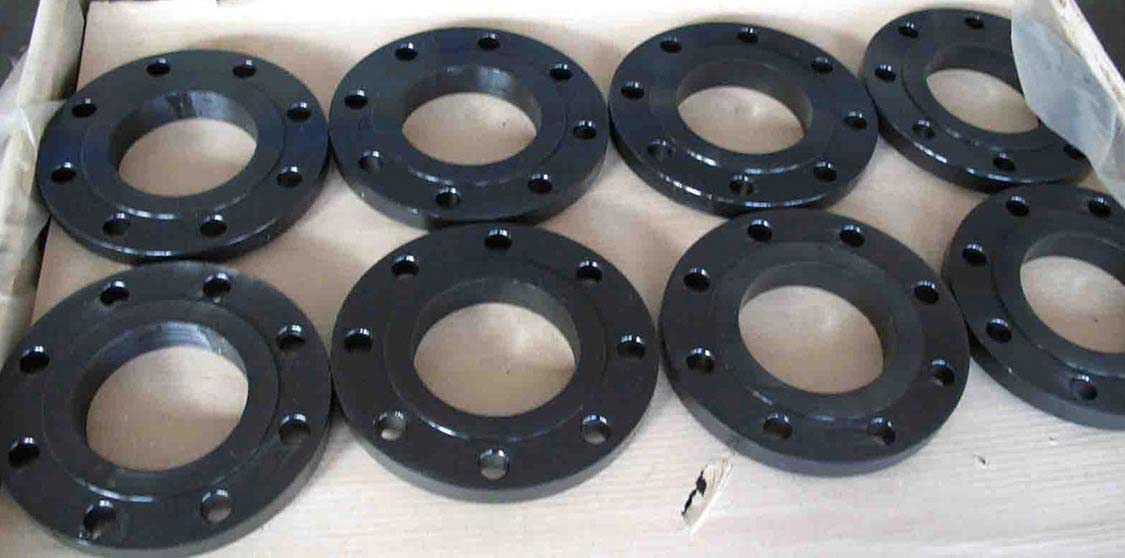
A piping system rarely fails along its straight runs. Carbon Steel Flanges carry that burden, bolting two pipe ends into one pressure-tight connection a crew can open again within the hour. Welded joints allow no such access. Flanged connections let operators swap a gasket, inspect a valve seat or blank off a branch while the plant keeps running. Carbon Steel Pipe Flanges suit this duty for a plain reason: carbon steel delivers high tensile strength and clean weldability at roughly a third of the cost of stainless equivalents.
What Are Carbon Steel Flanges?
Carbon steel holds iron with 0.05% to 0.35% carbon across most flange grades, plus controlled manganese, silicon, phosphorus and sulphur. Carbon governs hardness and strength. Mills forge flange blanks from billets instead of casting them, because forging aligns grain flow around the hub and lifts fatigue resistance, after which machinists finish the bore, face and bolt holes. ASTM A105 Carbon Steel Flanges cover most ambient and elevated temperature service at 485 MPa minimum tensile strength and 250 MPa minimum yield. ASTM A350 LF2 handles low-temperature duty to minus 46°C, while ASTM A694 grades serve high-yield transmission pipeline work.
Different Types of Carbon Steel Flanges
-
Weld Neck Flanges carry a tapered hub that butt welds to the pipe, transferring stress smoothly under cyclic pressure.
-
Slip-on flanges slide over the pipe end and take two fillet welds, which cuts fabrication time considerably.
-
Blind flanges carry no bore and seal off a pipe run, vessel nozzle, or future tie-in.
-
Socket Weld flanges seat pipe inside a machined recess, then one external fillet weld secures small bore lines.
-
Threaded flanges screw onto NPT threads without welding, suiting utility water, instrument air and low-pressure service.
-
Lap Joint flanges rotate freely on a stub end, easing bolt hole alignment on lines that crews dismantle at every shutdown.
Key Properties of Carbon Steel Flanges
-
A105 material yields at 250 MPa and withstands bolt preload, bending moments and line vibration for decades.
-
Standard Carbon Steel Flanges operate from minus 29°C to 425°C, with pressure capacity falling steadily as temperature climbs.
-
Carbon below 0.35% keeps welding procedures simple and lets machinists cut facings without rapid tool wear.
-
Bare carbon steel corrodes in wet service, so black oil, zinc plating or epoxy coating becomes mandatory.
Industrial Uses of Carbon Steel Flanges
-
Oil and gas pipelines bolt pump stations, pig launchers and isolation valves into long trunk lines.
-
Petrochemical plants connect reactor piping, exchanger nozzles and column inlets where catalyst changes demand repeated access.
-
Power stations route feedwater, condenser and steam header piping through Class 600 flanges under constant thermal cycling.
-
Water treatment networks join intakes, filter banks and distribution mains using coated flanges buried underground.
-
Refineries depend on them across crude units, hydrotreaters, furnace transfer lines and tank farm manifolds.
-
Construction projects use them for fire risers, chilled water HVAC loops and structural piping inside tunnels.
Benefits of Using Carbon Steel Flanges
-
Forged carbon steel absorbs shock loading, ground settlement and pressure surges that crack cast components.
-
Classes 150 through 2500 let one material family cover utility water lines and 420 bar wellhead piping.
-
Bolted gasket joints allow controlled torque sequencing, so crews repeat leak-tight sealing after every reassembly.
-
Carbon Steel Pipe Flanges run from 15 mm to 1500 mm bore across raised face, flat face and RTJ facings.
-
Carbon steel costs far less per kilogram than 316 stainless, which matters on a 2,000 flange order.
Carbon Steel Flange Standards and Pressure Classes
ASTM A105 fixes chemistry, heat treatment and mechanical properties for the forged material itself. Dimensional control sits elsewhere. ASME B16.5 governs flanges from 15 mm to 600 mm nominal size, setting outside diameter, thickness, bolt circle and facing geometry so a flange forged in India mates with a valve cast in Germany. ASME B16.47 extends the same control from 650 mm to 1500 mm through Series A and Series B bolt patterns. Classes 150, 300, 600, 900, 1500 and 2500 define the pressure-temperature envelope. A Class 300 flange in A105 holds 51.1 bar at 38°C and only 28.8 bar at 425°C.
How to Select the Right Carbon Steel Flange
-
Fix design pressure and peak operating temperature first, then read the rating table to pick a class.
-
Match nominal pipe size and schedule to the flange bore, since a mismatch creates turbulence and weld root defects.
-
Choose the type by connection method: butt weld for critical duty, socket weld for small bore piping.
-
Confirm the grade against service temperature, taking A350 LF2 below minus 29°C and A105 above it.
-
Verify gasket style, facing finish, and bolt grade together, because spiral wound gaskets need higher seating stress.
-
Specify coating or corrosion allowance that matches the environment, whether buried, coastal, insulated or chemically exposed.
Conclusion
Six flange types cover nearly every industrial requirement: weld neck for severe service, slip-on for economy, blind for isolation, socket weld for small bore, threaded for utilities, lap joint for frequent dismantling. Type matters, though class, grade, facing and gasket compatibility decide whether a joint holds twenty years or weeps after the first thermal cycle.















Comments (0)